
Now Reading: Weighing The Mass Of LHS 3844 b
-
01
Weighing The Mass Of LHS 3844 b


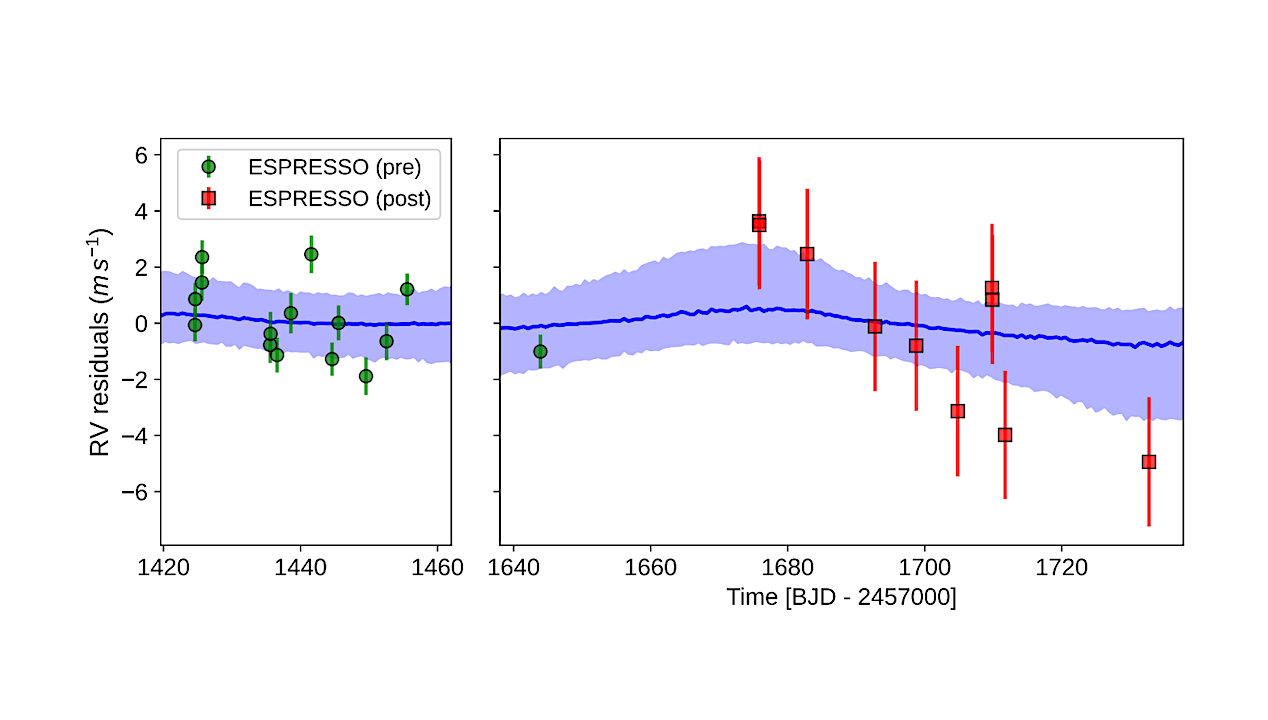

RV residuals of LHS 3844 after subtracting the per-instrument offsets and the orbital component, sampled from the posterior distribution of the model with highest marginal likelihood: WN+SE+QP kernel without drift terms (d0). The blue curve represents the median of the Gaussian Process (GP) predictive distribution, computed over the full posterior of the GP hyperparameters and marginalized over the linear parameters and orbital period. The shaded region denotes the 68% confidence interval. Data points correspond to ESPRESSO observations taken before (green circles) and after (red squares) the instrumental upgrade. Error bars include both the reported measurement uncertainties and the empirically derived per-instrument jitter, added in quadrature. — astro-ph.EP
Context: LHS 3844 b (TOI-136 b) is a ultra short-period, Earth-size exoplanet detected by TESS. It is one of the most favourable object for atmospheric characterisation and the study of its surface with the James Webb Space Telescope. However, the dynamical mass of this planet has not been measured yet.
Aims: We aim to determine the mass of LHS 3844 b using high-precision radial velocity (RV) measurements and assess the robustness of the inferred signal across different noise and orbital modelling assumptions.
Methods: We analyse 25 ESPRESSO RV observations within a fully Bayesian framework. We explore 15 competing RV models that differ in their treatment of correlated stellar variability (through different Gaussian Process kernels) and long-term drifts. Marginal likelihoods are computed for all models and used for Bayesian model comparison and evidence-weighted parameter estimation.
Results: The RV planetary signal is robustly detected across all models, and the inferred semi-amplitude remains stable under all tested noise and drift prescriptions. From the evidence-weighted posterior samples we derive a planetary mass of 2.27±0.23 M⊕ and a bulk density of 5.67±0.65 gcm−3, consistent with a predominantly rocky composition. Model comparison favours GP kernels including periodic or quasi-periodic components associated with stellar rotation and disfavors models with additional long-term drifts.
Using interior-structure inference, we find that the core mass fraction is comparable to (or slightly smaller than) Earth’s and only trace amounts of water are permitted, supporting a dry, terrestrial interior. We also investigate a tentative additional signal near ∼6.9 days, but Bayesian model comparison does not provide conclusive support for its planetary interpretation.
Alejandro Hacker, Nicola Astudillo-Defru, Rodrigo F. Díaz, Caroline Dorn, Xavier Bonfils, José M. Almenara, Pía Cortés-Zuleta, Xavier Delfosse, Thierry Forveille, Stephane Udry
Comments: Submitted to A&A. Revised version following the first round of referee reports. 18 pages, 13 figures, 9 tables
Subjects: Earth and Planetary Astrophysics (astro-ph.EP)
Cite as: arXiv:2603.28237 [astro-ph.EP](or arXiv:2603.28237v1 [astro-ph.EP] for this version)
https://doi.org/10.48550/arXiv.2603.28237
Focus to learn more
Submission history
From: Alejandro Hacker
[v1] Mon, 30 Mar 2026 09:58:06 UTC (1,525 KB)
https://arxiv.org/abs/2603.28237
Astrobiology, exoplanet,










Related Posts
Stay Informed With the Latest & Most Important News
Previous Post
Next Post


Advertisement
-
 01Two Black Holes Observed Circling Each Other for the First Time
 -
 02From Polymerization-Enabled Folding and Assembly to Chemical Evolution: Key Processes for Emergence of Functional Polymers in the Origin of Life
 -
 03Astronomy 101: From the Sun and Moon to Wormholes and Warp Drive, Key Theories, Discoveries, and Facts about the Universe (The Adams 101 Series)
 -
 04True Anomaly hires former York Space executive as chief operating officer
 -
 05Φsat-2 begins science phase for AI Earth images
 -
 06Hurricane forecasters are losing 3 key satellites ahead of peak storm season − a meteorologist explains why it matters
 -
 07Binary star systems are complex astronomical objects − a new AI approach could pin down their properties quickly