
Now Reading: Closeby Habitable Exoplanet Survey (CHES). V. Planetary Parameters Derived from Angular Separation Variations
-
01
Closeby Habitable Exoplanet Survey (CHES). V. Planetary Parameters Derived from Angular Separation Variations

Closeby Habitable Exoplanet Survey (CHES). V. Planetary Parameters Derived from Angular Separation Variations

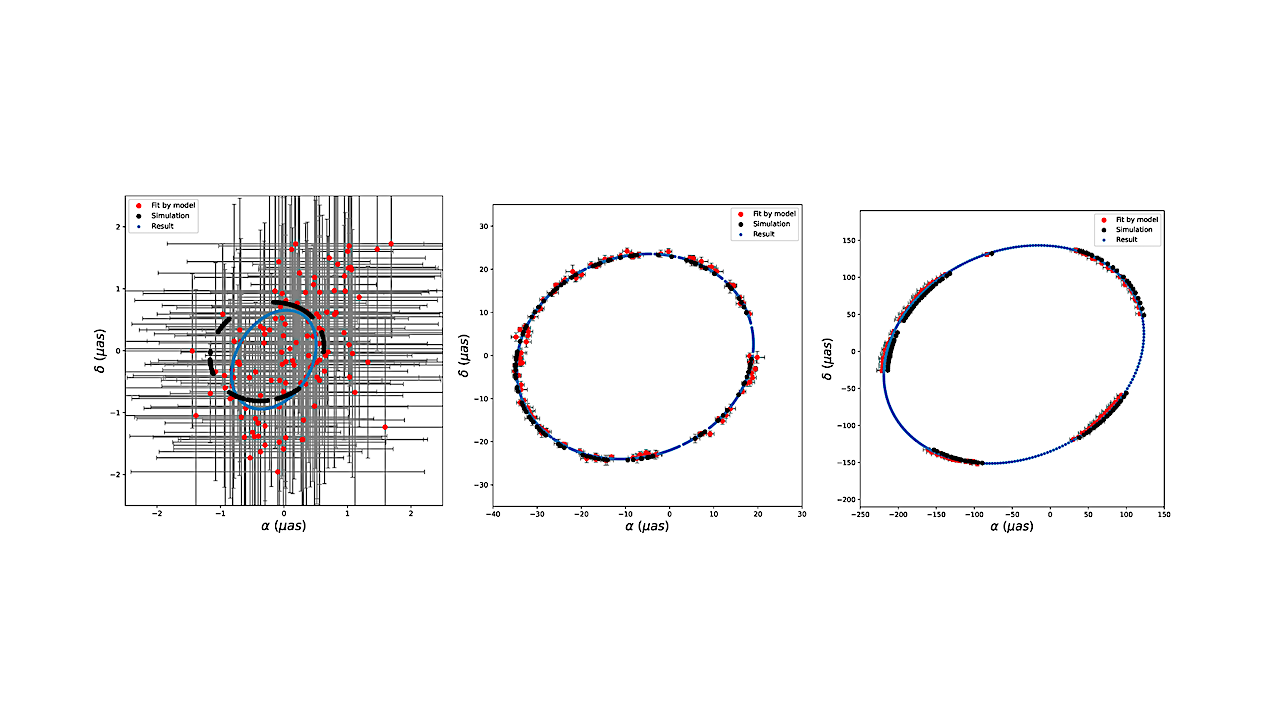
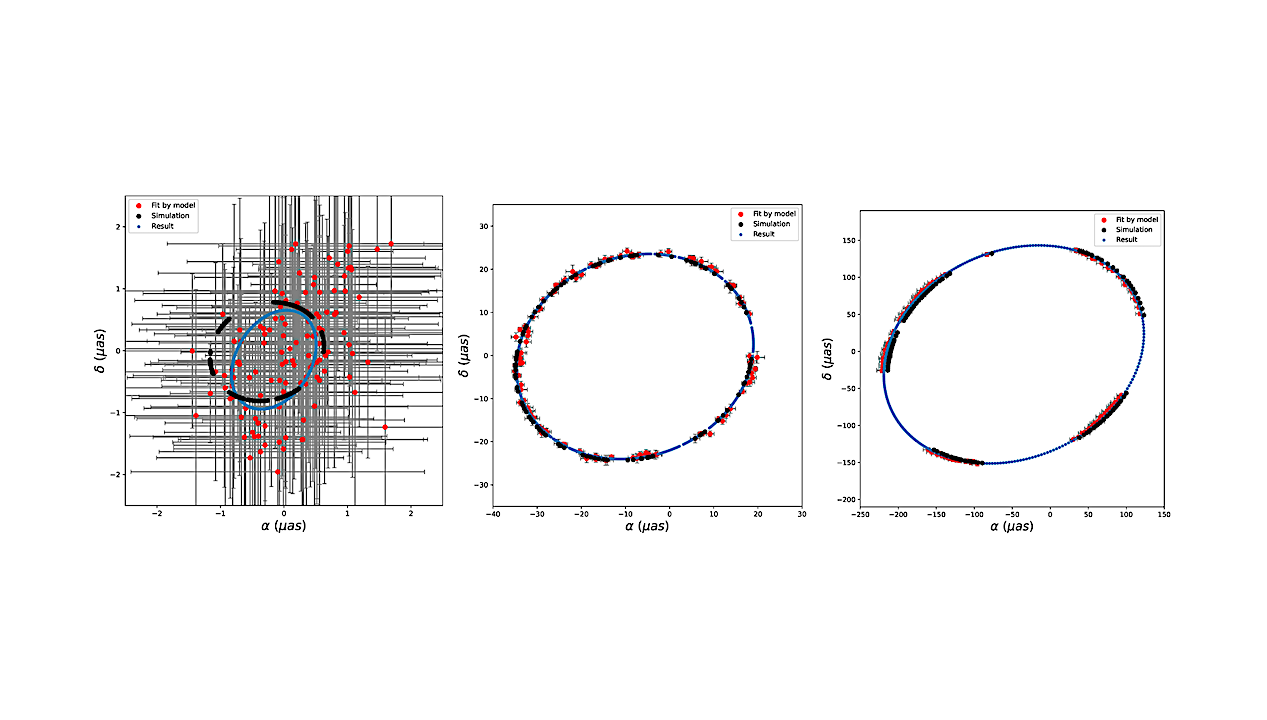
Fitting of exoplanets. (a) The target star is HD 88230, with a hypothetical Earth-like planet placed at a distance of 1 AU from the star. (b) The target star is again HD 88230, with a hypothetical warm Jupiter placed at a distance of 0.1 AU. (c) The target star is HD 147513, which is known to host the detected Jovian planet HD 147513 b. The angular distance measurement accuracy is 1 µas. The black points represent the simulated planetary parameters, while the red points show the residuals after removing proper motion and parallax through fitting. The blue points depict the stellar motion orbit induced by planetary perturbations, derived from a Keplerian fit to the residuals. — astro-ph.EP
The Closeby Habitable Exoplanet Survey (CHES) aims to achieve microarcsecond-level astrometry of about one hundred nearby FGK-type stars within 10 parsecs to detect Earth-like planets.
Such precision exceeds the capability of absolute astrometry relying on Gaia catalogs, whose positional accuracy degrades over time due to error propagation from stellar motion and epoch offsets, limiting their use in microarcsecond-level detection.
Traditional relative astrometry depends on positional components along right ascension and declination, requiring precise knowledge of field rotation and satellite attitude, which introduces additional errors. To address this, we propose a new relative measurement model based solely on variations in the length of angular separation between the target and reference stars, independent of direction.
The model incorporates effects such as proper motion, parallax, radial velocity, light aberration, gravitational lensing, and planetary perturbations, enabling reconstruction of planetary orbits and masses. This approach enhances measurement stability and precision, providing a framework that is not entirely dependent on the Gaia catalog and suitable for CHES and other future high-accuracy astrometric missions.
Dongjie Tan, Jianghui Ji, Chunhui Bao, Xiumin Huang, Guo Chen, Su Wang, Yao Dong, Jiacheng Liu, Zi Zhu, Haitao Li, Junbo Zhang, Liang Fang, Dong Li, Lei Deng
Comments: 20 pages, 7 figures, accepted to Research in Astronomy and Astrophysics
Subjects: Earth and Planetary Astrophysics (astro-ph.EP); Astrophysics of Galaxies (astro-ph.GA); Instrumentation and Methods for Astrophysics (astro-ph.IM); Solar and Stellar Astrophysics (astro-ph.SR); Space Physics (physics.space-ph)
Cite as: arXiv:2603.27603 [astro-ph.EP] (or arXiv:2603.27603v1 [astro-ph.EP] for this version)
https://doi.org/10.48550/arXiv.2603.27603
Focus to learn more
Submission history
From: Jianghui Ji
[v1] Sun, 29 Mar 2026 09:52:47 UTC (2,396 KB)
https://arxiv.org/abs/2603.27603
Astrobiology, exoplanet,










Related Posts
Stay Informed With the Latest & Most Important News
Previous Post
Next Post


Advertisement
-
 01Two Black Holes Observed Circling Each Other for the First Time
 -
 02From Polymerization-Enabled Folding and Assembly to Chemical Evolution: Key Processes for Emergence of Functional Polymers in the Origin of Life
 -
 03Astronomy 101: From the Sun and Moon to Wormholes and Warp Drive, Key Theories, Discoveries, and Facts about the Universe (The Adams 101 Series)
 -
 04True Anomaly hires former York Space executive as chief operating officer
 -
 05Φsat-2 begins science phase for AI Earth images
 -
 06Hurricane forecasters are losing 3 key satellites ahead of peak storm season − a meteorologist explains why it matters
 -
 07Binary star systems are complex astronomical objects − a new AI approach could pin down their properties quickly