
Now Reading: Finding Circumbinary Planets: A Semi-Automated Transit Search of TESS Eclipsing Binaries
-
01
Finding Circumbinary Planets: A Semi-Automated Transit Search of TESS Eclipsing Binaries

Finding Circumbinary Planets: A Semi-Automated Transit Search of TESS Eclipsing Binaries

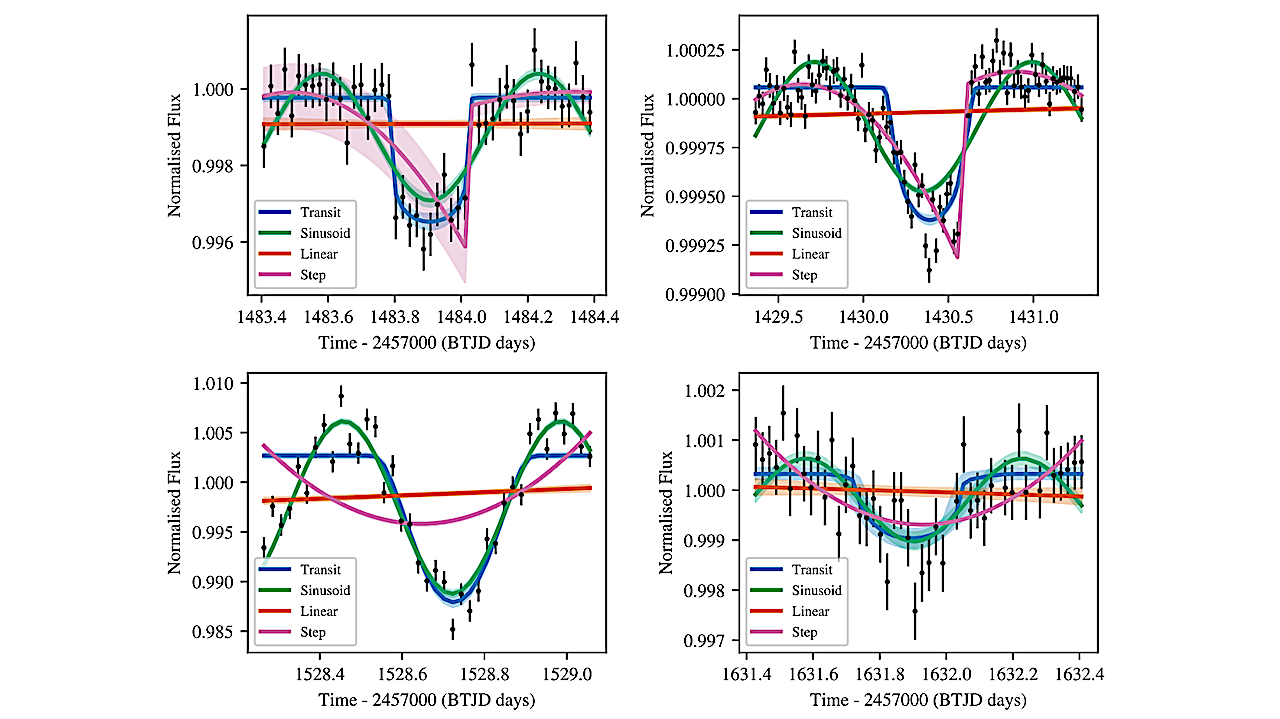

Examples of events identified by mono-cbp and vetted by the model comparison (Section 2.4). Top left: Sector 6 transit of TOI-1338 b (same as Fig. 1), classified as a transit. Top right: An instrumental systematic occurring in the Sector 4 light curve of TIC 55497281, classified as a step. Bottom left: Poor removal of stellar variability in the Sector 8 light curve of TIC 5092088, classified as a sinusoid. Bottom right: An unclassified event occurring in Sector 12 light curve of TIC 260502102, where there was no preferred model. In all panels, the shaded regions depict the 16th and 84th percentiles of the posterior distributions for each model. — astro-ph.EP
The discovery of circumbinary planets (CBPs) has advanced our understanding of planet formation and dynamical evolution in complex environments.
However, the population of such planets remains small, leading their underlying physical properties to be loosely constrained. In this work, we have developed a semi-automated framework to identify planetary transit events in light curves of eclipsing binaries observed by the Transiting Exoplanet Survey Satellite (TESS).
Our search method, 𝚖𝚘𝚗𝚘−𝚌𝚋𝚙, removes stellar eclipses and applies a custom detrending procedure, searching for individual transit events and applying automated vetting procedures to filter false positive signals.
We searched a sample of binaries from the TESS Eclipsing Binary Catalogue, yielding one candidate transit event. 𝚖𝚘𝚗𝚘−𝚌𝚋𝚙 was also tested on the known population of transiting CBPs, using the Kepler long-cadence photometry for the Kepler transiting CBPs and the TESS Full Frame Image photometry for the TESS CBPs.
Excluding transits that are shallower than the intrinsic noise of the Kepler/TESS data, 𝚖𝚘𝚗𝚘−𝚌𝚋𝚙 achieved a recovery rate of ≥50 per cent for each planet, reaching >75 per cent for 9 of the 14 planets.
To test the limits of our framework, we injected simulated transit profiles with varying depth and duration into our sample of TESS light curves, finding that our recovery rate is a strong function of transit duration and the metrics used to filter false positive signals. This framework may be applied to large samples of TESS eclipsing binaries with little computational burden and to photometry from future space-based photometric surveys.
Benjamin D. R. Davies, David J. A. Brown, Samuel Gill, Jenni R. French
Comments: 18 pages, 15 figures, 3 tables. Accepted for publication in MNRAS. Code available at this https URL
Subjects: Earth and Planetary Astrophysics (astro-ph.EP); Instrumentation and Methods for Astrophysics (astro-ph.IM); Solar and Stellar Astrophysics (astro-ph.SR)
Cite as: arXiv:2604.09435 [astro-ph.EP] (or arXiv:2604.09435v1 [astro-ph.EP] for this version)
https://doi.org/10.48550/arXiv.2604.09435
Focus to learn more
Submission history
From: Benjamin Davies MPhys
[v1] Fri, 10 Apr 2026 15:51:44 UTC (1,587 KB)
https://arxiv.org/abs/2604.09435
Astrobiology, Astronomy, exoplanet,










Related Posts

Stay Informed With the Latest & Most Important News
Previous Post
Next Post





Advertisement
-
 01Two Black Holes Observed Circling Each Other for the First Time
 -
 02From Polymerization-Enabled Folding and Assembly to Chemical Evolution: Key Processes for Emergence of Functional Polymers in the Origin of Life
 -
 03Astronomy 101: From the Sun and Moon to Wormholes and Warp Drive, Key Theories, Discoveries, and Facts about the Universe (The Adams 101 Series)
 -
 04True Anomaly hires former York Space executive as chief operating officer
 -
 05Φsat-2 begins science phase for AI Earth images
 -
 06Hurricane forecasters are losing 3 key satellites ahead of peak storm season − a meteorologist explains why it matters
 -
 07Binary star systems are complex astronomical objects − a new AI approach could pin down their properties quickly