
Now Reading: The Lyrids are coming! How I watch meteor showers from the middle of a city
-
01
The Lyrids are coming! How I watch meteor showers from the middle of a city


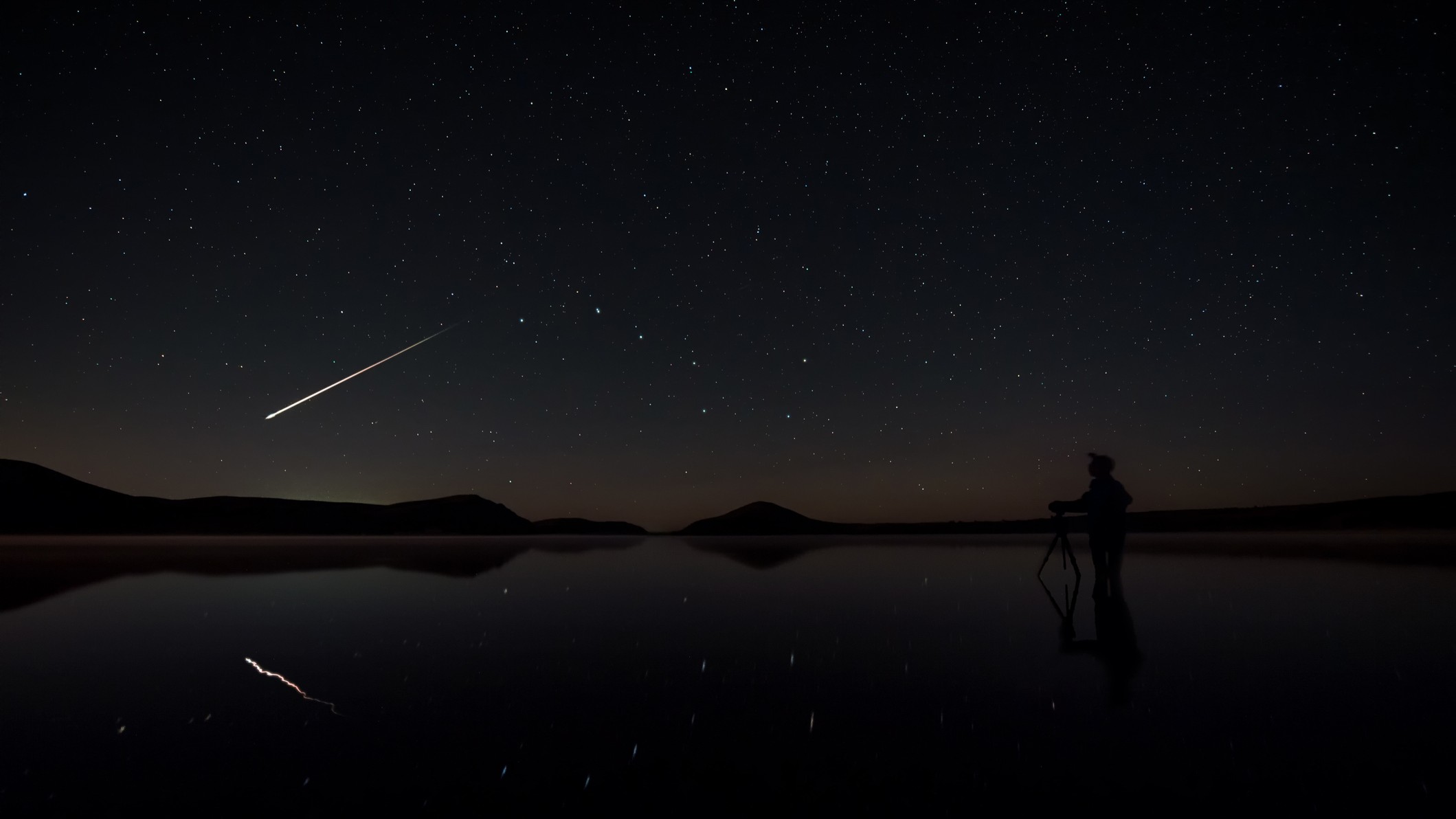
During last April’s Lyrid meteor shower, I left my camera outside and went to bed. I’d set my tripod, wide-angle lens pointed skyward, exposures firing every 30 seconds. It’s my usual routine for meteor showers, particularly relatively minor displays like the Lyrids. Sure, it’s the first display of “shooting stars” since January, but my camera would be more patient than I — and see more meteors than I could from my light-polluted location. It’s a calculated kind of laziness, and I’d done just enough to feel like I’d taken part.
Hours later, just before dawn, I stepped outside to bring my camera in. The sky was tinted with a deep pre-sunrise blue, the stars beginning to fade. I switched off the camera — and then, of course, it happened. A sudden, brilliant meteor tore across the sky — exactly what the Lyrids are known for. Excited, I went inside, straight to my laptop, slid the camera’s SD card in, and started flicking through its hundreds of identical images for a previous fireball. Nothing — not a trace. The camera had been watching all night, but captured zilch.
Meteor showers are about persistence, but they’re also about luck. The camera gives you coverage — a way to stack the odds — and it’s still the best tool there is for catching a fleeting streak of light. However, sometimes the sky keeps its best moments for those who happen to be looking up at exactly the right time. Even a lazy stargazer like me.
What’s happening and when to look
The Lyrids peak overnight on Tuesday, April 21, through Wednesday, April 22 — officially. This year, the early hours of Wednesday will likely favor North American observers, while that day’s post-sunset hours are best for European skywatchers. That’s because the Lyrids are predicted to come to a peak at around 20:00 UTC (4:00 p.m. EDT and 9:00 p.m. BST) on April 22. That peak falls in daylight in Europe and North America, which means the real opportunities come before dawn and after sunset on either side.
However, the exact timing isn’t that important for the Lyrids, since the rates — about 18 per hour under perfect skies — tend to hold up for a night or so either side. So the committed meteor-hunter effectively gets two chances this year, with the early hours of Thursday, April 23, worth considering as well. The sweet spot is the early hours — around 4-5 a.m. — when the radiant point, in the constellation Lyra, climbs high in the northeast, close to the brilliant star Vega.
This year, the lunar timing is also kind. A new moon on April 17 means skies will be largely free of moonlight during the peak mornings. That means even faint meteors may shine through from a dark-sky location.
The Lyrids have fascinated skywatchers for centuries. They originate from debris left by Comet C/1861 G1 Thatcher, a long-period visitor that last passed through the inner solar system in 1861 and will next visit in 2283. Each April, Earth plows through its dusty trail — tiny grains burning up in the atmosphere at around 30 miles per second. A few explode into fireballs.
How and when I’m watching the Lyrids

You don’t need perfect darkness to get something out of a meteor shower. You certainly don’t need a telescope (something that will hugely restrict your chances). You just need patience — and a decent workaround.
For me, that workaround is “lucky imaging.” I’ll point a wide-angle lens — somewhere between 14mm and 24mm — towards the northeast, roughly where Lyra will climb. Focus is really important. I know exactly where on the focus dial to set my Sigma 14mm F1.8 DG HSM ART to produce sharp-looking stars (I used to use a tiny sticker to help me — now I just remember). If you don’t know your lens as well as that, focus manually on a star, zooming in on it either in live mode or on the captured image. Or set the dial to infinity point (∞) on your lens’ dial and take an image, nudging past it for each successive image until the stars are sharp.
It goes without saying that you should always have a fresh, empty SD card and shoot in RAW. I’ll set the camera to ISO 800-1600 and use 30-second exposures in continuous mode. At first, I’ll effectively be trying to create a sharp-looking night sky image. Once I’m happy with the sharpness and the composition, I’ll click the shutter release and lock it in position. Then I’ll leave it for three hours or more, taking image after image.
The beauty of this method is that the camera only blinks every 30 seconds. While I’m inside, warm and probably distracted, the camera is quietly collecting evidence — frame after frame of empty sky, until one contains a “shooting star.”
Is this the purest way to watch a meteor shower? No, but it gives me choices. I can be outside, eyes adapted, scanning the sky. After all, there’s no substitute for witnessing a meteor in real time. But delegating to a camera is also fine (it’s what professional astronomers spend their entire careers doing), and often results in great images.
Stargazer’s corner: April 19-25, 2026

The Lyrids are not the only fireballs in town. The eta Aquariids — produced by none other than Halley’s comet — kick off on April 19, and though the peak isn’t until May 5-6, it increases the chances of seeing a “shooting star.” But there’s more than meteors to see this week.
- On Sunday, April 19, a 9%-illuminated waxing crescent moon will hang above the Pleiades open cluster. Look below for Venus, now beginning to dominate the post-sunset sky as the “Evening Star — and set to stun all summer.
- On Wednesday, April 22, the 38%-illuminated moon meets Jupiter in Gemini, creating a striking pairing early in the evening as the Lyrids pop.
- All week, Venus slides past the Pleiades after sunset, getting nearest on Thursday, April 23, a close conjunction that will have stargazers and astrophotographers out in force.
- By Saturday, April 25, a waxing gibbous moon sits right beside Regulus in Leo, a “grazing occultation” as seen from the eastern U.S.
Asterism of the week: farewell to the Winter Triangle

It’s time to bid farewell to the bright stars of winter. Look to the southwest just after dark from the Northern Hemisphere this month, and you’ll see the iconic Belt of Orion close to the horizon. So too an equilateral triangle of bright stars; Procyon in Canis Minor, reddish Betelgeuse in Orion and Sirius in Canis Major. They’re most easily found this week by first locating bright planet Jupiter and looking below. The triangle, however, is merely an optical illusion, with Procyon and Sirius at 11.4 and 8.7 light-years from the sun, but Betelgeuse at a whopping 650 light-years distant. The night sky isn’t flat. With careful eyes, you can appreciate depth by identifying the sun’s very close neighbors from distant stars.
My stargazing obsession: what the night sky looks like from space

The news that light pollution has worsened by 16% between 2014 and 2022 is truly depressing — and utterly obvious to stargazers who’ve witnessed the migration to cheap LED lighting. Last week, we got a glimpse of what the night sky looks like from the ultimate dark-sky site: space itself. NASA’s Artemis II astronauts recently shared an image of the Milky Way from deep space, a beautiful shot of its bright core without distortion — and photobombed by the Large Magellanic Cloud (LMC) in the bottom-right corner. The image appeared just before April 12, nicknamed Yuri’s Night to commemorate the date in 1961 that Yuri Gagarin became the first human in space in Vostok 1, and the first to see the stars from orbit.










Related Posts


Stay Informed With the Latest & Most Important News
Previous Post
Next Post


Advertisement
-
 01Two Black Holes Observed Circling Each Other for the First Time
 -
 02From Polymerization-Enabled Folding and Assembly to Chemical Evolution: Key Processes for Emergence of Functional Polymers in the Origin of Life
 -
 03Astronomy 101: From the Sun and Moon to Wormholes and Warp Drive, Key Theories, Discoveries, and Facts about the Universe (The Adams 101 Series)
 -
 04True Anomaly hires former York Space executive as chief operating officer
 -
 05Φsat-2 begins science phase for AI Earth images
 -
 06Hurricane forecasters are losing 3 key satellites ahead of peak storm season − a meteorologist explains why it matters
 -
 07Binary star systems are complex astronomical objects − a new AI approach could pin down their properties quickly