
Now Reading: Three ESA-built satellites on show in France
-
01
Three ESA-built satellites on show in France



16/04/2026
196 views
5 likes
Three Earth observation satellites, developed by the European Space Agency (ESA) with European partners, and due to launch later this year, have completed their functional and environmental tests and are ready to travel to the European spaceport in French Guiana. But first, journalists were invited to have one last look.
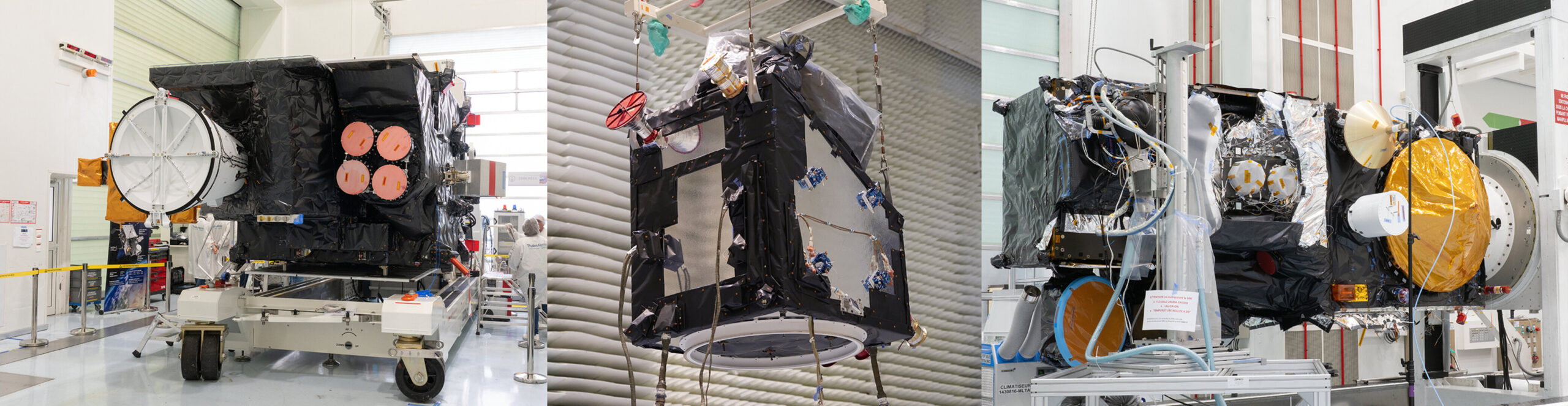
ESA’s Fluorescence Earth Explorer satellite, known as FLEX, together with the Meteosat Third Generation (MTG) Imager weather satellite, MTG-I2, as well as the next satellite in the European Commission’s Copernicus programme, Sentinel-3C, were all on show at the media event hosted by Thales Alenia Space at their cleanrooms in Cannes, France.
Members of the media had an opportunity to listen to presentations and conduct interviews with key mission partners as well as photograph and film all three impressive spacecraft and their instruments. This was the last public view of the satellites before they are transported to the European Spaceport in French Guiana, where they are scheduled for liftoff on ESA’s Ariane 6 and Vega-C launchers.
The three missions demonstrate the excellence of European industry in the domain of Earth observation. Leaders and experts from ESA’s Earth Observation Directorate, Eumetsat, the European Commission, Thales Alenia Space and other partners were on site in Cannes to give speeches and speak individually to journalists.
ESA’s Earth Explorer Missions Programme Manager, Dirk Bernaerts, said, “We are thrilled to see each of these missions in their final stages before launch. Each one of the satellites will have an important role to play in providing data to monitor and measure our planet’s ecosystems, from vegetation health to more accurate forecasting of weather events and precise monitoring of conditions of sea ice, oceans and land. We look forward to seeing them launch later this year and take this opportunity to reiterate the importance of European collaboration in each mission’s success.”
ESA’s Director of Earth Observation Programmes, Simonetta Cheli, said, “Many thanks go to all the teams that have contributed to the design and realisation of the FLEX Earth Explorer mission, MTG-I2 with Eumetsat and Sentinel-3C with the European Commission. I am proud of the dedication and expertise that ESA brings to the development of these Earth observation missions. The ultimate goal for each satellite is, of course, to provide world-class data products that will improve the lives of citizens, benefitting people in numerous ways: from more timely extreme weather warnings, to a better understanding of the vegetation photosynthesis process and its influence on the carbon and water cycles, as well as the operational provision of accurate data supporting prediction and forecasting, and long term observations that will improve future climate models. We now look forward to some successful launches later in the year.”
FLEX ready to detect global plant health
FLEX is the eighth innovative Earth Explorer mission developed by ESA’s FutureEO programme in conjunction with the science community. FLEX is designed to measure and map the health of plants from space by detecting the fluorescent signal emitted by vegetation.
Photosynthesis is one of the most fundamental processes on Earth and is essential for sustaining life. Most people know it as the mechanism that allows plants to grow by consuming carbon dioxide and releasing oxygen. However, few may realise that as plants photosynthesise, they also emit a very faint fluorescence signal.
Fluorescence is invisible to the naked eye, but FLEX will be able to detect it with its fluorescence imaging spectrometer, or FLORIS for short. The instrument provides data on how the signal varies according to environmental conditions and the health or stress of the vegetation.
Both FLEX and Copernicus Sentinel-3C will be launched on the same Vega-C flight, due for liftoff in September 2026. Once operational, FLEX will fly in the same orbit as the Sentinel-3 mission, which will provide FLEX with required information on the atmosphere and Earth’s surface properties.
Ralf Bock, ESA’s FLEX Project Manager, noted, “Thanks to the excellence and dedication of more than 30 European companies we’ve completed the challenging development of the FLEX satellite and will soon be ready for launch. We are looking forward to demonstrating the innovation in the FLEX Earth Explorer mission that promises to produce exciting new scientific insights into our Earth system and advance our understanding of the role of vegetation in the carbon cycle.”
Sentinel-3C to continue monitoring for Copernicus
Copernicus Sentinel-3C is the third satellite for the Sentinel-3 mission, which captures operational data and provides services for near real time responses as well as for long term climate monitoring over Earth’s land surfaces, inland water, ice, oceans and atmosphere. It is part of the Copernicus fleet of satellites, which contributes altimetry data and optical imagery to the European Commission’s Copernicus Earth observation programme. Sentinel-3 is often considered as the ‘workhorse’ mission for Copernicus due to the breadth of data it provides, which ranges from altimetry to spectrometry and radiometry in infrared and thermal channels.
Just like the two Sentinel-3 satellites already in orbit, Sentinel-3C carries a suite of cutting-edge instruments that measure the height of the ocean, sea and ice surface temperatures, ocean colour and sea ice thickness. Over land, it measures vegetation, wildfires, the variations of ice sheet as well as the water height of inland lakes and rivers. Its data help us understand multi-scale, global climate dynamics of the Earth System and are free of charge to users worldwide.
ESA’s Sentinel-3 Project Manager, Nic Mardle, noted, “We are delighted that Sentinel-3C is now joining the -A and -B satellites in orbit, to continue the Sentinel-3 mission into the next decade. This mission tracks many phenomena – sea-level rise, ice sheet melting, wildfires and flooding are just a few examples – which are so closely related to the climatic changes we are now experiencing.”
MTG-Imager the storm nowcaster
Meteosat Third Generation-Imager2 (MTG-I2) will be the first of the three satellites shown at today’s event to be rolled out on the launch pad. It is part of the MTG constellation for Eumetsat – two are already in orbit – and it will produce images for weather forecasting in Europe in unprecedented detail. This mission provides completely new data products and capabilities for European weather services, especially suited to nowcasting of severe weather events. MTG-I2 is scheduled for launch on Ariane 6 this summer.
The MTG-Imager satellites carry two instruments, a Lightning Imager and a Flexible Combined Imager. The Lightning Imager offers completely new capabilities for European meteorological satellites by continuously monitoring for lightning. By doing this from geostationary orbit, which is at an altitude of about 36 000 km above the equator, it can scan more than 80% of Earth’s surface seen from that viewpoint.
The Flexible Combined Imager, on the other hand, builds a picture of fast-evolving weather systems and can be used to issue timely weather warnings. It is particularly relevant for air traffic safety. It is able to scan the entire Earth disc in just 10 minutes and can scan Europe and northern Africa every 2.5 minutes.
When MTG is fully operational, it is expected to produce at least 50 times more data than the previous Meteosat Second Generation (MSG) satellites.
ESA’s MTG Project Manager, James Champion, said, “Reaching this milestone means we are a step closer to having all three MTG satellites in orbit. I would like to thank all the teams throughout Europe whose dedication has enabled us to get to this point – it helped that this is the second MTG-Imager and we were able to work more fluidly as a team during the satellite’s build and test phase. Everyone is now very much looking forward to beginning the launch campaign in French Guiana.”
Collaboration
FLEX is an ESA mission and will be operated from ESA’s European Space Operations Centre (ESOC) in Darmstadt, Germany. Mission control for FLEX will be in coordination with Eumetsat for tandem flight with Copernicus Sentinel-3.
The other two satellites were built for European partners. MTG-I2 is developed by ESA and will be operated by Eumetsat, while Sentinel-3C is built for the European Commission’s Copernicus programme and will be jointly operated by ESA and Eumetsat.
Thales Alenia Space France leads the industrial consortium for MTG as the overall prime contractor for the MTG mission. It is also the prime contractor for the Sentinel-3C satellite (and two of its instruments) as well as for ESA’s FLEX satellite. Leonardo (Italy), OHB System (Germany) and Airbus (Spain) were also prime contractors and main partners on one or more of the missions.










Related Posts
Stay Informed With the Latest & Most Important News
Previous Post
Next Post

Advertisement
-
 01Two Black Holes Observed Circling Each Other for the First Time
 -
 02From Polymerization-Enabled Folding and Assembly to Chemical Evolution: Key Processes for Emergence of Functional Polymers in the Origin of Life
 -
 03Astronomy 101: From the Sun and Moon to Wormholes and Warp Drive, Key Theories, Discoveries, and Facts about the Universe (The Adams 101 Series)
 -
 04True Anomaly hires former York Space executive as chief operating officer
 -
 05Φsat-2 begins science phase for AI Earth images
 -
 06Hurricane forecasters are losing 3 key satellites ahead of peak storm season − a meteorologist explains why it matters
 -
 07Binary star systems are complex astronomical objects − a new AI approach could pin down their properties quickly