
Now Reading: An Atmosphere On The Ultra-Short Period Super-Earth HD 3167 b
-
01
An Atmosphere On The Ultra-Short Period Super-Earth HD 3167 b


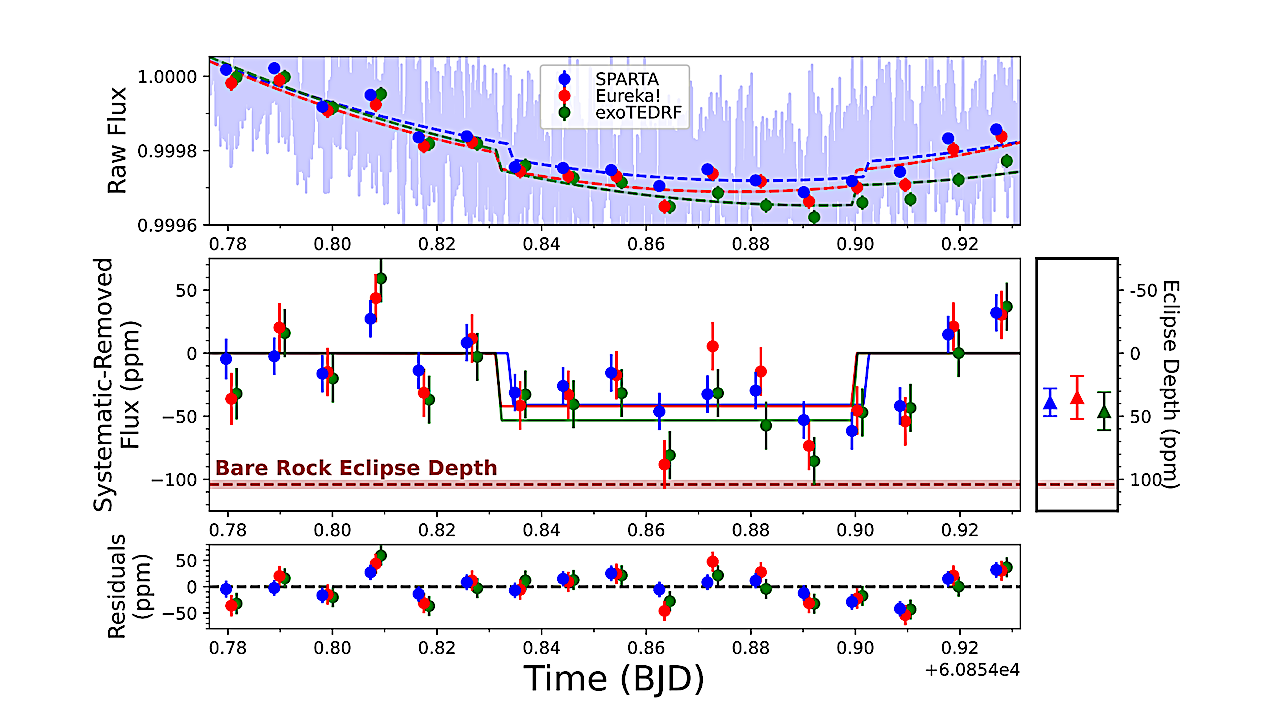
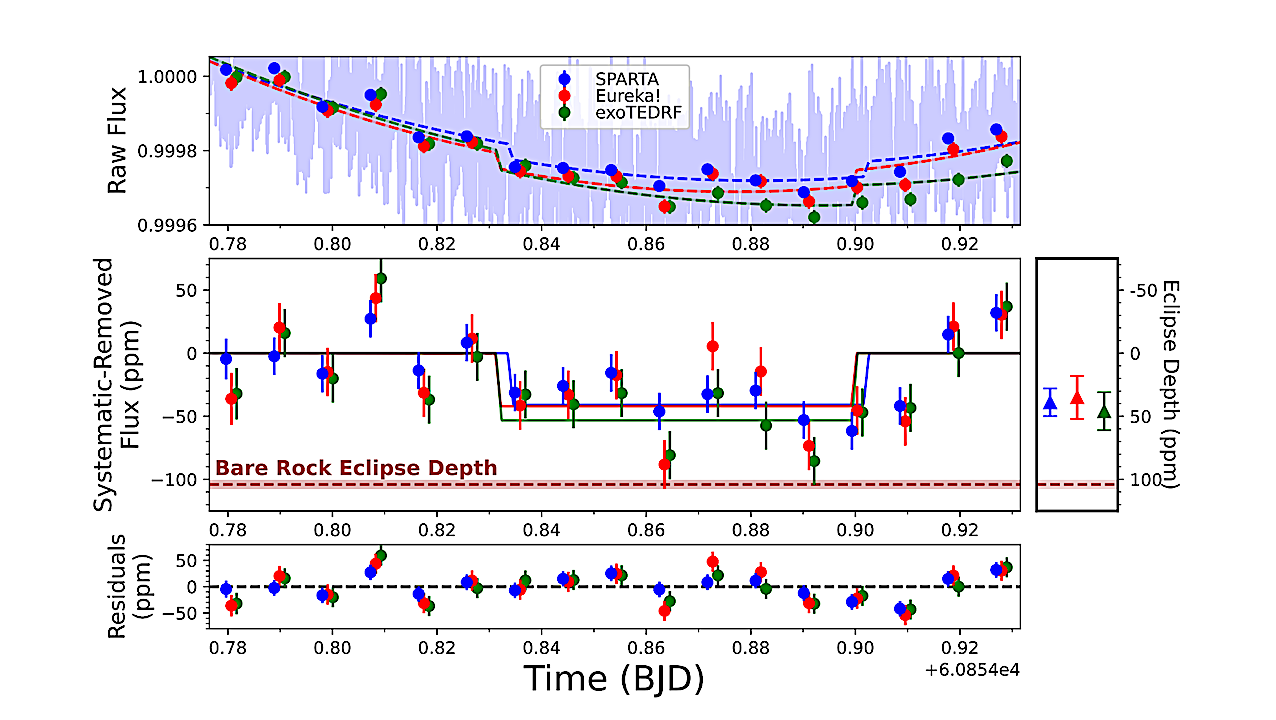
Best-fit white light (5.06–10.55 µm) curves of HD 3167 b’s secondary eclipse from our SPARTA (blue), Eureka! (red), and exoTEDRF (green) reductions. (Top) Binned raw white light fluxes. The best-fit full SPARTA model (with integration-level x decorrelation), Eureka, and exoTEDRF models are shown alongside the quadratic ramp component shown as dashed lines. (Middle) Binned fluxes after dividing by the best-fit systematics model for each reduction. Retrieved eclipse depths and uncertainties are shown on the right. (Bottom) Binned residuals of the best-fit full models. For all plots, Eureka!/exoTEDRF data are offset by 0.001/0.002 days for visual clarity. — astro-ph.EP
‘Lava worlds’-Earth-sized planets hot enough (Teq >~ 1100 K) to melt their dayside silicate surfaces-have emerged as promising candidates for atmospheric detection and characterization. Thermal emission observations show an apparent dichotomy: the hottest lava worlds have colder daysides than the temperature of a maximally emitting bare rock, indicating the likely presence of thick and/or reflective atmospheres while the coldest ones do not.
However, where in instellation flux this potential bifurcation occurs is uncertain. We present a JWST MIRI LRS eclipse of the ultra-short period (USP) lava world HD 3167 b (Teq = 1786 K, R = 1.6 Rearth, P = 0.96 d) that helps bridge this gap. We measure the white light eclipse depth to be 38 +/- 11 ppm, more than 5 sigma lower than the expected eclipse depth of a dark, maximally hot bare rock.
We use this to derive a dayside brightness temperature that is best explained by the presence of an atmosphere that cools the dayside by reflecting incoming starlight and/or efficiently redistributing heat to the planet’s nightside.
An atmosphere is further compatible with the planet’s slight under-density compared to an Earth-like composition. The corresponding dayside emission spectrum is not precise enough to constrain atmospheric composition, motivating follow-up spectroscopic observations with JWST NIRSpec.
Lastly, we use our observation and existing data to refine key planetary parameters of the HD 3167 system. HD 3167 b is currently the least irradiated USP super-Earth with evidence for an atmosphere.
Brandon Park Coy, Qiao Xue, Megan Weiner Mansfield, Jason D. Eastman, Anjali A.A. Piette, Tyler Fairnington, Cole Smith, Michael Zhang, Eliza M.R. Kempton, Jacob L. Bean, Xuan Ji, Peter Gao, Jegug Ih, Daniel D.B. Koll, Rafael Luque, Jaume Orell-Miquel, Edwin S. Kite
Comments: Comments welcome, submitted to AAS Journals
Subjects: Earth and Planetary Astrophysics (astro-ph.EP)
Cite as: arXiv:2604.11911 [astro-ph.EP] (or arXiv:2604.11911v1 [astro-ph.EP] for this version)
https://doi.org/10.48550/arXiv.2604.11911
Focus to learn more
Submission history
From: Brandon Park Coy
[v1] Mon, 13 Apr 2026 18:04:01 UTC (612 KB)
https://arxiv.org/abs/2604.11911
Astrobiology, exoplanet,










Related Posts
Stay Informed With the Latest & Most Important News
Advertisement
-
 01Two Black Holes Observed Circling Each Other for the First Time
 -
 02From Polymerization-Enabled Folding and Assembly to Chemical Evolution: Key Processes for Emergence of Functional Polymers in the Origin of Life
 -
 03Astronomy 101: From the Sun and Moon to Wormholes and Warp Drive, Key Theories, Discoveries, and Facts about the Universe (The Adams 101 Series)
 -
 04True Anomaly hires former York Space executive as chief operating officer
 -
 05Φsat-2 begins science phase for AI Earth images
 -
 06Hurricane forecasters are losing 3 key satellites ahead of peak storm season − a meteorologist explains why it matters
 -
 07Binary star systems are complex astronomical objects − a new AI approach could pin down their properties quickly