
Now Reading: Correlative Microstructural Analysis of a Weathered Nantan Meteorite Fragment
-
01
Correlative Microstructural Analysis of a Weathered Nantan Meteorite Fragment


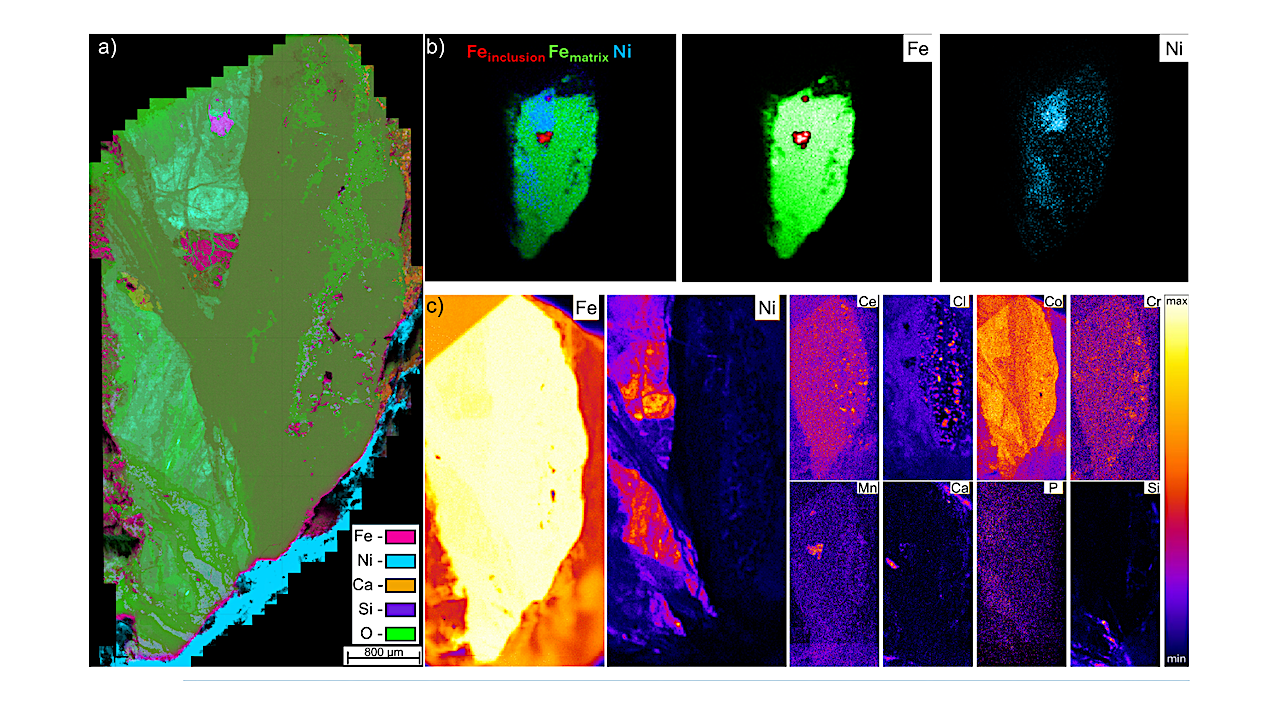
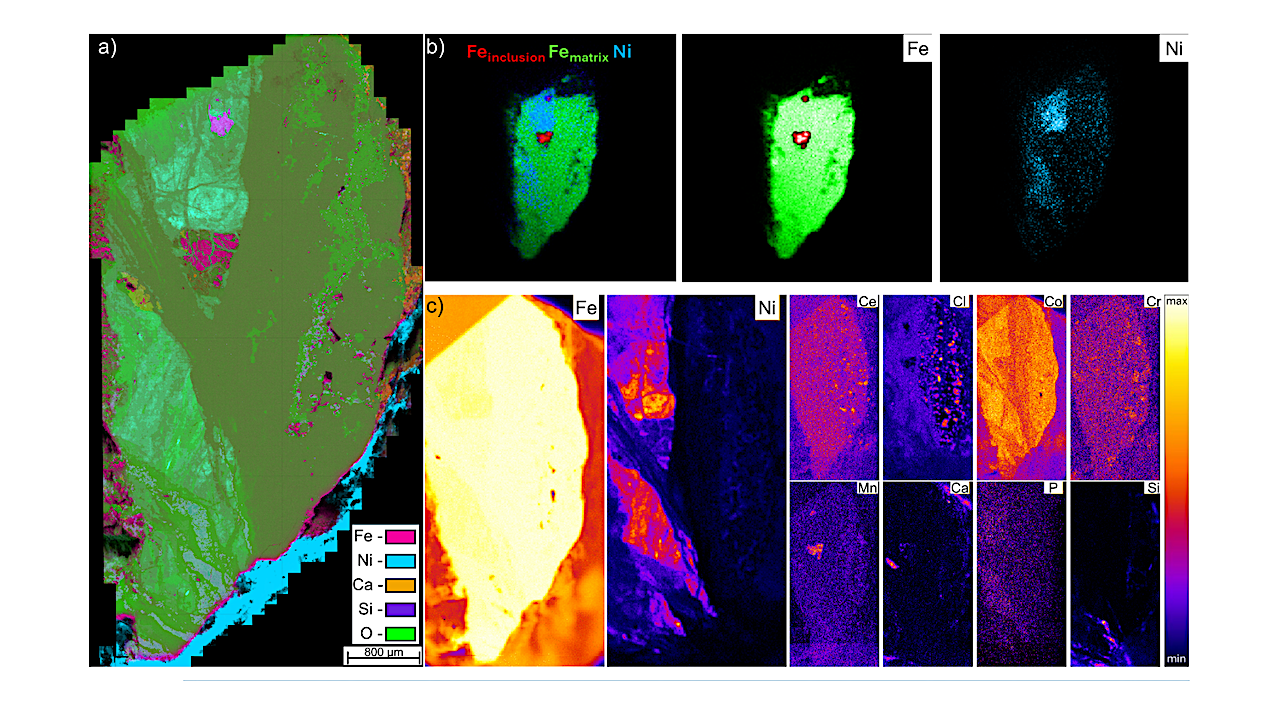
a) Large area EDS map of Nantan meteorite sample showing the distribution of detected elements. b) XPS SnapMaps of Nantan fragment showing the distribution of Fe and Ni. c) XRF maps of individual elements detected, with a focus on Fe and Ni. — astro-ph.EP
The weathering of iron-rich phases within meteorites is a multi-stage process that significantly alters the microstructure and chemical composition based both on the environmental condition at the location of landing and the exposure time since the fall. This work investigates the resulting phases of this process in a correlative and comparative manner using a naturally weathered Nantan meteorite fragment.
Techniques including X-ray Photoelectron Spectroscopy, Energy Dispersive X-ray Spectroscopy, and X-ray Fluorescence Spectroscopy were used for compositional determination and X-ray Diffraction and Electron Backscatter Diffraction for phase determination and microstructural analysis.
Use of these techniques revealed the meteorite matrix to be predominantly composed of magnetite, with distinct regions of high Ni content. The grain structure was found to be very fine (approx. 5 μm) in areas of high Ni (≥2.6 at%) content with a visible boundary of 100-200 μm extending into the low Ni (≤0.9 at%) regions, wherein the grains averaged 10s of μm in size. Other common products of weathering, including goethite, lepidocrocite, and feroxyhyte, were also found within the matrix alongside Ni(OH)2.
Additionally, a brecciated phase was found within the sample and appeared to be a large cohenite grain which exhibits signs of aqueous weathering, including in a vein-like structure, composed of NiO and magnetite, and deposits of iron and nickel carbonates.
These results indicate that the distinct matrix regions formed through the weathering mechanism of discrete primary phases, with the high Ni regions forming from aqueous alteration of kamacite and the low Ni regions forming from direct dissolution and oxidation of the source Fe-Ni metal.
Graeme J. Francolini, Brendan V. Dyck, Paul Mack, Ben Britton
Subjects: Geophysics (physics.geo-ph); Earth and Planetary Astrophysics (astro-ph.EP); Materials Science (cond-mat.mtrl-sci)
Cite as: arXiv:2604.14187 [physics.geo-ph] (or arXiv:2604.14187v1 [physics.geo-ph] for this version)
https://doi.org/10.48550/arXiv.2604.14187
Focus to learn more
Submission history
From: Graeme Francolini
[v1] Tue, 31 Mar 2026 19:54:51 UTC (40,257 KB)
https://arxiv.org/abs/2604.14187
Astrobiology, Astrochemistry,










Related Posts

Stay Informed With the Latest & Most Important News



Advertisement
-
 01Two Black Holes Observed Circling Each Other for the First Time
 -
 02From Polymerization-Enabled Folding and Assembly to Chemical Evolution: Key Processes for Emergence of Functional Polymers in the Origin of Life
 -
 03Astronomy 101: From the Sun and Moon to Wormholes and Warp Drive, Key Theories, Discoveries, and Facts about the Universe (The Adams 101 Series)
 -
 04True Anomaly hires former York Space executive as chief operating officer
 -
 05Φsat-2 begins science phase for AI Earth images
 -
 06Hurricane forecasters are losing 3 key satellites ahead of peak storm season − a meteorologist explains why it matters
 -
 07Binary star systems are complex astronomical objects − a new AI approach could pin down their properties quickly