
Now Reading: From Dust to Planets — A Chemical Perspective
-
01
From Dust to Planets — A Chemical Perspective


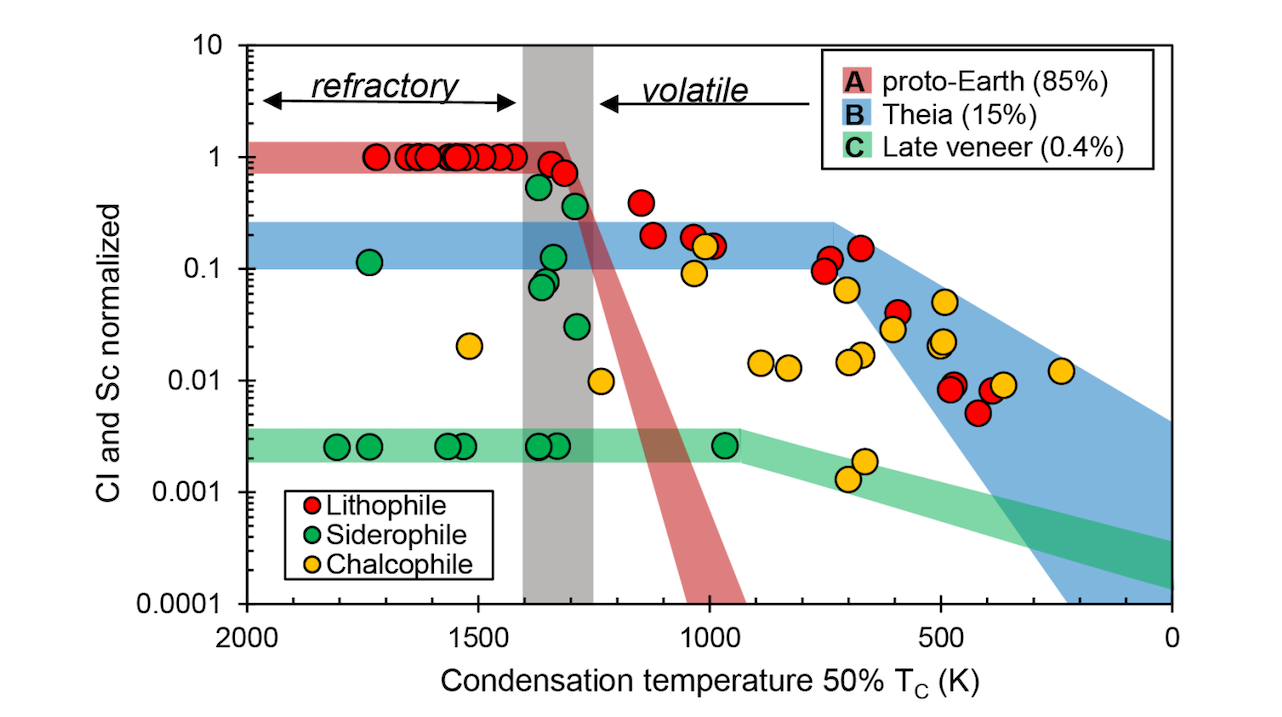
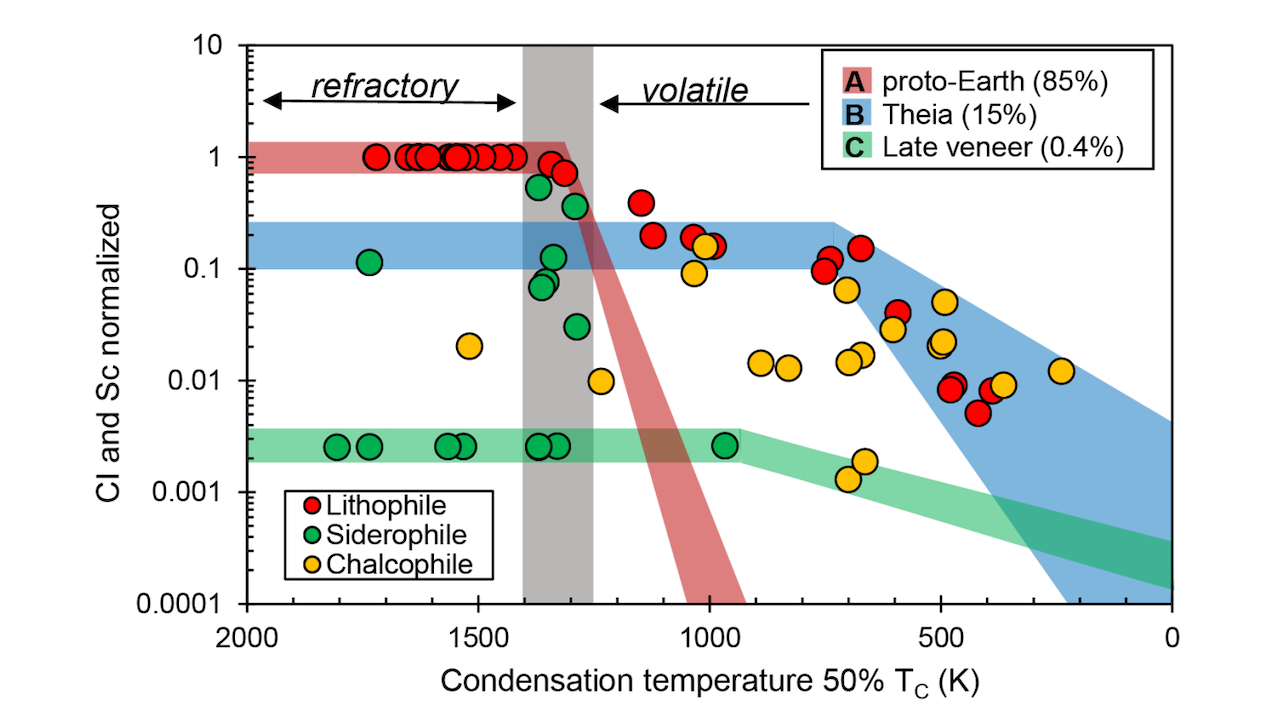
The element abundances in the silicate Earth can be modelled as the result of accretion of three distinct components with distinct element abundances and isotope composition: A: a strongly volatile element depleted and reduced proto-Earth, B: a moderately volatile depleted and more oxidized Moon-forming impactor (Theia) and C: a near chondritic and oxidized late veneer. The absolute abundance of the siderophile and chalcophile elements was modified by core formation following accretion (after Mezger et al., 2021). — astro-ph.EP
Chemical and chronological information preserved in meteorites permits the reconstruction of events and processes in the solar nebula from the formation of the first solids to the accretion of planetary bodies and their subsequent differentiation.
The path from a gas-dust cloud to differentiated planets includes intervals of steady evolution interrupted by singular events that dramatically altered this steady path, leading to planetary bodies with distinct chemical compositions and different degrees of internal differentiation.
The dominant continuous process in the early Solar System was the cooling of the gas-dust cloud, which caused a steady condensation of elements into solid compounds and a continuous increase in the dust/gas ratio. Planetesimal formation started within less than 1 Ma of Solar System formation and continued for ca. 3 Ma apparently in random regions within the disk.
The first planetesimals most likely formed due to streaming instabilities and created gaps in the gas-dust disk that prevented significant element exchange. Later planetesimals formed by accretion of chondrules that had developed in the dust rings by bow shocks.
The Earth formed by early accretion of volatile-poor material and a later collision with a Mars-sized volatile richer body after proto-Earth had formed a metal core. This chance event provided the chemical conditions that transformed the Earth into a habitable planet.
Klaus Mezger, Jonas Pape, Aryavart Anand, Pascal M. Kruttasch, Hauke Vollstaedt, Jan Hoffmann
Comments: Chapter accepted for publication in the NCCR PlanetS Legacy Book: Benz, W. et al. (Eds), The National Center for Competence in Research, PlanetS: A Swiss-wide network expanding planetary sciences. Springer (2026)
Subjects: Earth and Planetary Astrophysics (astro-ph.EP)
Cite as: arXiv:2604.11405 [astro-ph.EP] (or arXiv:2604.11405v1 [astro-ph.EP] for this version)
https://doi.org/10.48550/arXiv.2604.11405
Focus to learn more
Submission history
From: Klaus Mezger
[v1] Mon, 13 Apr 2026 12:45:11 UTC (904 KB)
https://arxiv.org/abs/2604.11405
Astrobiology, exoplanet,










Related Posts
Stay Informed With the Latest & Most Important News
Previous Post
Next Post


Advertisement
-
 01Two Black Holes Observed Circling Each Other for the First Time
 -
 02From Polymerization-Enabled Folding and Assembly to Chemical Evolution: Key Processes for Emergence of Functional Polymers in the Origin of Life
 -
 03Astronomy 101: From the Sun and Moon to Wormholes and Warp Drive, Key Theories, Discoveries, and Facts about the Universe (The Adams 101 Series)
 -
 04True Anomaly hires former York Space executive as chief operating officer
 -
 05Φsat-2 begins science phase for AI Earth images
 -
 06Hurricane forecasters are losing 3 key satellites ahead of peak storm season − a meteorologist explains why it matters
 -
 07Binary star systems are complex astronomical objects − a new AI approach could pin down their properties quickly