
Now Reading: Prebiotic Chemistry Insights for Dragonfly II: Thermodynamic Favorability of Nucleobases, Ribose, and Fatty Acids in Selk Crater on Titan
-
01
Prebiotic Chemistry Insights for Dragonfly II: Thermodynamic Favorability of Nucleobases, Ribose, and Fatty Acids in Selk Crater on Titan

Prebiotic Chemistry Insights for Dragonfly II: Thermodynamic Favorability of Nucleobases, Ribose, and Fatty Acids in Selk Crater on Titan

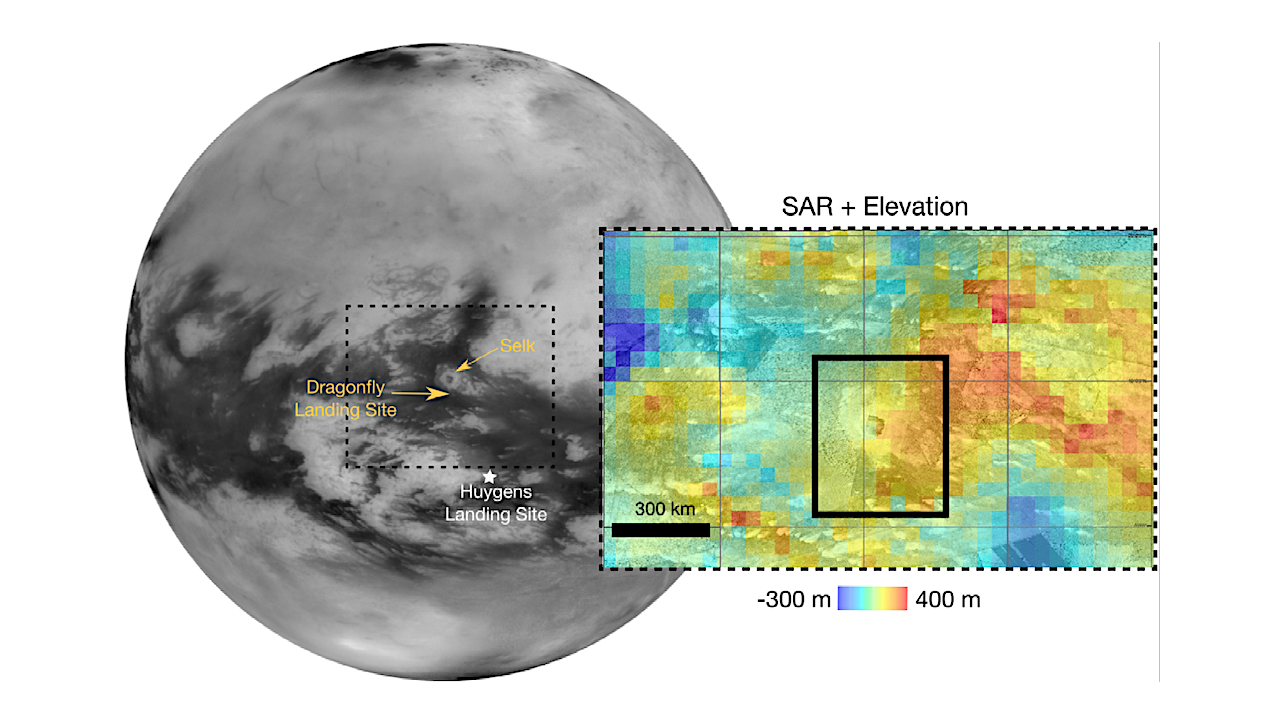

Saturn’s moon Titan is a prime destination for investigating prebiotic chemistry beyond Earth, particularly at impact crater sites where transient liquid water may have enabled aqueous reactions between organic molecules.
Selk crater represents one such environment and is a primary target of NASA’s Dragonfly mission. Here, we present a thermodynamic assessment of nucleobases, ribose, and fatty acids formed from simple atmospheric precursors (HCN and C2H2) within a Selk-sized aqueous melt pool across varying ammonia (NH3) abundances. We find that ammonia acts as a chemical gatekeeper for molecular accessibility.
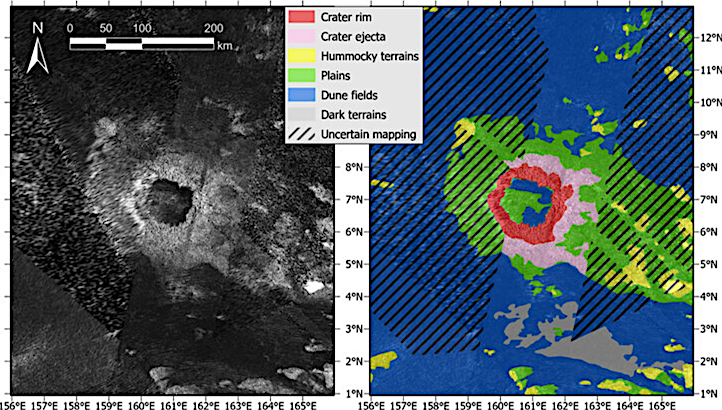
Left: mosaic of the incidence-angle-corrected SAR swaths within the ROI. Right: geomorphological map of the ROI. Source: Composition, Roughness, and Topography from Radar Backscatter at Selk Crater, the Dragonfly Landing Site, The Planetary Science Journal
In NH3-free systems, accessibility is restricted to adenine and butanoic acid. Once >=1% NH3 is introduced, all investigated molecular classes become thermodynamically accessible. Distinct molecular classes have different NH3 sensitivities: nucleobases, ribose, and C2-C6 fatty acids yield peaks at 1% NH3, and C7-C12 fatty acids yield peaks at 2% NH3.
The modeled preference for pyrimidines vs. purines and monotonic decline of fatty acid abundance with chain length qualitatively mirror patterns observed in carbonaceous meteorites and returned asteroid samples. We show how molecular distributions and cross-class correlations may provide indirect constraints on Selk’s past aqueous environment, help constrain past ammonia availability, and distinguish abiotic production from potential anomalies.
By coupling thermodynamic predictions with an assessment of Dragonfly’s mass spectrometer (DraMS) capabilities, we posit concrete, testable predictions for evaluating Selk’s prebiotic potential in situ.
Ishaan Madan, Ben K.D. Pearce
Comments: Accepted in Planetary Science Journal, April 2026
Subjects: Earth and Planetary Astrophysics (astro-ph.EP); Chemical Physics (physics.chem-ph); Biomolecules (q-bio.BM)
Cite as: arXiv:2604.16249 [astro-ph.EP] (or arXiv:2604.16249v1 [astro-ph.EP] for this version)
https://doi.org/10.48550/arXiv.2604.16249
Focus to learn more
Related DOI:
https://doi.org/10.3847/PSJ/ae5f91
Focus to learn more
Submission history
From: Ishaan Madan
[v1] Fri, 17 Apr 2026 17:11:17 UTC (795 KB)
https://arxiv.org/abs/2604.16249
Astrobiology, Astrogeology, Astrochemistry,










Related Posts


Stay Informed With the Latest & Most Important News
Previous Post
Next Post



Advertisement
-
 01Two Black Holes Observed Circling Each Other for the First Time
 -
 02From Polymerization-Enabled Folding and Assembly to Chemical Evolution: Key Processes for Emergence of Functional Polymers in the Origin of Life
 -
 03Astronomy 101: From the Sun and Moon to Wormholes and Warp Drive, Key Theories, Discoveries, and Facts about the Universe (The Adams 101 Series)
 -
 04True Anomaly hires former York Space executive as chief operating officer
 -
 05Φsat-2 begins science phase for AI Earth images
 -
 06Hurricane forecasters are losing 3 key satellites ahead of peak storm season − a meteorologist explains why it matters
 -
 07Binary star systems are complex astronomical objects − a new AI approach could pin down their properties quickly