
Now Reading: Europa’s Lyman-α Emissions From HST/STIS Observations
-
01
Europa’s Lyman-α Emissions From HST/STIS Observations


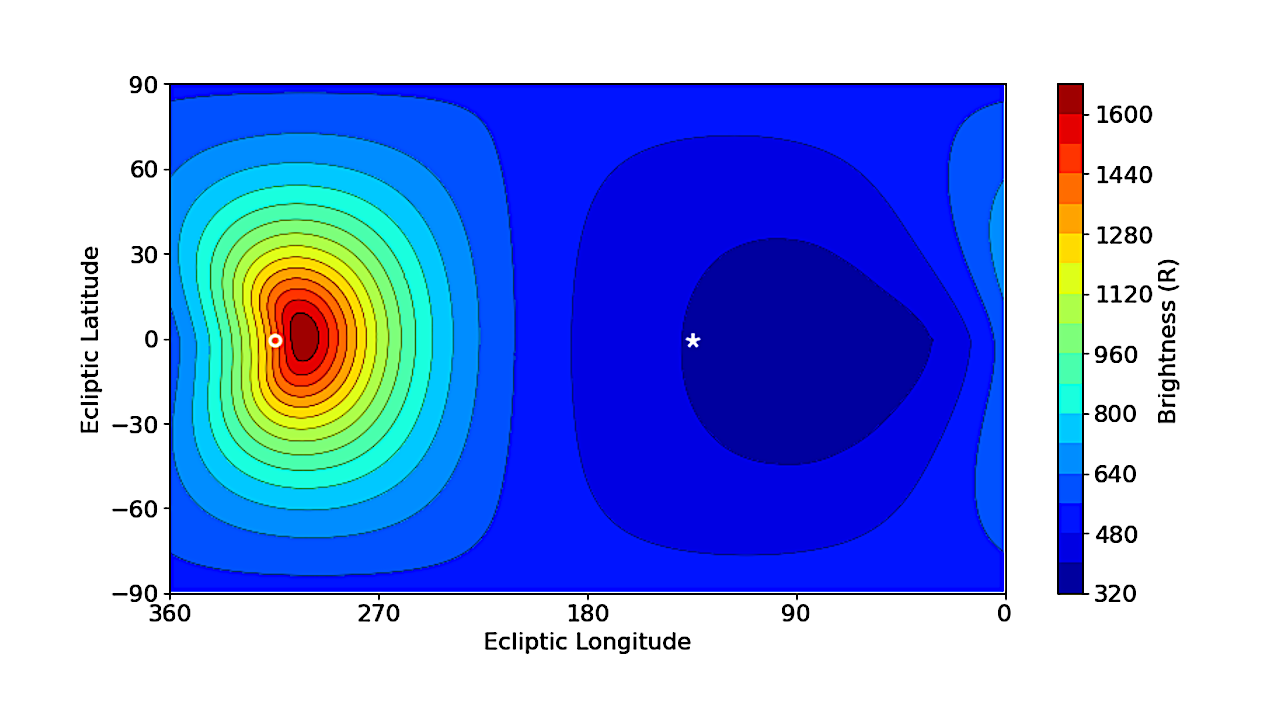
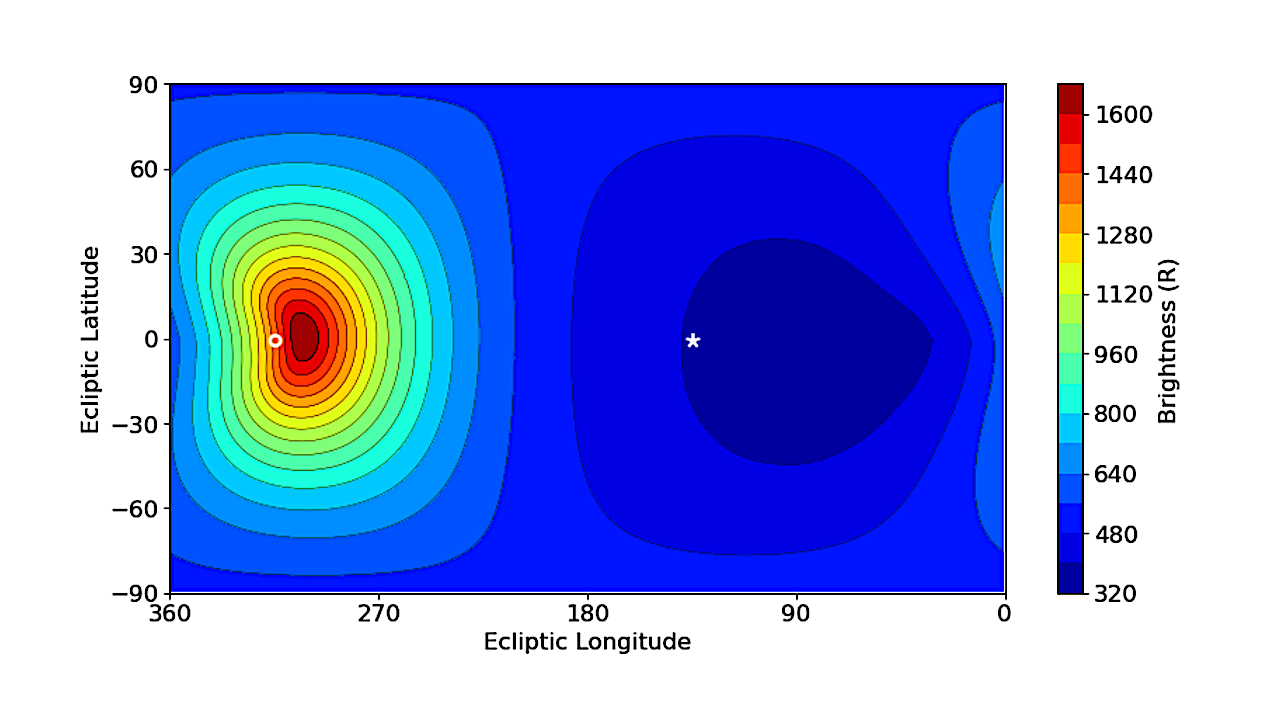
Sky map of the Lyα brightness seen from Europa for visit 12 (Jan 26, 2015) from interplanetary medium H scattering model (Pryor et al. 2024). The direction to the Sun is shown by the small white circle, the anti-Sun direction is shown by the white asterisk. — astro-ph.EP
Context. An image of Lyman-α (Lyα) emission from Europa obtained with the Hubble Space Telescope’s Space Telescope Imaging Spectrograph (HST/STIS) provided the first evidence for localized water vapor (H2O) aurora, potentially originating from outgassing. Subsequent STIS observations revealed the presence of a global atomic hydrogen (H) exosphere at Europa.
Aims. We present a comprehensive analysis of STIS Lyα observations of Europa acquired in 1999 and between 2012 and 2020 to search for localized auroral emissions and to constrain the properties of Europa’s H exosphere.
Methods. The complete dataset of the STIS observations obtained when Europa was sunlit and not transiting Jupiter is analyzed. We construct a model that accounts for all known sources of Lyα emission, including resonantly scattered sunlight from Europa’s H exosphere. To identify localized anomalies such as H2O aurora, we subtract the modeled Lyα emission and analyze the residuals.
Results. Emission from Europa’s H exosphere is detected at all observing epochs but is attenuated by absorption in Earth’s exosphere when Europa’s radial velocity relative to Earth, and thus the Doppler shift, is small. From the velocity dependence of this attenuation, we estimate an H-exosphere temperature of ∼1000 K and derive an upper limit of 5100 K. For the best-constrained epoch in 2014/2015, we infer a vertical H column density of 1.4 × 1012 cm−2 and an H source rate of 1.1 × 1027 s −1 . No localized emission enhancements are detected in any of the observations, including the image previously interpreted as evidence for H2O aurora near Europa’s south pole. The discrepancy with earlier results arises primarily from differences in the assumed position of Europa’s disk on the detector.
The inclusion of an H-exosphere signal in the present analysis also contributes to this difference. When adopting the same disk position as in the previous study and neglecting the H-exosphere signal, the localized emission enhancement is again detected with similar statistical significance. However, with the updated approach to disk positioning and the more complete modeling of emission sources, including the H exosphere, we consider the results presented here as the preferred interpretation.
Conclusions. We find evidence for a persistent hydrogen exosphere at Europa but no evidence for localized water vapor.
Astrobiology,
L. Roth, K.D. Retherford, J. Saur, D.F. Strobel, T. Becker, S. Bergman, A. Blöcker, S.R. Carberry Mogan, C. Grava, M. Ivchenko, S. Joshi, M.A. McGrath, F. Nimmo, L. Paganini, W. Pryor, J.R. Spencer
Subjects: Earth and Planetary Astrophysics (astro-ph.EP); Space Physics (physics.space-ph)
Cite as: arXiv:2604.20324 [astro-ph.EP](or arXiv:2604.20324v1 [astro-ph.EP] for this version)
https://doi.org/10.48550/arXiv.2604.20324
Focus to learn more
Related DOI:
https://doi.org/10.1051/0004-6361/202659406
Focus to learn more
Submission history
From: Lorenz Roth
[v1] Wed, 22 Apr 2026 08:20:53 UTC (4,477 KB)
https://arxiv.org/abs/2604.20324
Astrobiology, Astrochemistry, Astrogeology, Space Weather,










Related Posts
Stay Informed With the Latest & Most Important News


Advertisement
-
 01Two Black Holes Observed Circling Each Other for the First Time
 -
 02From Polymerization-Enabled Folding and Assembly to Chemical Evolution: Key Processes for Emergence of Functional Polymers in the Origin of Life
 -
 03Astronomy 101: From the Sun and Moon to Wormholes and Warp Drive, Key Theories, Discoveries, and Facts about the Universe (The Adams 101 Series)
 -
 04True Anomaly hires former York Space executive as chief operating officer
 -
 05Φsat-2 begins science phase for AI Earth images
 -
 06Hurricane forecasters are losing 3 key satellites ahead of peak storm season − a meteorologist explains why it matters
 -
 07Binary star systems are complex astronomical objects − a new AI approach could pin down their properties quickly