
Now Reading: Feeling the Pressure: Effects of Formation Pressure on the Physical Properties of Titan Haze Analogs
-
01
Feeling the Pressure: Effects of Formation Pressure on the Physical Properties of Titan Haze Analogs

Feeling the Pressure: Effects of Formation Pressure on the Physical Properties of Titan Haze Analogs

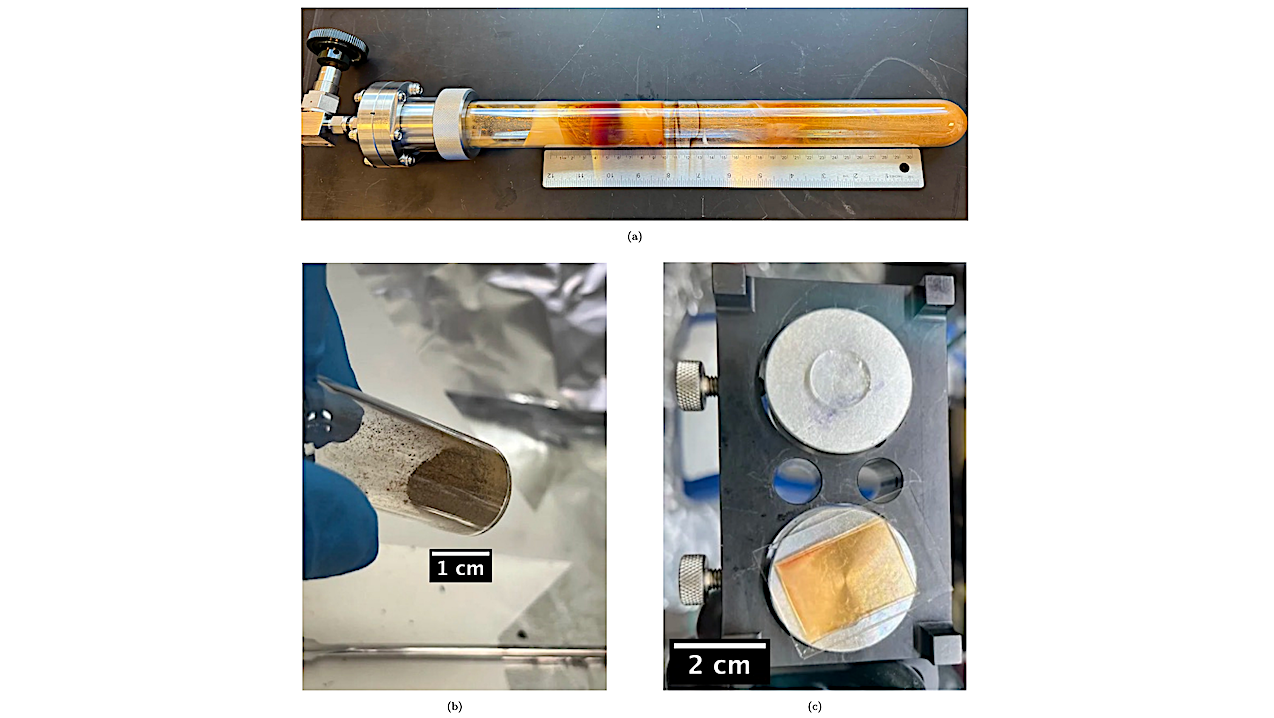
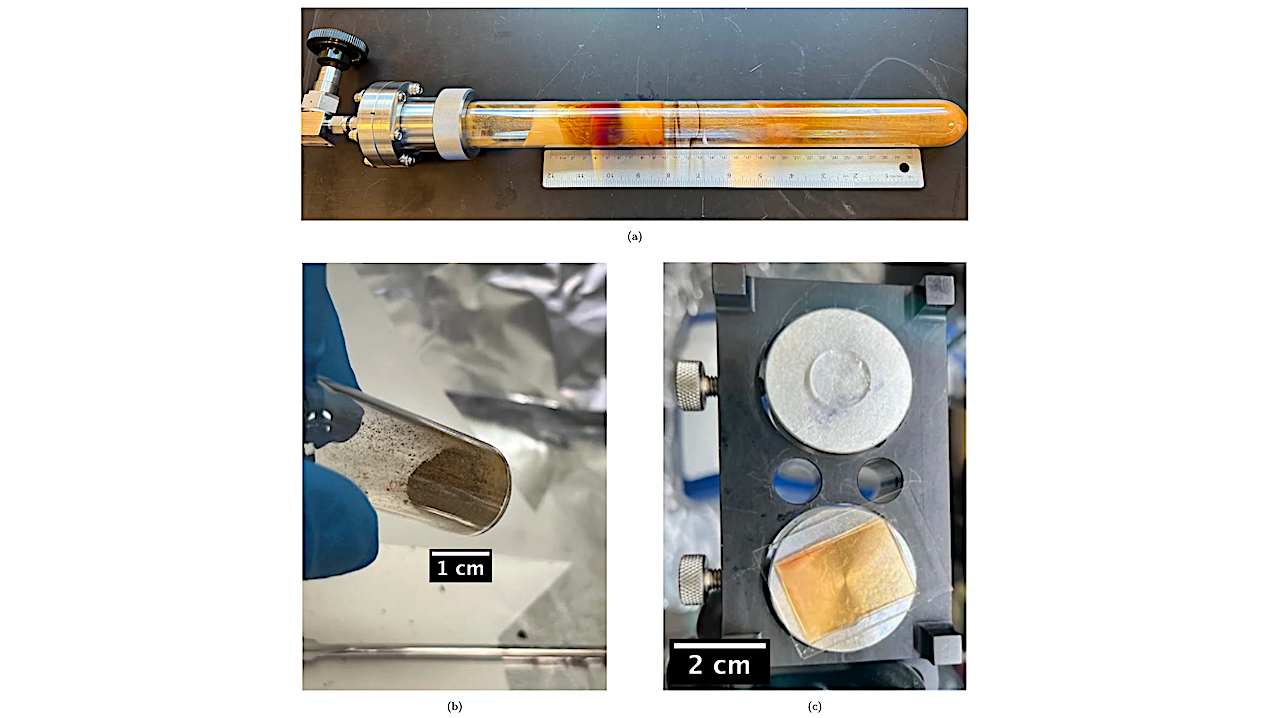
(a) A tube with synthesized high-pressure material (tan and red regions) before collection. The origin of the color difference is unclear, but it is thought to be due to a difference of the thickness/amount of deposited material in each region. Black markings (around 10.7 and 12 cm) are from highly localized arc discharging where the RF plasma electrodes are located, and only affect the glass tube itself. Significant arcing has not been witnessed and is not expected to occur or affect resulting tholin. The run time of this experiment is 180 hours. (b) Powder samples obtained after manual scraping of the red and tan regions in subfigure a. Scraped powders achieve a uniform color with no clear tan or red differences after collection. (c) A fused silica standard (top) and tholin thin film on glass (bottom), ready for nanoindentation measurements. — astro-ph.EP
The Cassini-Huygens mission detected large negative ions in Titan’s ionosphere at pressures as low as 10−6 torr. These ions ultimately polymerize to form Titan’s complex organic haze particles, which are observed throughout the atmosphere and potentially on the surface.
Laboratory analogs of these hazes, known as tholins, have been used to study Titan’s aerosols; however, most are produced at much higher pressures. The influence of formation pressures on key physical properties — such as particle size, density, surface energy, and mechanical strength — remains poorly constrained. These properties govern the haze’s aggregation efficiency, radiative behavior, and surface-atmosphere interactions, shaping Titan’s climate and surface.
To investigate the effects of formation pressure, we generate tholins using a newly developed cold plasma discharge system. A 95% nitrogen and 5% methane gas mixture is exposed to plasma at two pressures, 1 torr and 0.125 torr. For both samples, we measure the production rate, particle size, morphology, density, surface free energy, Young’s modulus, and nanoindentation hardness.
While particle size, morphology, surface energy, and Young’s modulus are similar across both pressures, tholins produced at lower pressure exhibited a threefold lower production rate, but a higher density and nanoindentation hardness.
These variations likely reflect pressure-dependent changes in chemical structure, porosity, and mechanical strength. Because Titan’s hazes form at much lower pressures than investigated here, actual haze particles are potentially even denser and mechanically stronger than our analogs, with implications for aerosol aggregation, aeolian and fluvial transport, and surface modification on Titan.
Adis Husić (1), Xinting Yu (1), Ryan C. Blase (2), Edward L. Patrick (2), Eric Austin (1), Alan G. Whittington (3) ((1) Department of Physics and Astronomy, University of Texas at San Antonio, (2) Southwest Research Institute, (3) Department of Earth and Planetary Sciences, University of Texas at San Antonio)
Comments: 23 pages, 7 figures, 4 tables
Subjects: Earth and Planetary Astrophysics (astro-ph.EP)
Cite as: arXiv:2604.20057 [astro-ph.EP] (or arXiv:2604.20057v1 [astro-ph.EP] for this version)
https://doi.org/10.48550/arXiv.2604.20057
Focus to learn more
Submission history
From: Adis Husić
[v1] Tue, 21 Apr 2026 23:35:17 UTC (3,322 KB)
https://arxiv.org/abs/2604.20057
Astrobiology,










Related Posts
Stay Informed With the Latest & Most Important News




Advertisement
-
 01Two Black Holes Observed Circling Each Other for the First Time
 -
 02From Polymerization-Enabled Folding and Assembly to Chemical Evolution: Key Processes for Emergence of Functional Polymers in the Origin of Life
 -
 03Astronomy 101: From the Sun and Moon to Wormholes and Warp Drive, Key Theories, Discoveries, and Facts about the Universe (The Adams 101 Series)
 -
 04True Anomaly hires former York Space executive as chief operating officer
 -
 05Φsat-2 begins science phase for AI Earth images
 -
 06Hurricane forecasters are losing 3 key satellites ahead of peak storm season − a meteorologist explains why it matters
 -
 07Binary star systems are complex astronomical objects − a new AI approach could pin down their properties quickly