
Now Reading: ORCHARD: A General Planetary Evolution Code
-
01
ORCHARD: A General Planetary Evolution Code


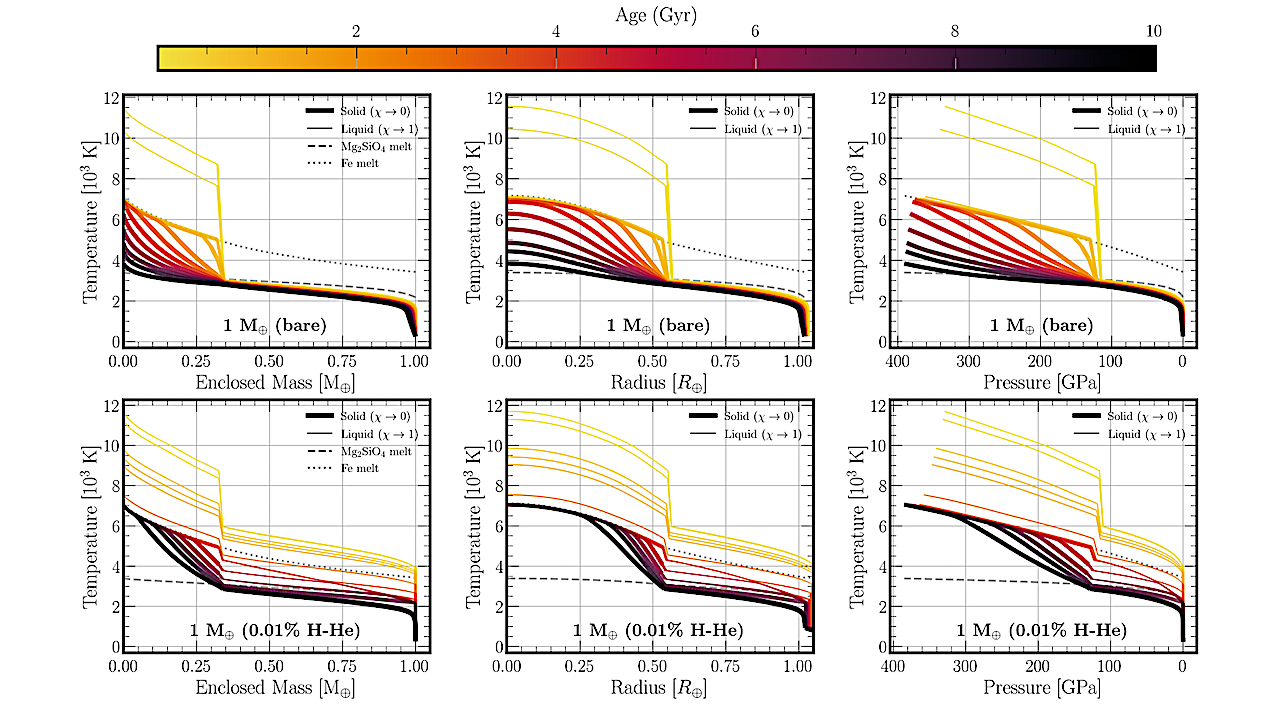

Thermal evolution of a 1 M⊕ model with no atmosphere (top row) and a model with a thin 0.01% H-He by mass atmosphere/envelope. Thicker line segments indicate solidified regions, with thickness varying according to the model’s melt fraction, while thin line segments indicate liquid states. The left, center, and right panels show the temperature evolution as a function of mass, radius, and pressure, respectively. The faint dotted line is the iron melt curve of F. Gonz´alez-Cataldo & B. Militzer (2023), and the faint dashed curve is the Mg2SiO4 melt curve of D. C. Presnall & M. J. Walter (1993). The mantles begin fully liquid and solidify within the first 1 Myr in the bare model, but the mantles of the thin atmosphere model begin solidifying at 3-4 Gyrs. The pure iron core follows the melt curve as it releases latent heat and begins to solidify. The inner core regions solidify first, and the outer core regions cool faster as they begin to solidify. After the core fully solidifies, heat transport is solely by conduction, creating extended temperature gradients between the mantle and the inner, partially molten core. Inserting an envelope into the model, even if it comprises only 0.01% of its mass, affects its thermal evolution by inhibiting cooling. — astro-ph.EP
We present ORCHARD, a publicly available planetary evolution code based on the gas giant evolution code, APPLE, capable of modeling the evolution and structures of terrestrial, super-Earth, sub-Neptune, Neptune, and gas giant planets and exoplanets from 0.5 M⊕ to 10 MJ.
It supports not only the inhomogeneous and non-adiabatic evolution of gas giants and sub-Neptunes, but also the solidification of the mantles and cores of terrestrial planets, sub-Neptunes, and super-Earths.
ORCHARD incorporates a state-of-the-art hydrogen-helium equation of state, “metal” equations of state (water, ice mixtures, enstatite/perovskite, olivine/forsterite, iron), and atmospheric boundary conditions ranging from detailed non-gray radiative transfer models for Solar System giants to irradiated sub-Neptune atmospheres and bare rocky surfaces.
The purpose of ORCHARD is to provide the scientific community with a flexible, unified tool for modeling planetary structures and evolution across the entire mass continuum of general astrophysical and planetary interest.
Roberto Tejada Arevalo, Adam Burrows, Ankan Sur, Yubo Su
Comments: 34 pages, 11 Figures, 4 Tables, 2 Appendices. Submitted to ApJ
Subjects: Earth and Planetary Astrophysics (astro-ph.EP); Instrumentation and Methods for Astrophysics (astro-ph.IM)
Cite as: arXiv:2604.24845 [astro-ph.EP] (or arXiv:2604.24845v1 [astro-ph.EP] for this version)
https://doi.org/10.48550/arXiv.2604.24845
Focus to learn more
Submission history
From: Roberto Tejada Arevalo
[v1] Mon, 27 Apr 2026 18:00:01 UTC (8,273 KB)
https://arxiv.org/abs/2604.24845
Astrobiology, Stellar Cartography, exoplanet,










Related Posts
Stay Informed With the Latest & Most Important News
Previous Post
Next Post




Advertisement
-
 01Two Black Holes Observed Circling Each Other for the First Time
 -
 02From Polymerization-Enabled Folding and Assembly to Chemical Evolution: Key Processes for Emergence of Functional Polymers in the Origin of Life
 -
 03Astronomy 101: From the Sun and Moon to Wormholes and Warp Drive, Key Theories, Discoveries, and Facts about the Universe (The Adams 101 Series)
 -
 04True Anomaly hires former York Space executive as chief operating officer
 -
 05Φsat-2 begins science phase for AI Earth images
 -
 06Hurricane forecasters are losing 3 key satellites ahead of peak storm season − a meteorologist explains why it matters
 -
 07Binary star systems are complex astronomical objects − a new AI approach could pin down their properties quickly