
Now Reading: In The Heart Of Planetary Nebula Tc 1, A Buckyball Of Buckyballs
-
01
In The Heart Of Planetary Nebula Tc 1, A Buckyball Of Buckyballs


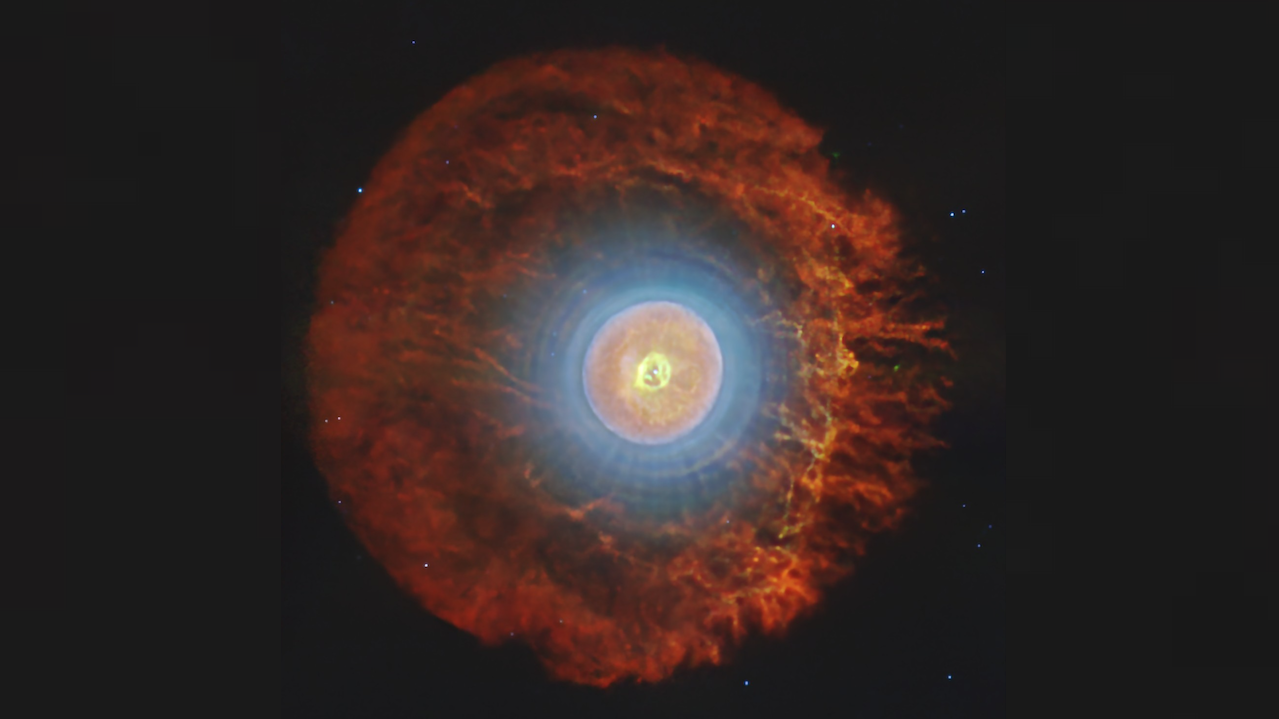
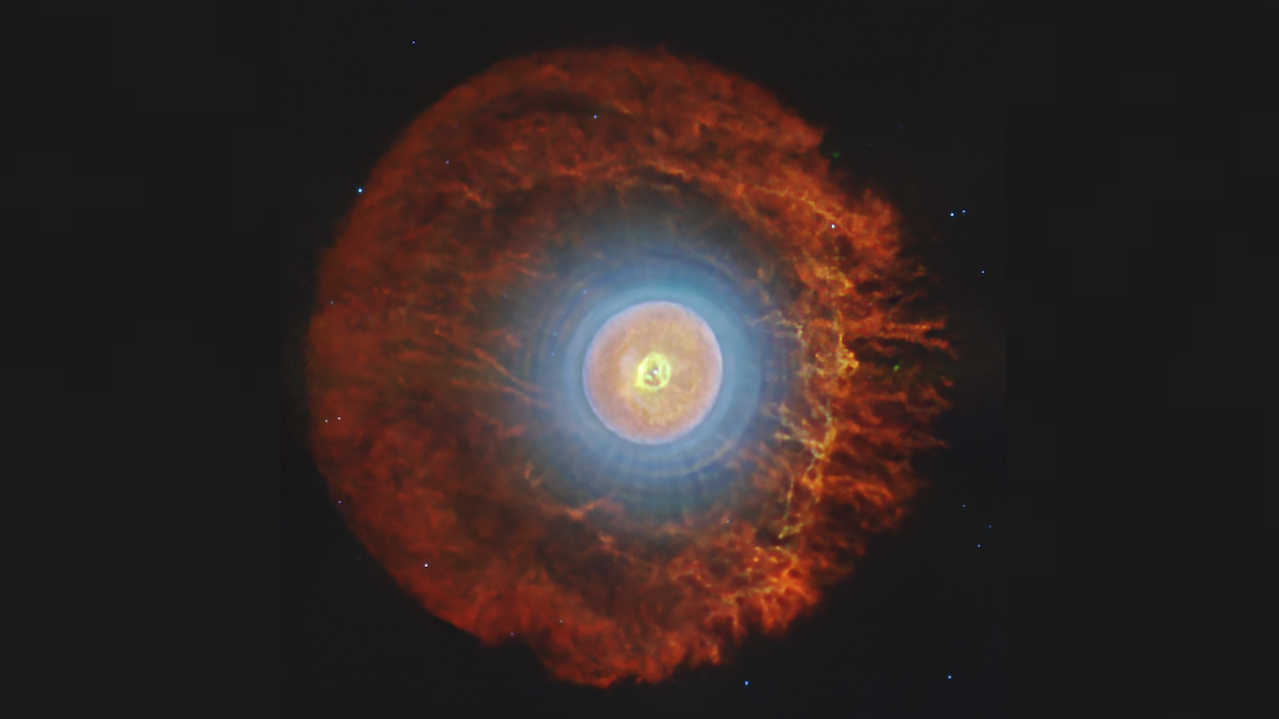
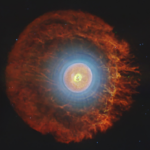
The planetary nebula Tc 1, as observed by JWST’s MIRI mid-infrared instrument, uses a combination of nine filters covering wavelengths from 5.6 to 25.5 microns, well beyond what the human eye can perceive. Blue tones represent the hottest gas, at shorter mid-infrared wavelengths; red tones indicate cooler material, at longer wavelengths. The image was processed by Katelyn Beecroft using PixInsight. Credits: NASA / ESA / CSA / Western University, J. Cami
Fullerene C60, the molecule that looks like a soccer ball, had already been identified in the planetary nebula Tc 1 by the Spitzer Space Telescope in 2010. Now a team led by the same scientist as then – Jan Cami of Western University – has returned to the site of the discovery, this time using the Webb Space Telescope. Here’s what they discovered.
With a shape that perfectly mirrors the alternating 20 hexagons and 12 pentagons of a soccer ball, the C60 fullerene molecule —composed of 60 carbon atoms—is one of the most fascinating in nature. At least in terms of its molecular structure, because if we consider the substance in which these spherical molecules are most commonly found— soot —there’s very little that’s fascinating.
This is on Earth. In space, however, buckminsterfullerene —the molecule’s full name, often abbreviated to buckyball —can be found in some of the most striking places. This is demonstrated by the spectacular image below: a photograph of the planetary nebula Tc 1 taken with the Miri instrument on the James Webb Space Telescope ( JWST ).
Theoretically predicted as early as the late 1960s , synthesized for the first time in the mid-1980s , and the undisputed stars of the 1996 Nobel Prize in Chemistry, buckyballs were also spotted in space for the first time in 2010 , when NASA’s Spitzer Space Telescope detected their spectral signature right inside Tc 1, the planetary nebula now photographed by Webb. Same region of the universe, same scientist: in fact, in both cases, the one in 2010 with Spitzer and this one today with Webb, the one leading the observations was astrophysicist Jan Cami , now as then a professor at Western University, in Canada.
“Tc 1 was already an extraordinary object, having revealed the existence of buckyballs in space, but this new image shows us that we’ve only scratched the surface,” says Cami. “The structures we see now are breathtaking and raise as many questions as they provide answers.”

Jan Cami of Western University demonstrates a buckyball model. Credit: Christopher Kindratsky/Western Communications
The observations conducted with Webb don’t end with the image shown above. In addition to functioning as an infrared camera, the Miri instrument allows for the chemical fingerprint of the gas and dust to be acquired for each point in the nebula—or for each pixel in the image, if you prefer. This technique, known as integral field spectroscopy , allows scientists to map not only the appearance of Tc 1, but also its ingredients: the spatial distribution of temperature, density, chemical composition, and motion of the gas throughout the nebula. The result is a unique view of the physics and chemistry of a dying star, a planetary nebula —an object that, despite its name, has nothing to do with planets.
“As beautiful as this image is, for me it’s first and foremost a dataset,” Charmi Bhatt , a doctoral student in physics and astronomy at Western University, aptly summarizes. “The sharpness and sensitivity of JWST are unmatched by anything I’ve worked with before. Structures that were previously completely invisible to us now present themselves with stunning clarity: the shells, the rays, the minute details in the outer halo… And, crucially, thanks to integral-field spectroscopy, we can now connect everything we see morphologically in the image directly to the chemistry and physics occurring in the nebula. It’s this combination that makes this dataset so powerful.”
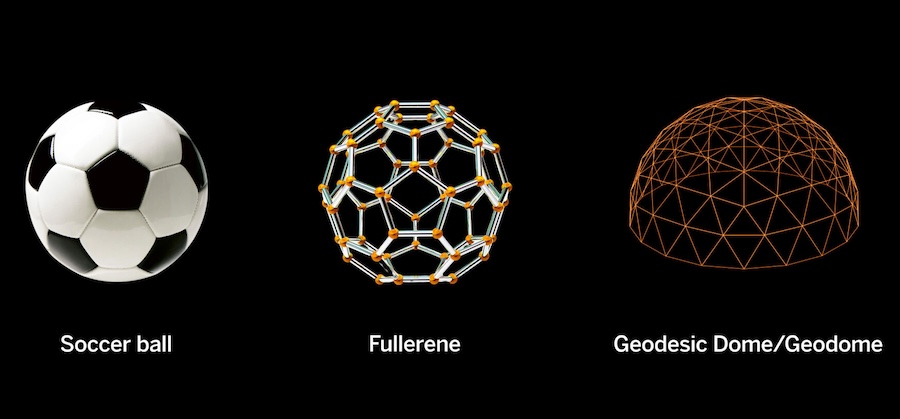
The 60 carbon molecules in the “buckyballs” are arranged at the vertices of hexagons and pentagons, resembling the design of a soccer ball or a geodesic dome. Credit: Western Communications
So how are the C60 molecules distributed within Tc 1? The data show that they are not scattered randomly throughout the nebula, but rather concentrated in a thin spherical shell surrounding the central star. Yes, a “thin spherical shell”: precisely the three-dimensional shape of the molecules themselves.
“We meticulously measured the properties of the buckyballs throughout our dataset and then created a map showing their locations,” explains Morgan Giese , also a doctoral student at Western University. “It’s interesting to note that these microscopic hollow spheres are distributed precisely in the shape of a hollow sphere. The buckyballs are arranged as if they were a single, giant buckyball .”
The reason for this distribution is still unclear, just as there is currently no explanation for the structure that vaguely resembles an inverted question mark visible exactly in the center of the image produced by Webb.
“We put a lot of effort into analyzing the data because we had so many questions about buckyballs and their surroundings. After a long time, we thought we were finally starting to glimpse some answers, but the nebula slammed a giant question mark in our faces. The universe has a cruel sense of humor,” concludes another doctoral student on the team, Simon Van Schuylenbergh .
Original post (in Italian)
Astrobiology, Astrochemistry, Astronomy,










Related Posts
Stay Informed With the Latest & Most Important News
Previous Post
Next Post
Advertisement
-
 01Two Black Holes Observed Circling Each Other for the First Time
 -
 02From Polymerization-Enabled Folding and Assembly to Chemical Evolution: Key Processes for Emergence of Functional Polymers in the Origin of Life
 -
 03Astronomy 101: From the Sun and Moon to Wormholes and Warp Drive, Key Theories, Discoveries, and Facts about the Universe (The Adams 101 Series)
 -
 04True Anomaly hires former York Space executive as chief operating officer
 -
 05Φsat-2 begins science phase for AI Earth images
 -
 06Hurricane forecasters are losing 3 key satellites ahead of peak storm season − a meteorologist explains why it matters
 -
 07Binary star systems are complex astronomical objects − a new AI approach could pin down their properties quickly