
Now Reading: Stunning Satellite Image Captures Tulip Blooms and Phytoplankton in the Netherlands
-
01
Stunning Satellite Image Captures Tulip Blooms and Phytoplankton in the Netherlands

Stunning Satellite Image Captures Tulip Blooms and Phytoplankton in the Netherlands

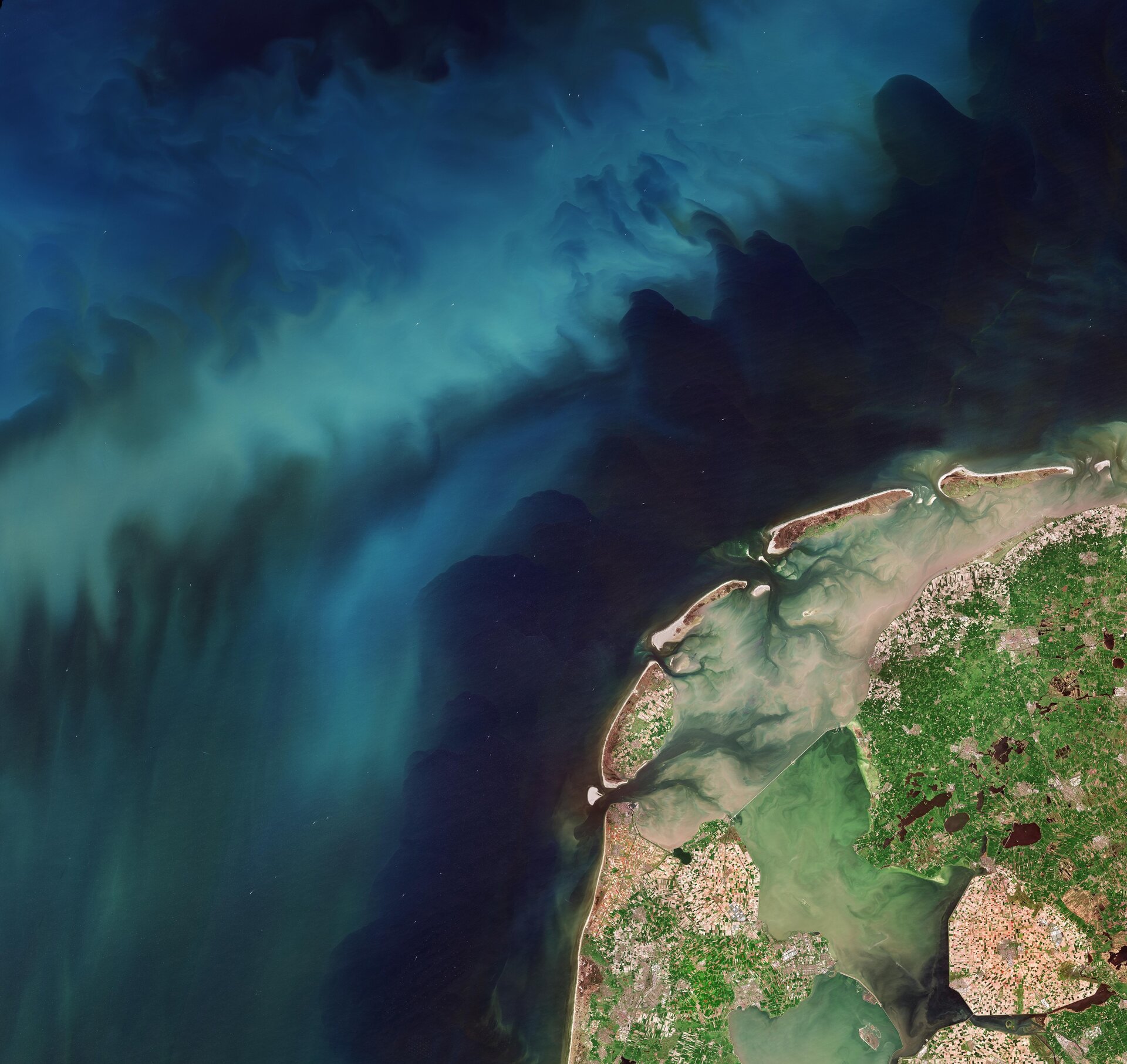

A recent image captured by the Copernicus Sentinel-2 mission on April 21, 2026, showcases a striking double bloom in the Netherlands, highlighting the country’s iconic tulip fields alongside the blue-green hues of phytoplankton in the North Sea. The photograph reveals the northwestern edge of the Netherlands, characterized by its intricate network of islands, peninsulas, and waterways. The scene includes sections of the provinces of Flevoland, North Holland, and Friesland, featuring the low-lying West Frisian Islands that arch delicately toward the mainland.
Separated from the mainland, these islands are bordered by the shallow waters and tidal mudflats of the Wadden Sea, an inlet of the North Sea. The image captures the nutrient-rich brown waters of the Wadden Sea, contrasting sharply with the deeper, darker hues of the surrounding ocean. Two prominent dams create divisions in the internal waters, giving rise to the larger IJsselmeer lake and the smaller Markermeer.
The vibrant patchwork of farmland in the image displays fields at various stages of cultivation and harvest, including major crops like cereals, potatoes, sugar beets, onions, and an array of tulips. The tulip fields, adorned with flourishing blooms in bright yellow, red, and violet, typically attract millions of tourists each spring. Farmers hasten to prune the flowers just as they reach their peak to redirect energy back into the bulbs, ensuring their strength for future seasons.
In stark contrast, the outer regions of the North Sea are characterized by a bloom of a different nature: phytoplankton. These microscopic marine plants flourish in the upper layers of water, thriving in spring when nutrients are plentiful due to mixing between surface waters and deeper layers. Though individually tiny, the collective chlorophyll of these organisms alters the color of the sea, creating the distinctive blues and greens visible in the satellite image. Advanced sensors on the Sentinel-2, particularly its multispectral imager, allow for the detection of these minute but vital forms of oceanic life from space.










Related Posts


Stay Informed With the Latest & Most Important News




Advertisement
-
 01Two Black Holes Observed Circling Each Other for the First Time
 -
 02From Polymerization-Enabled Folding and Assembly to Chemical Evolution: Key Processes for Emergence of Functional Polymers in the Origin of Life
 -
 03Astronomy 101: From the Sun and Moon to Wormholes and Warp Drive, Key Theories, Discoveries, and Facts about the Universe (The Adams 101 Series)
 -
 04True Anomaly hires former York Space executive as chief operating officer
 -
 05Φsat-2 begins science phase for AI Earth images
 -
 06Hurricane forecasters are losing 3 key satellites ahead of peak storm season − a meteorologist explains why it matters
 -
 07Binary star systems are complex astronomical objects − a new AI approach could pin down their properties quickly