
Now Reading: The Effect Of Spectral Resolution On Biosignature Detection Via Reflected Light Observations Of The Earth Through Time
-
01
The Effect Of Spectral Resolution On Biosignature Detection Via Reflected Light Observations Of The Earth Through Time

The Effect Of Spectral Resolution On Biosignature Detection Via Reflected Light Observations Of The Earth Through Time

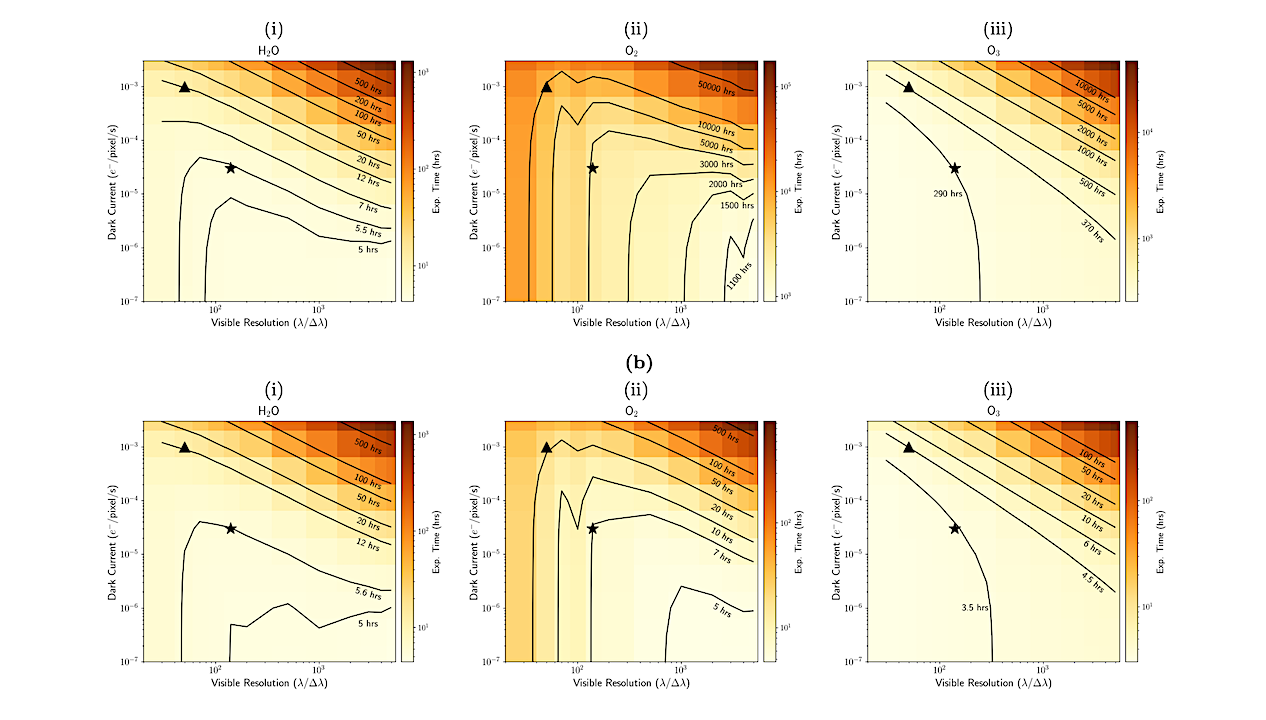
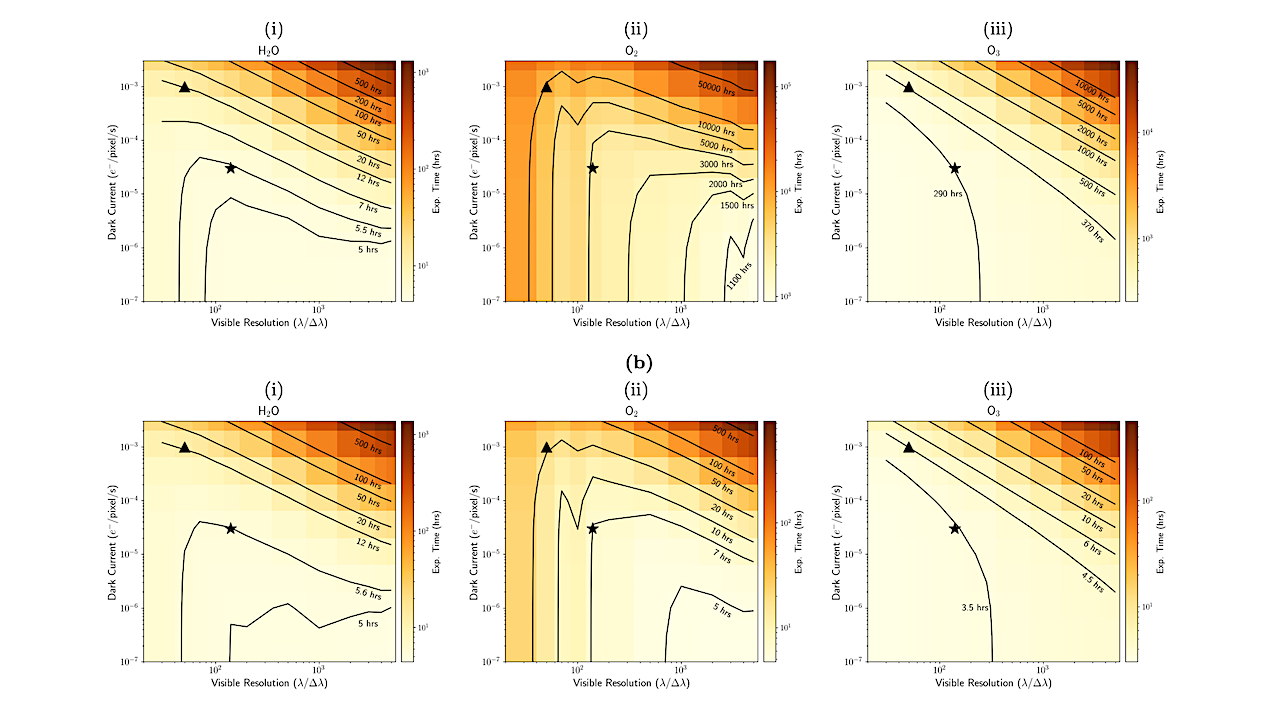
Contour plots showing the relationship between dark current, visible band-pass resolution, and exposure time required for molecular detection. (a) High-CH4 Proterozoic Earth: (i) H2O, (ii) O2, (iii) O3. While higher visible resolution correlates with lower relative exposure times to detect O2 at low Proterozoic abundances, detection remains infeasible in a reasonable time for all cases. (b) Phanerozoic Earth: (i) H2O, (ii) O2, (iii) O3. Increasing visible resolution could lower O2 detection exposure times, but only if detector noise is also significantly reduced from the nominal value. In both panels, the star marks nominal HWO EAC1 values in pyEDITH, and the triangle marks the nominal resolution (R∼50) and dark current (1 × 10⁻³ e −/pixel/s) of the Nancy Grace Roman Telescope Coronagraph Instrument Spectrograph. — astro-ph.EP
NASA’s Habitable Worlds Observatory (HWO) will search for biosignatures on Earth-like exoplanets using reflected light spectroscopy.
A critical instrument design parameter is resolving power, which must balance biosignature detectability against exposure time and detector noise constraints. We assess the resolving power needed to detect and characterize key biosignature gases and habitability indicators including O2, O3, H2O, CH4, CO2 and CO across atmospheres representing the Archean, Proterozoic, and Phanerozoic Earth.
We combine analytical detectability calculations spanning spectral resolutions (λ/Δλ) R=20-5000 with atmospheric retrievals using the rfast radiative transfer model and pyEDITH exposure time calculator for realistic wavelength-dependent noise modeling.
In the visible (0.4-1.0 μm), the nominal resolution RVis=140 is sufficient for detecting O2 in Phanerozoic-like atmospheres. Higher resolutions could theoretically reduce exposure times for low-O2 Proterozoic atmospheres, but require >10× reductions in dark current and could increase H2O detection exposure times by ∼2×, penalizing the foundational habitability constraint that anchors downstream biosignature searches.
The most efficient path for low-O2 atmospheres may instead be indirect inference via O3, whose Hartley-Huggins bands are detectable at RUV∼7. In the near-IR (1.0-1.7 μm), RNIR≥40 is necessary to avoid a degeneracy between CO2 and CO that could produce false positive detections of abundant CO. The nominal RNIR=70 is sufficient for characterizing all Earth-through-time cases.
These results support HWO’s current baseline resolution choices and provide actionable guidance for finalizing spectrometer requirements while maintaining technological feasibility for the search for life on exoplanets.
Samantha Gilbert-Janizek, Jacob Lustig-Yaeger, Joshua Krissansen-Totton
Comments: Accepted at The Astrophysical Journal; 27 pages, 11 figures, 5 tables, 1 appendix
Subjects: Earth and Planetary Astrophysics (astro-ph.EP); Instrumentation and Methods for Astrophysics (astro-ph.IM)
Cite as: arXiv:2604.26925 [astro-ph.EP] (or arXiv:2604.26925v1 [astro-ph.EP] for this version)
https://doi.org/10.48550/arXiv.2604.26925
Focus to learn more
Submission history
From: Samantha Gilbert-Janizek
[v1] Wed, 29 Apr 2026 17:39:38 UTC (11,499 KB)
https://arxiv.org/abs/2604.26925
Astrobiology, exoplanet,










Related Posts
Stay Informed With the Latest & Most Important News
Previous Post
Next Post


Advertisement
-
 01Two Black Holes Observed Circling Each Other for the First Time
 -
 02From Polymerization-Enabled Folding and Assembly to Chemical Evolution: Key Processes for Emergence of Functional Polymers in the Origin of Life
 -
 03Astronomy 101: From the Sun and Moon to Wormholes and Warp Drive, Key Theories, Discoveries, and Facts about the Universe (The Adams 101 Series)
 -
 04True Anomaly hires former York Space executive as chief operating officer
 -
 05Φsat-2 begins science phase for AI Earth images
 -
 06Hurricane forecasters are losing 3 key satellites ahead of peak storm season − a meteorologist explains why it matters
 -
 07Binary star systems are complex astronomical objects − a new AI approach could pin down their properties quickly