
Now Reading: Ammonia As A Parameter Shaping Habitability On Icy Moons
-
01
Ammonia As A Parameter Shaping Habitability On Icy Moons


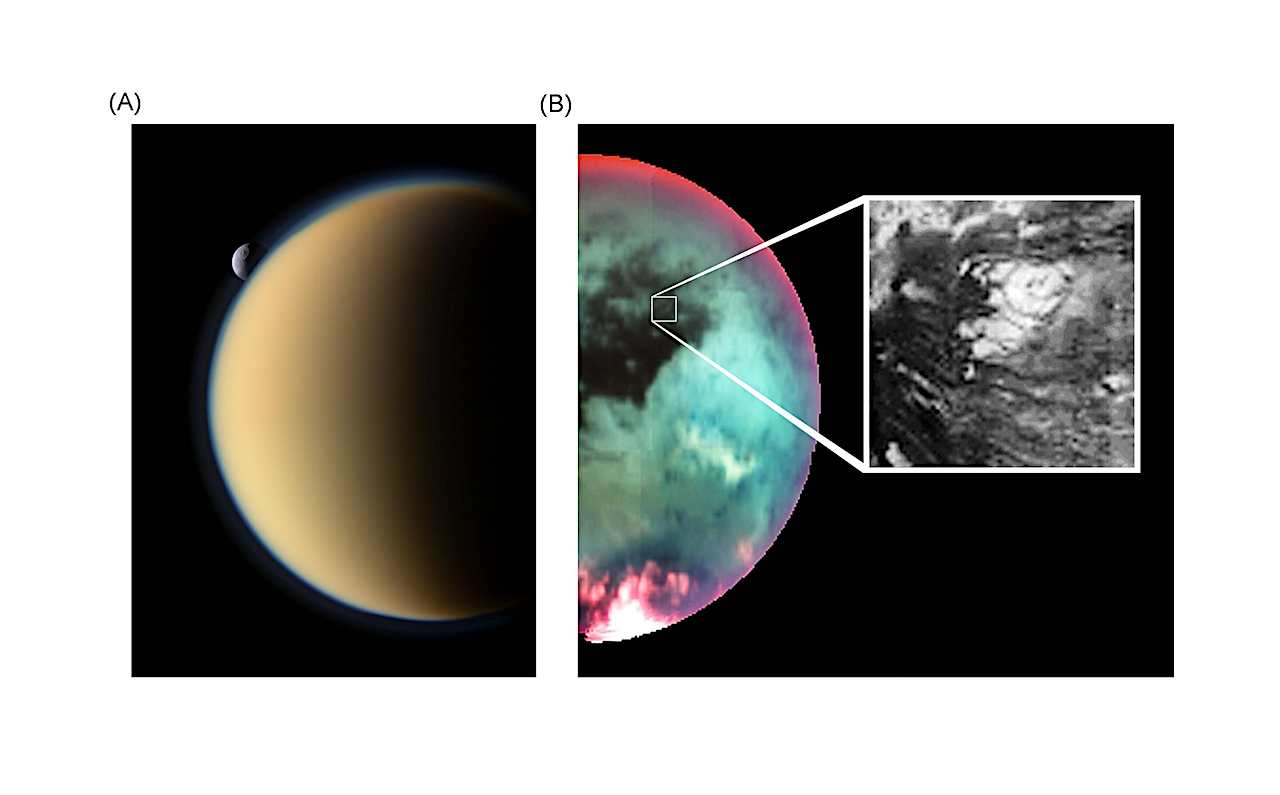

Titan is an abode of NH3. (A) Titan captured by the Cassini Imaging Science Subsystem. The thick atmosphere of Titan is visible by a haze across the surface and a lack of surface details. Saturn’s other moon, Tethys, is observed behind Titan. Image credits: NASA/JPL-Caltech/Space Science Institute. (B) False-colour mosaic of Titan obtained by the Visual and Infrared Mapping Spectrometer of Cassini. Colours correspond to atmospheric (red) and surface features (green and blue). The inset image indicates the possible occurrence of a cryovolcano on the surface. Cryovolcanic slurries of water, NH3, and methanol have been tentatively observed on the surface. Image credit: NASA/JPL/University of Arizona.
The search for life now extends beyond the traditional habitable zone to include the icy moons of Jupiter and Saturn. These moons feature ice-covered surfaces overlying substantial oceans formed primarily of liquid water and other potential constituents, such as ammonia.
On Earth, ammonia supports biochemistry at low concentrations by providing nitrogen but becomes disruptive at higher concentrations. Ammonia could therefore influence the habitability of extraterrestrial oceans, yet this topic has received limited attention in the literature.
This review synthesises current research on ammonia in Saturn’s icy moons, Enceladus and Titan, and its effects on terrestrial life. We summarize the celestial incorporation, speciation, and phase behaviour of ammonia and review data on its occurrence and concentration in icy moon oceans.
We examine the role of ammonia in prebiotic chemistry, biochemistry, and toxicity. Focusing on bacteria, we compare known survival limits in ammonia to estimated ammonia concentrations on Enceladus and Titan.
We find that bacterial survival limits exceed concentrations estimated on Enceladus, but are below those estimated on Titan, and propose that ammonia measurements are crucial for assessing extraterrestrial habitability.
Finally, we highlight outstanding knowledge gaps and challenges that influence our understanding of how ammonia shapes the potential for life beyond Earth.
Astrobiology,










Related Posts
Stay Informed With the Latest & Most Important News
Previous Post
Next Post

Advertisement
-
 01Two Black Holes Observed Circling Each Other for the First Time
 -
 02From Polymerization-Enabled Folding and Assembly to Chemical Evolution: Key Processes for Emergence of Functional Polymers in the Origin of Life
 -
 03Astronomy 101: From the Sun and Moon to Wormholes and Warp Drive, Key Theories, Discoveries, and Facts about the Universe (The Adams 101 Series)
 -
 04True Anomaly hires former York Space executive as chief operating officer
 -
 05Φsat-2 begins science phase for AI Earth images
 -
 06Hurricane forecasters are losing 3 key satellites ahead of peak storm season − a meteorologist explains why it matters
 -
 07Binary star systems are complex astronomical objects − a new AI approach could pin down their properties quickly