
Now Reading: PALEOS: Multiphase Equations of State and Mass-Radius Relations for Exoplanet Interiors
-
01
PALEOS: Multiphase Equations of State and Mass-Radius Relations for Exoplanet Interiors

PALEOS: Multiphase Equations of State and Mass-Radius Relations for Exoplanet Interiors

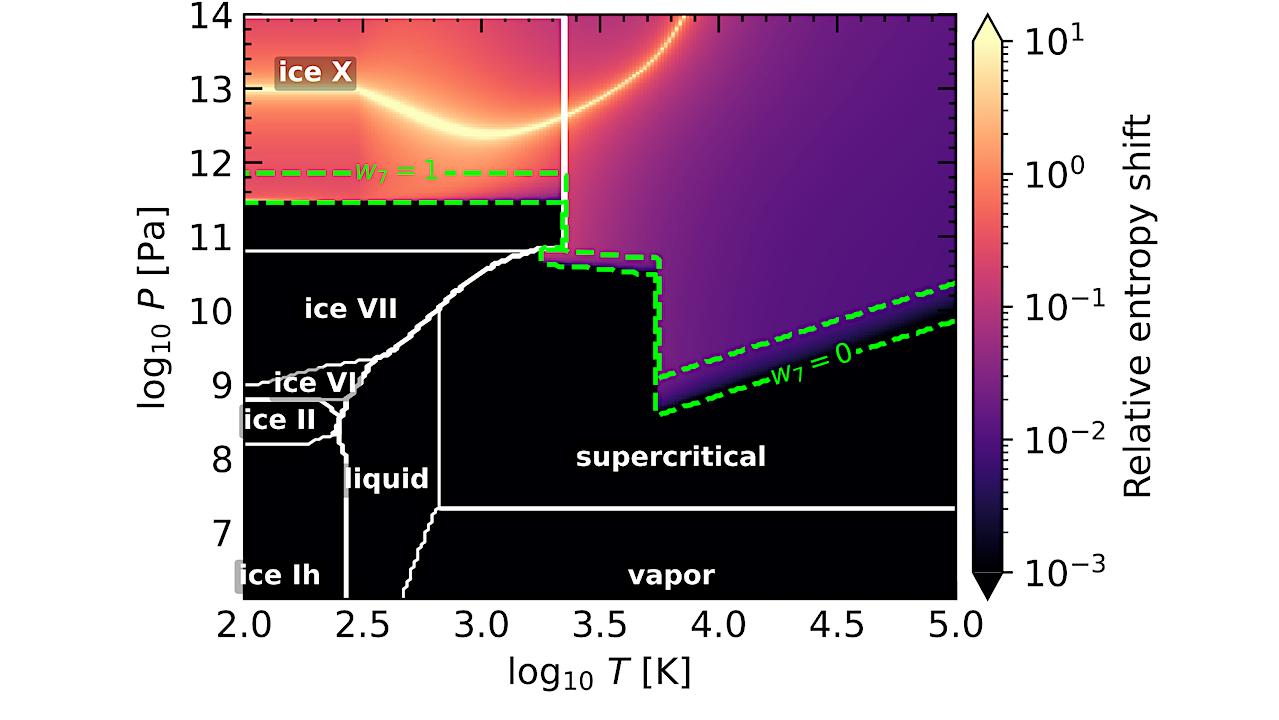
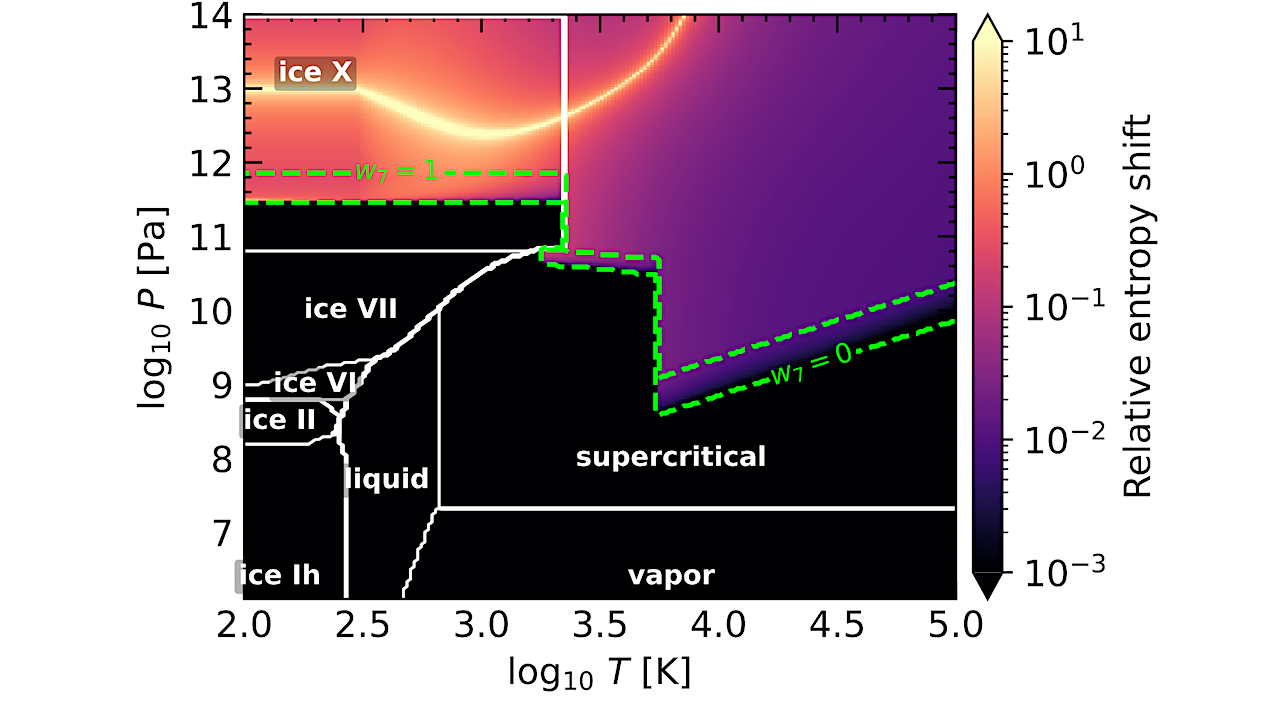
Relative entropy shift applied by the Mazevet et al. (2019) correction (Eq. (17)) across the water phase diagram in plog10 T, log10 Pq space. The colormap is logarithmic between 10´3 and 10, with the upper bound saturating along a narrow ridge where the aqua baseline entropy nearly vanishes. Solid white lines mark the phase boundaries of the underlying aqua table; labels identify the fields of ices, liquid, vapor, and supercritical water. Dashed lime contours with inline labels mark the analytic gate w7 that selects where the patch is applied: w7“0 outside the patch (no shift) and w7“1 inside its core (full correction). The figure shows that the correction is concentrated in a localized strip of the supercritical regime between ice X and the Brown (2018) fluid, leaving the rest of the aqua table untouched. — astro-ph.EP
Modeling the interior of a rocky or water-rich exoplanet is a thermodynamic closure problem: every layer’s density, temperature gradient, and phase must follow from an equation of state (EoS) that remains self-consistent across the pressure-temperature range from surface to core.
Existing EoS span disciplines, use different formalisms, and rarely supply the full thermodynamic quantities needed by evolutionary models of interior phase transitions. We present PALEOS (Planetary Assemblage Layers: Equations of State), an open-source toolkit consolidating EoS for iron, magnesium silicate (MgSiO3), and water (H2O) into a unified, phase-aware, thermally responsive framework spanning 17 phases.
PALEOS derives density, energy, entropy, heat capacities, thermal expansion, and the adiabatic gradient analytically via Maxwell relations, and is released as lookup tables on regular P-T grids.
We validate it against the Preliminary Reference Earth Model, recovering Earth’s radius to 0.3% and lower-mantle densities to 3%, and compute 17,900 mass-radius relations from 0.1 to 100 M⊕ for rocky (Fe + MgSiO3) and water-rich (Earth-like core + H2O envelope) compositions at 300-4000 K.
Continuous solid-to-melt EoS let thermal expansion span the fully-solid to magma-ocean regime: the radius offset exceeds 1% above 1500 K and reaches 16% at 4000 K for low-mass silicate planets, comparable to composition degeneracy and transit-radius uncertainties.
We demonstrate this on two ultrashort-period super-Earths, WASP-47 e and TOI-1807 b: each admits two purely rocky solutions indistinguishable in mass and radius but in radically different states, one fully solid with no dynamo, the other hosting a deep magma ocean and a liquid iron core capable of sustaining a magnetic field. Phase-aware, thermally resolved EoS are essential for translating astronomical observations into exoplanetary geophysics.
Mara Attia, Tim Lichtenberg, Ema Jungová, Mariana Sastre
Comments: Submitted for publication in A&A. Abstract abridged for arXiv
Subjects: Earth and Planetary Astrophysics (astro-ph.EP)
Cite as: arXiv:2605.03741 [astro-ph.EP] (or arXiv:2605.03741v1 [astro-ph.EP] for this version)
https://doi.org/10.48550/arXiv.2605.03741
Focus to learn more
Submission history
From: Mara Attia
[v1] Tue, 5 May 2026 13:28:21 UTC (265 KB)
https://arxiv.org/abs/2605.03741
Astrobiology, exoplanet,










Related Posts

Stay Informed With the Latest & Most Important News
Advertisement
-
 01Two Black Holes Observed Circling Each Other for the First Time
 -
 02From Polymerization-Enabled Folding and Assembly to Chemical Evolution: Key Processes for Emergence of Functional Polymers in the Origin of Life
 -
 03Astronomy 101: From the Sun and Moon to Wormholes and Warp Drive, Key Theories, Discoveries, and Facts about the Universe (The Adams 101 Series)
 -
 04True Anomaly hires former York Space executive as chief operating officer
 -
 05Φsat-2 begins science phase for AI Earth images
 -
 06Hurricane forecasters are losing 3 key satellites ahead of peak storm season − a meteorologist explains why it matters
 -
 07Binary star systems are complex astronomical objects − a new AI approach could pin down their properties quickly