
Now Reading: Early Life On Earth Relied On A Surprisingly Scarce Metal: Molybdenum
-
01
Early Life On Earth Relied On A Surprisingly Scarce Metal: Molybdenum


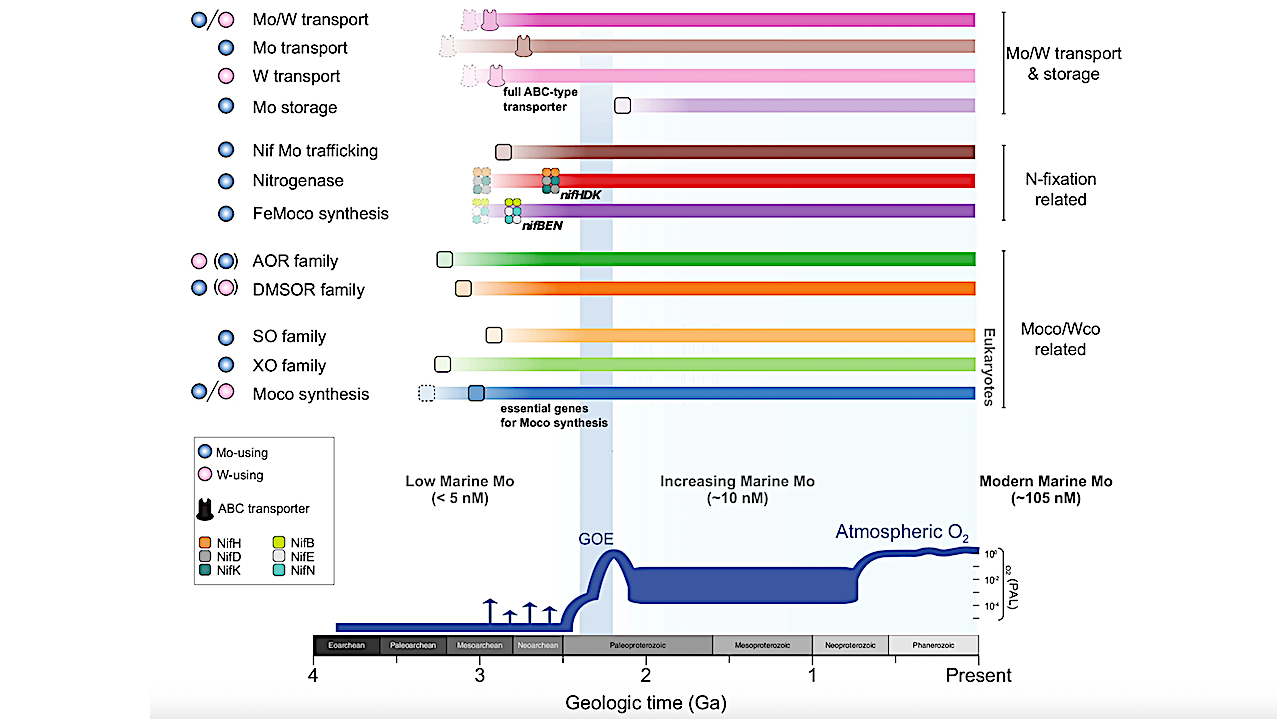
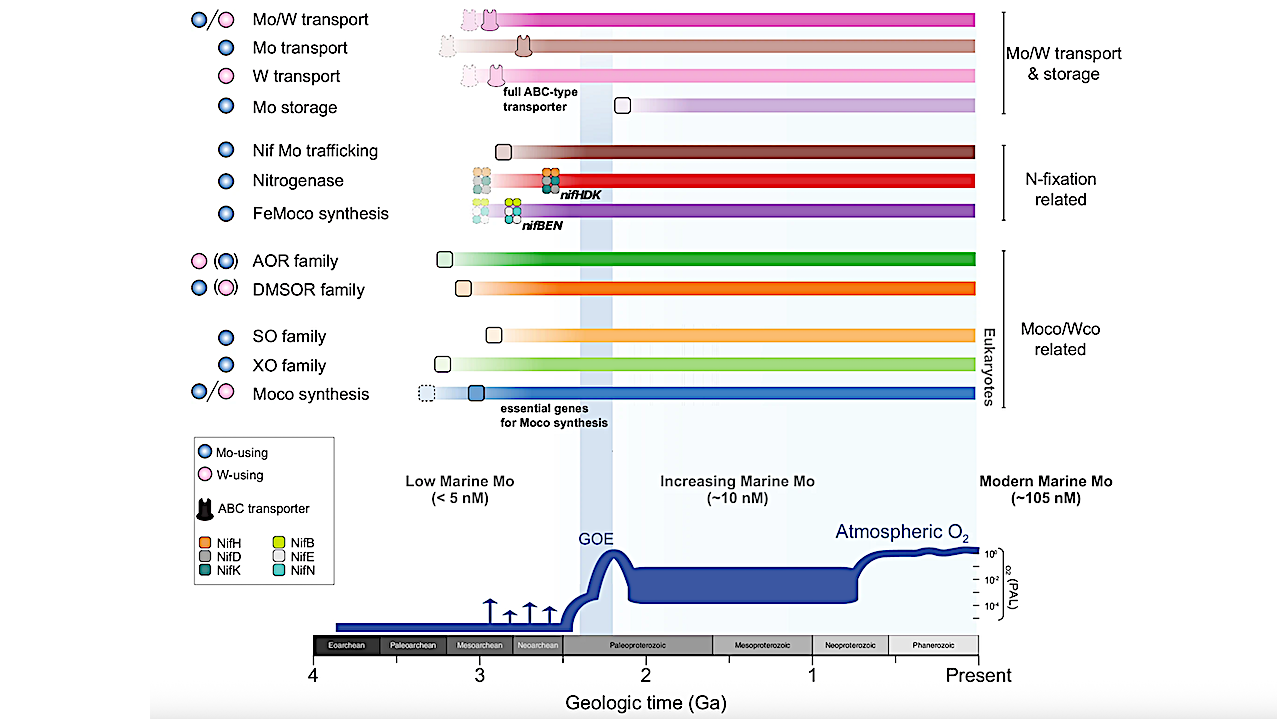
Shapes at the start of bars correspond to the midpoint date (or right node date for speciation events) of the earliest gene event recorded for genes within a given group. Events occurring on terminal branches were not considered here. For six groups, faded shapes at the start of bars distinguish the earliest gene event for a single gene within the group, while the second, darker shape corresponds to the earliest point by which all important genes within the group had a recorded gene event. These subgroups of important genes include: all three subunits encoding ABC-type Mo(/W) transporters (ModABC, TupABC, WtpABC), subunits essential for FeMoco synthesis (NifBEN) and nitrogenase activity (NifHDK), and 9 genes essential for Moco synthesis as described by Mendel & Leimkühler (2015)6. Dates were taken from reconciliation results using the CIR clock model with an HGT cost of 3 and should be interpreted as estimates for the earliest phylogenetic evidence of Mo/W-related genes per category. Results from the symmetric median reconciliation were used for all groups except “Moco synthesis” and “AOR family” groups, where random reconciliations were only available for the proteins with the earliest recorded gene events within these groups (see methods for further discussion). A plot showing changes in levels of atmospheric O2, adapted from Lyons et al. (2014)81 (see ref. in “Methods”) are shown at the bottom, alongside estimates for marine Mo concentrations derived from Johnson et al. (2021)14. The gray shading refers to the divergence of Eukaryotic Moco synthesis, XO family, and SO family genes after the evolution of Eukaryotes. Blue spheres represent Mo-usage, while pink spheres represent W-usage by proteins within each group. — Nature
A new study from researchers at the University of Wisconsin–Madison shows that 3.4 billion years ago, life on Earth relied on a metal called molybdenum, despite its limited availability at the time. Published in Nature Communications, the study is the first to trace molybdenum’s use this far back in time.
Molybdenum is a metal vital for many biochemical processes because it speeds up the rate of chemical reactions needed to perform those processes, such as nitrogen fixation. These reactions could still occur without the metal, but not fast enough to sustain life.
“What is kind of counterintuitive is that, according to the geochemical record, molybdenum abundance on the early Earth seems to have been a lot lower billions of years ago, particularly before the advent of oxygenic photosynthesis,” says Aya Klos, a PhD student in bacteriology at UW–Madison.
Yet for some reason, despite its limited availability, life continued to evolve using biochemical processes that rely on molybdenum. Those processes have been passed down to modern-day organisms.
For the study, the researchers also tracked molybdenum in cells to understand how it moves through and is used by them. The team plans to continue research aimed at understanding why life would continue to invest in molybdenum-reliant biochemical processes even when other, more plentiful elements were available.
They also traced back in time the use of tungsten, a metal that can act like molybdenum but is typically associated with modern organisms that live in extreme environments. The study suggests that life was already experimenting with both molybdenum and tungsten billions of years ago.
Betül Kaçar, a professor of bacteriology at UW–Madison and the senior author of the paper, explains that understanding which elements early life relied on can aid astrobiologists in identifying other planets that could potentially support life.
“This study shows that just because an element is scarce in the environment doesn’t mean life will not find a way to use it and even build an empire with it,” Kaçar says. “Life works in surprising ways. Discoveries like this remind us that the search for life beyond Earth may require us to imagine possibilities we haven’t yet considered.”
This research is supported by the NASA Interdisciplinary Consortium for Astrobiology Research: Metal Utilization and Selection Across Eons (80NSSC17K0296), a NASA Astrobiology Program Grant (80NSSC18KO82) and a NERC Frontiers grant (NE/V010824/1. Additional support was provided by the Paglia Post-Baccalaureate Research Fellowship from Carleton College and the NASA Postdoctoral Program, administered by Oak Ridge Associated Universities under contract with NASA.
Biological use of molybdenum and tungsten stems back to 3.4 billion years ago, Nature (open access)
Astrobiology,










Related Posts
Stay Informed With the Latest & Most Important News
Previous Post
Next Post






Advertisement
-
 01Two Black Holes Observed Circling Each Other for the First Time
 -
 02From Polymerization-Enabled Folding and Assembly to Chemical Evolution: Key Processes for Emergence of Functional Polymers in the Origin of Life
 -
 03Astronomy 101: From the Sun and Moon to Wormholes and Warp Drive, Key Theories, Discoveries, and Facts about the Universe (The Adams 101 Series)
 -
 04True Anomaly hires former York Space executive as chief operating officer
 -
 05Φsat-2 begins science phase for AI Earth images
 -
 06Hurricane forecasters are losing 3 key satellites ahead of peak storm season − a meteorologist explains why it matters
 -
 07Binary star systems are complex astronomical objects − a new AI approach could pin down their properties quickly