
Now Reading: Characterizing The Extended Molecular Hydrogen Winds In Protoplanetary Disks From The JWST Disk Infrared Spectroscopic Chemistry Survey
-
01
Characterizing The Extended Molecular Hydrogen Winds In Protoplanetary Disks From The JWST Disk Infrared Spectroscopic Chemistry Survey

Characterizing The Extended Molecular Hydrogen Winds In Protoplanetary Disks From The JWST Disk Infrared Spectroscopic Chemistry Survey

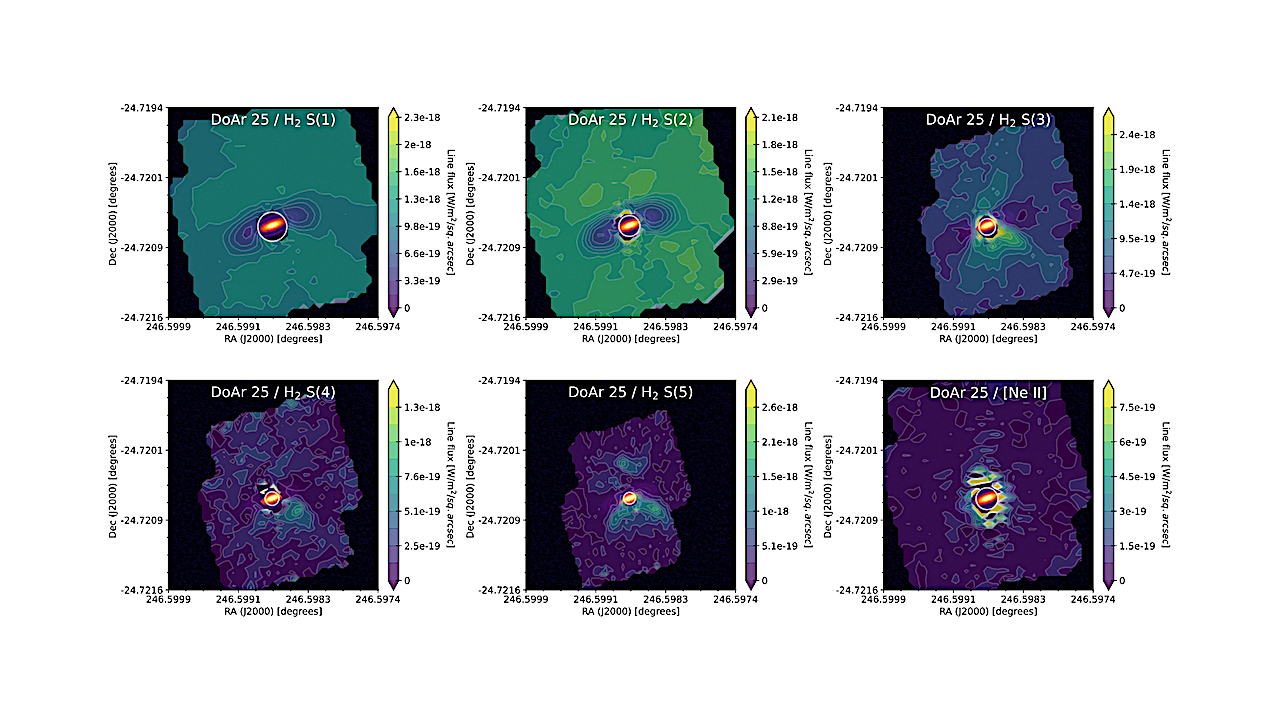

The H2 and [Ne II] emission detected towards DoAr 25 on top of the ALMA 240 GHz continuum emission (shown in the background as a reddish-yellow image). The white central circle shows the inner working angle from JWST. In this case, the disk itself is seen in absorption against line emission from the Ophiuchus PDR for H2 S(1)-S(3) (17.03-9.66 µm). — astro-ph.SR)
We present a comprehensive analysis of extended H2 emission from 34 protoplanetary disks observed with the JWST Disk Infrared Spectroscopic Chemistry Survey (JDISCS), supplemented by archival data.
We investigated the morphology, kinematics, excitation conditions, and mass dynamics of H2. Extended emission from pure rotational H2 lines is found to be common, with 16 sources exhibiting clear signatures of disk winds. These include monopolar and bipolar structures in inclined disks and ring-like or bubble-like morphologies in face-on systems features indicative of wide-angle disk winds.
Our analysis shows that the H2 is consistent with slow (4.2+6.7 −3.0 km s−1 ) MHD driven winds. For ten disks, we model the wind morphology and find a median half-opening angle of 45◦+5−4 and a characteristic power-law index of α ∼ 1.6. Excitation analysis yields a median gas temperature of 624 ± 130 K and a column density of log(Ntot[cm−2 ]) = 18.6 ± 0.6.
The median wind mass-loss rate, log10(M˙ totwind) = −9 +0.8 −0.4 M⊙ yr−1 , implies that, if molecular winds are the dominant mechanism responsible for disk dispersal, a typical disk with a mass of 2 − 3 MJup would dissipate on a ∼2-3 Myr timescale, consistent with observed disk lifetimes.
The M˙ tot wind span a relatively narrow range (∼2 dex) and do not correlate strongly with accretion rates onto the star, suggesting that the mass loss rate and the accretion rates are probing different timescales. Our findings demonstrate that spatially extended warm H2 emission is a widespread and reliable tracer of molecular disk winds in protoplanetary systems.
Mayank Narang, Klaus M. Pontoppidan, Colette Salyk, Nicole Arulanantham, Geoffrey A. Blake, Andrea Banzatti, Joan Najita, Ilaria Pascucci, Jane Huang, Sebastiaan Krijt, Karin Oberg, Giovanni Rosotti, Till Kaeufer, Emma Dahl, L. Ilsedore Cleeves, Ke Zhang, Joel Green
Comments: Accepted at ApJ. 52 pages, 7 main Figure, 2 Figure sets and 5 Tables
Subjects: Solar and Stellar Astrophysics (astro-ph.SR)
Cite as: arXiv:2605.07016 [astro-ph.SR] (or arXiv:2605.07016v1 [astro-ph.SR] for this version)
https://doi.org/10.48550/arXiv.2605.07016
Focus to learn more
Submission history
From: Mayank Narang
[v1] Thu, 7 May 2026 22:59:45 UTC (115,373 KB)
https://arxiv.org/abs/2605.07016
Astrobiology, astrochemistry,










Related Posts

Stay Informed With the Latest & Most Important News
Previous Post
Next Post



Advertisement
-
 01Two Black Holes Observed Circling Each Other for the First Time
 -
 02From Polymerization-Enabled Folding and Assembly to Chemical Evolution: Key Processes for Emergence of Functional Polymers in the Origin of Life
 -
 03Astronomy 101: From the Sun and Moon to Wormholes and Warp Drive, Key Theories, Discoveries, and Facts about the Universe (The Adams 101 Series)
 -
 04True Anomaly hires former York Space executive as chief operating officer
 -
 05Φsat-2 begins science phase for AI Earth images
 -
 06Hurricane forecasters are losing 3 key satellites ahead of peak storm season − a meteorologist explains why it matters
 -
 07Binary star systems are complex astronomical objects − a new AI approach could pin down their properties quickly