
Now Reading: Exploring TRAPPIST-1 Climate States With An Energy Balance Model
-
01
Exploring TRAPPIST-1 Climate States With An Energy Balance Model


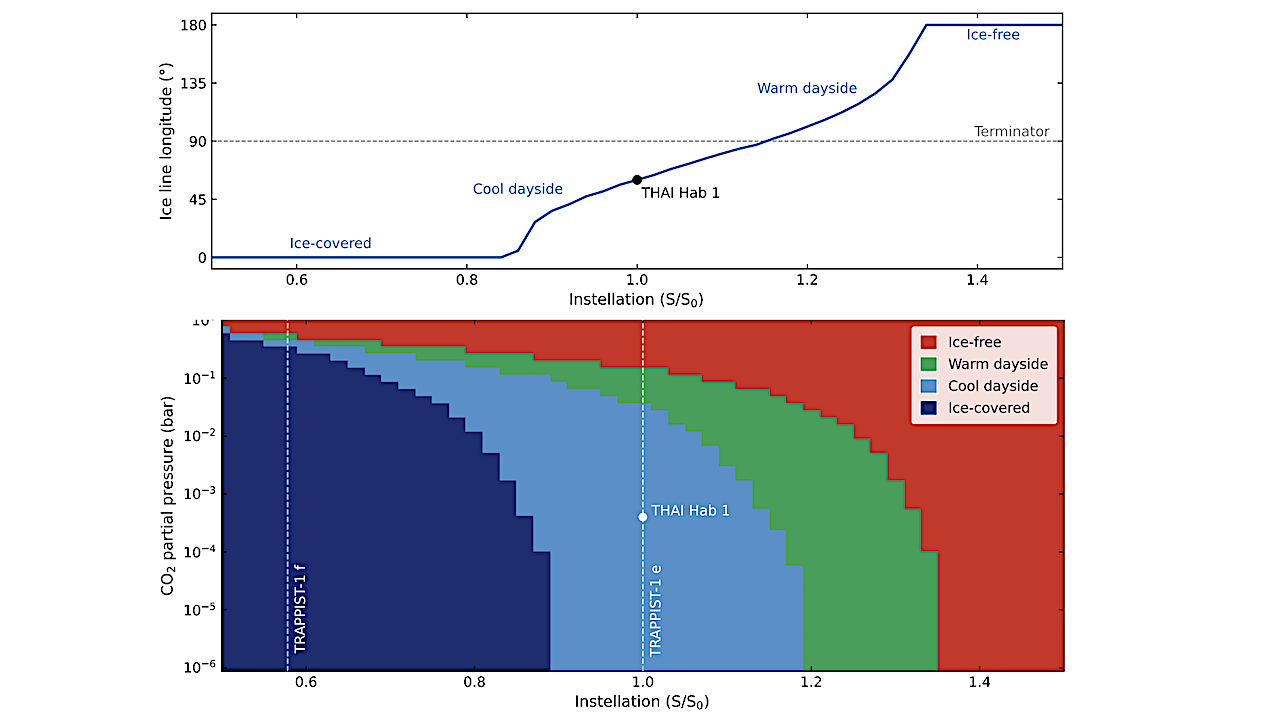

TOP Ice states for HEXTOR calculations based on the THAI Hab 1 configuration, which show smooth transitions from ice-covered to cool dayside to warm dayside to ice-free states as instellation increases. These results do not depend on the choice of initialization temperature. BOTTOM Ice states for HEXTOR calculations based on the THAI Hab 1 configuration, across a parameter space of instellation and CO2 partial pressure. — astro-ph.EP
This paper presents a version of the HEXTOR energy balance model that has been configured for the study of habitable terrestrial planets orbiting low-mass stars. The model is validated for rapidly-rotating Earth-like planets using latitudinal coordinates, which shows expected patterns of bistability.
A tidally-locked coordinate transformation is then applied to the model, which is calibrated to match mean values of the minimum, average, and maximum surface temperatures from a general circulation model ensemble of TRAPPIST-1 e. This calibrated energy balance model is used to characterize the possible climate states of such a synchronously rotating planet across a parameter space of instellation and carbon dioxide partial pressure.
These calculations suggest a state of partial ice cover for TRAPPIST-1 e and complete ice cover for TRAPPIST-1 f, unless carbon dioxide partial pressure is ~1 bar or greater. This approach demonstrates the capability of a simplified one-dimensional model to study the climates of terrestrial planets in synchronous rotation, which can help guide more complex models and observations toward the most promising targets of interest.
Jacob Haqq-Misra
Comments: Submitted to The Open Journal of Astrophysics
Subjects: Earth and Planetary Astrophysics (astro-ph.EP); Instrumentation and Methods for Astrophysics (astro-ph.IM)
Cite as: arXiv:2605.06964 [astro-ph.EP] (or arXiv:2605.06964v1 [astro-ph.EP] for this version)
https://doi.org/10.48550/arXiv.2605.06964
Focus to learn more
Submission history
From: Jacob Haqq-Misra
[v1] Thu, 7 May 2026 21:33:36 UTC (94 KB)
https://arxiv.org/abs/2605.06964
Astrobiology, exoplanet,










Related Posts
Stay Informed With the Latest & Most Important News


Advertisement
-
 01Two Black Holes Observed Circling Each Other for the First Time
 -
 02From Polymerization-Enabled Folding and Assembly to Chemical Evolution: Key Processes for Emergence of Functional Polymers in the Origin of Life
 -
 03Astronomy 101: From the Sun and Moon to Wormholes and Warp Drive, Key Theories, Discoveries, and Facts about the Universe (The Adams 101 Series)
 -
 04True Anomaly hires former York Space executive as chief operating officer
 -
 05Φsat-2 begins science phase for AI Earth images
 -
 06Hurricane forecasters are losing 3 key satellites ahead of peak storm season − a meteorologist explains why it matters
 -
 07Binary star systems are complex astronomical objects − a new AI approach could pin down their properties quickly