
Now Reading: Revisiting the Greenhouse Effect of Non-greenhouse Gases in the Atmospheres of Earth-like Planets
-
01
Revisiting the Greenhouse Effect of Non-greenhouse Gases in the Atmospheres of Earth-like Planets

Revisiting the Greenhouse Effect of Non-greenhouse Gases in the Atmospheres of Earth-like Planets

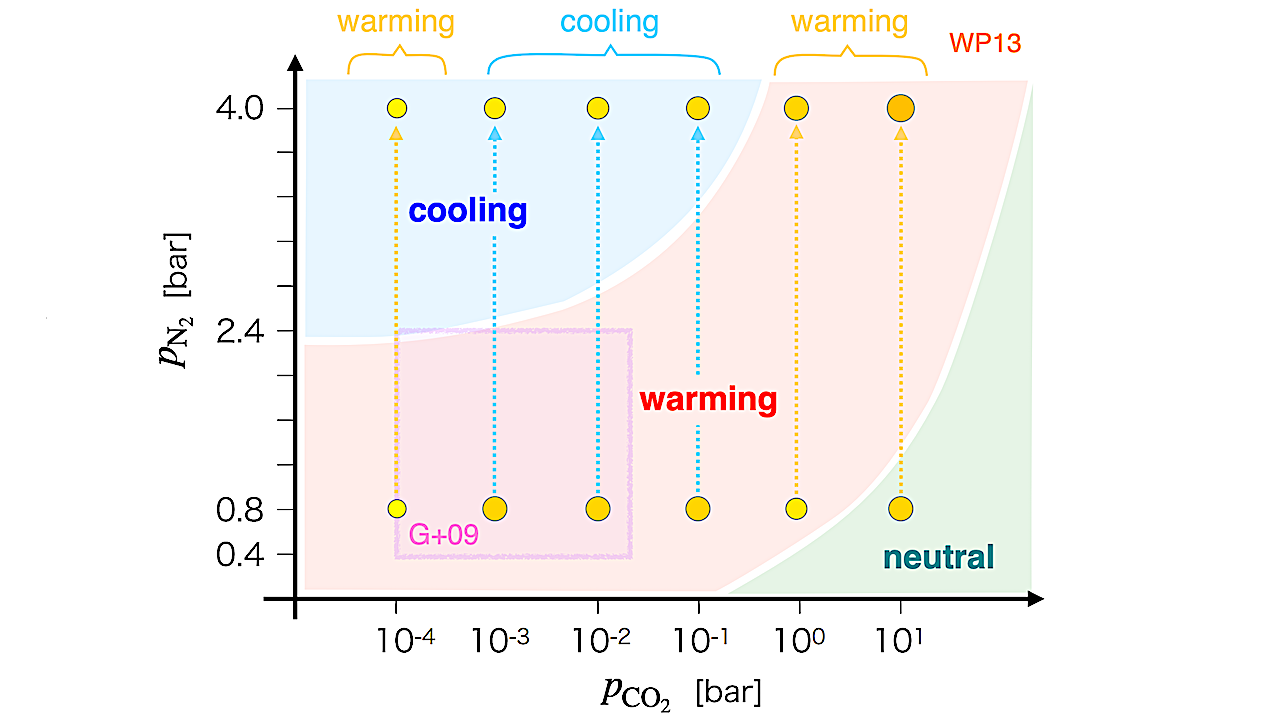
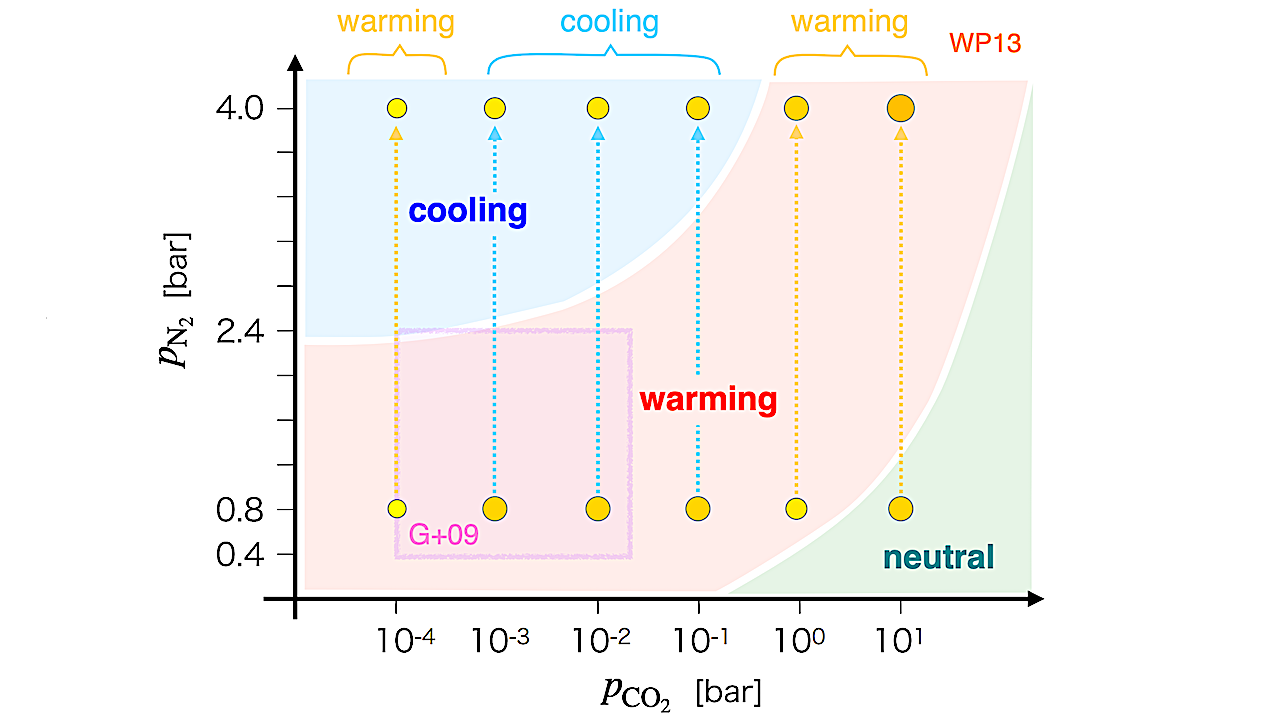
Schematic summary of the surface temperature response to increasing pN2 on the pCO2 –pN2 plane, comparing Goldblatt et al. (2009, G+09), Wordsworth & Pierrehumbert (2013, WP13), and this work. For Goldblatt et al. (2009), the pink shaded region denotes the parameter range they explored, within which all cases show warming as pN2 increases. For Wordsworth & Pierrehumbert (2013), circles mark the parameter sets shown in their Figure 14a, and the annotation at the top summarizes their reported response. Circle size and color qualitatively indicate the surface temperature, with larger circles and warmer colors corresponding to higher temperatures. In Wordsworth & Pierrehumbert (2013), the sign of the response is inferred from the two data points connected by arrows, which indicate the direction of increasing pN2 . Background shading shows the approximate regimes obtained in this work, namely cooling, warming, and neutral surface-temperature response to increasing pN2. — astro-ph.EP
Although non-greenhouse gases can vary substantially in abundance in Earth-like atmospheres, their climatic influences remain insufficiently understood.
To investigate how such gases regulate climate, we vary the abundance of N2 as a representative non-greenhouse component in one-dimensional N2–CO2–H2O model atmospheres. Beyond pressure broadening of absorption lines and Rayleigh scattering emphasized in previous studies, our results show that changes in background N2 pressure influence climate by modifying the amount of atmospheric H2O, producing two effects: altering the thermodynamic lapse rate (H2O-dilute warming) and changing the radiative contribution of H2O to the greenhouse effect (H2O-load warming).
The resulting climate response to increasing N2 depends on the CO2 abundance. Under low CO2 conditions, dilution of atmospheric H2O leads to warming, whereas under high CO2 conditions, increased H2O loading also produces warming.
At sufficiently high N2 abundances, Rayleigh scattering induces cooling, an effect further amplified by the accompanying decrease in atmospheric H2O. Under high CO2 conditions, however, enhanced H2O loading increases the absorption of stellar radiation and overwhelms the contribution of Rayleigh scattering, causing the cooling response to disappear.
These results reveal multiple physical pathways through which non-greenhouse gases influence climate and provide a framework for understanding climate responses and habitability in diverse Earth-like atmospheres.
Tetsuo Taki, Hiroyuki Kurokawa, Yuka Fujii, Kosuke Aoki
Comments: 15 pages, 5 figures, accepted for publication in the Astrophysical Journal
Subjects: Earth and Planetary Astrophysics (astro-ph.EP)
Cite as: arXiv:2605.10757 [astro-ph.EP] (or arXiv:2605.10757v1 [astro-ph.EP] for this version)
https://doi.org/10.48550/arXiv.2605.10757
Focus to learn more
Submission history
From: Tetsuo Taki
[v1] Mon, 11 May 2026 15:55:19 UTC (769 KB)
https://arxiv.org/abs/2605.10757
Astrobiology, Atmosphere,










Related Posts

Stay Informed With the Latest & Most Important News
Previous Post
Next Post



Advertisement
-
 01Two Black Holes Observed Circling Each Other for the First Time
 -
 02From Polymerization-Enabled Folding and Assembly to Chemical Evolution: Key Processes for Emergence of Functional Polymers in the Origin of Life
 -
 03Astronomy 101: From the Sun and Moon to Wormholes and Warp Drive, Key Theories, Discoveries, and Facts about the Universe (The Adams 101 Series)
 -
 04True Anomaly hires former York Space executive as chief operating officer
 -
 05Φsat-2 begins science phase for AI Earth images
 -
 06Hurricane forecasters are losing 3 key satellites ahead of peak storm season − a meteorologist explains why it matters
 -
 07Binary star systems are complex astronomical objects − a new AI approach could pin down their properties quickly