
Now Reading: AST SpaceMobile may use ULA’s Vulcan
-
01
AST SpaceMobile may use ULA’s Vulcan


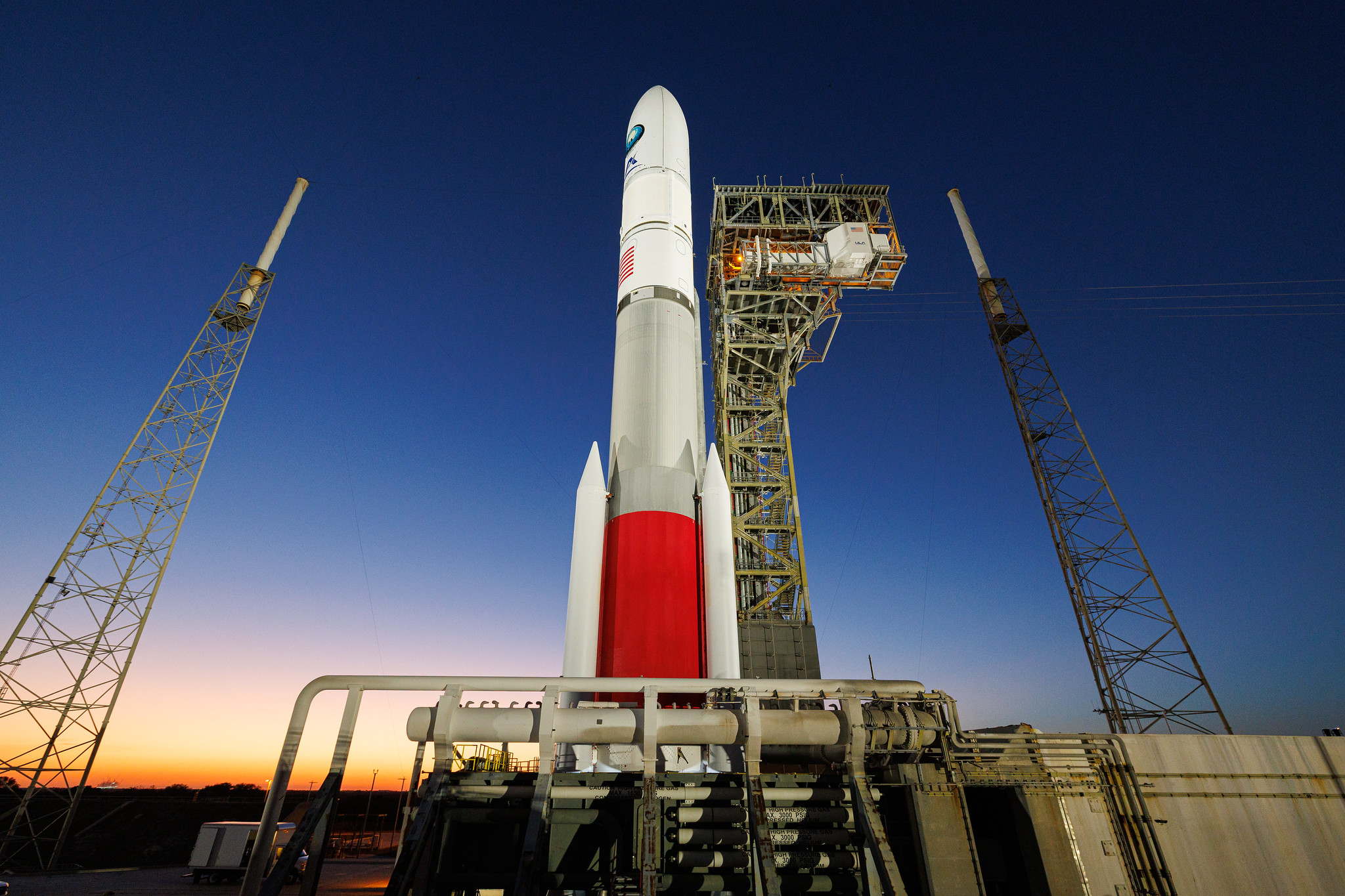

WASHINGTON — AST SpaceMobile may launch some of its direct-to-device satellites on United Launch Alliance’s Vulcan rocket to expand the launch options for its constellation.
In a May 11 earnings call, Abel Avellan, chairman and chief executive of AST SpaceMobile, mentioned Vulcan alongside other rockets the company is planning to use to launch its satellites.
“The way that we stack the satellites is like tuna cans where you put three of them, one on top of another, on the Falcon 9, up to eight of them on the Blue Origin New Glenn rocket or up to five of them on Vulcan,” he said in response to a question on satellite manufacturing.
While AST SpaceMobile has contracts with both Blue Origin and SpaceX, neither it nor ULA has announced a launch contract involving the companies. Asked about this later in the call, company executives declined to confirm whether it has a launch contract with ULA.
“Our strategy has always been to have many launch providers, and I would put ULA in that category,” said Scott Wisniewski, AST’s chief strategy officer. “We have been developing other heavy launch providers for some time, and we will have more updates as appropriate. But right now, we plan to use Blue Origin and SpaceX and equivalents to the max.”
AST SpaceMobile said it is retaining a goal of having 45 satellites in orbit by the end of the year despite the loss of its BlueBird 7 satellite on a New Glenn launch April 19. A problem during the second burn of the rocket’s upper stage left the satellite in a low orbit, and the spacecraft’s electric propulsion was insufficient to compensate.
“We do have contracted launch capacity to meet our target for 2026,” Wisniewski said. “The way to think about it is basically a handful of Blue Origin launches and a handful of SpaceX-equivalent launches, and that is what gets us to approximately 45.” He did not define what a “SpaceX-equivalent” launch might include.
With New Glenn launches on hold because of the investigation into the April failure, the next launch of AST SpaceMobile satellites will be in mid-June, with a Falcon 9 carrying BlueBirds 8, 9 and 10.
Wisniewski said he expected New Glenn launches would resume soon. “An upper-stage anomaly like this is not uncommon early in programs, and we feel optimistic about them getting back to the pad soon,” he said. Blue Origin has not provided any recent updates on the investigation or its return-to-flight plans.
He added that the next New Glenn launch for AST SpaceMobile would carry four satellites, which he said is linked to the company’s confidence in stacking multiple satellites on a single vehicle.
One challenge for AST’s use of Vulcan is that vehicle is also grounded after an anomaly with one of its solid rocket boosters, or SRBs, during a February launch of a U.S. Space Force mission. While the launch was ultimately successful, ULA has paused launches of Vulcan while investigating the issue.
In a May 11 update, ULA said it is beginning stacking of the Vulcan rocket for its next flight even as the investigation continues.
“While the SRB anomaly investigation continues from the previous Vulcan launch, stacking the vehicle and new low Earth orbit-optimized 85K Centaur upper stage allows the team to conduct these first-time operations, test the systems and ground support equipment and rollout to the pad for a wet dress rehearsal to be ready for launch once the investigation concludes,” the company stated.
The customer for that launch is Amazon, which signed a contract for 38 Vulcan launches to deploy much of its Amazon Leo constellation. That contract, along with a backlog of U.S. Space Force missions, may make it difficult for AST SpaceMobile or other customers to secure many near-term launches of Vulcan.










Related Posts
Stay Informed With the Latest & Most Important News
Previous Post
Next Post


Advertisement
-
 01Two Black Holes Observed Circling Each Other for the First Time
 -
 02From Polymerization-Enabled Folding and Assembly to Chemical Evolution: Key Processes for Emergence of Functional Polymers in the Origin of Life
 -
 03Astronomy 101: From the Sun and Moon to Wormholes and Warp Drive, Key Theories, Discoveries, and Facts about the Universe (The Adams 101 Series)
 -
 04True Anomaly hires former York Space executive as chief operating officer
 -
 05Φsat-2 begins science phase for AI Earth images
 -
 06Hurricane forecasters are losing 3 key satellites ahead of peak storm season − a meteorologist explains why it matters
 -
 07Binary star systems are complex astronomical objects − a new AI approach could pin down their properties quickly