
Now Reading: House appropriators approve spending bill that keeps NASA budget flat
-
01
House appropriators approve spending bill that keeps NASA budget flat


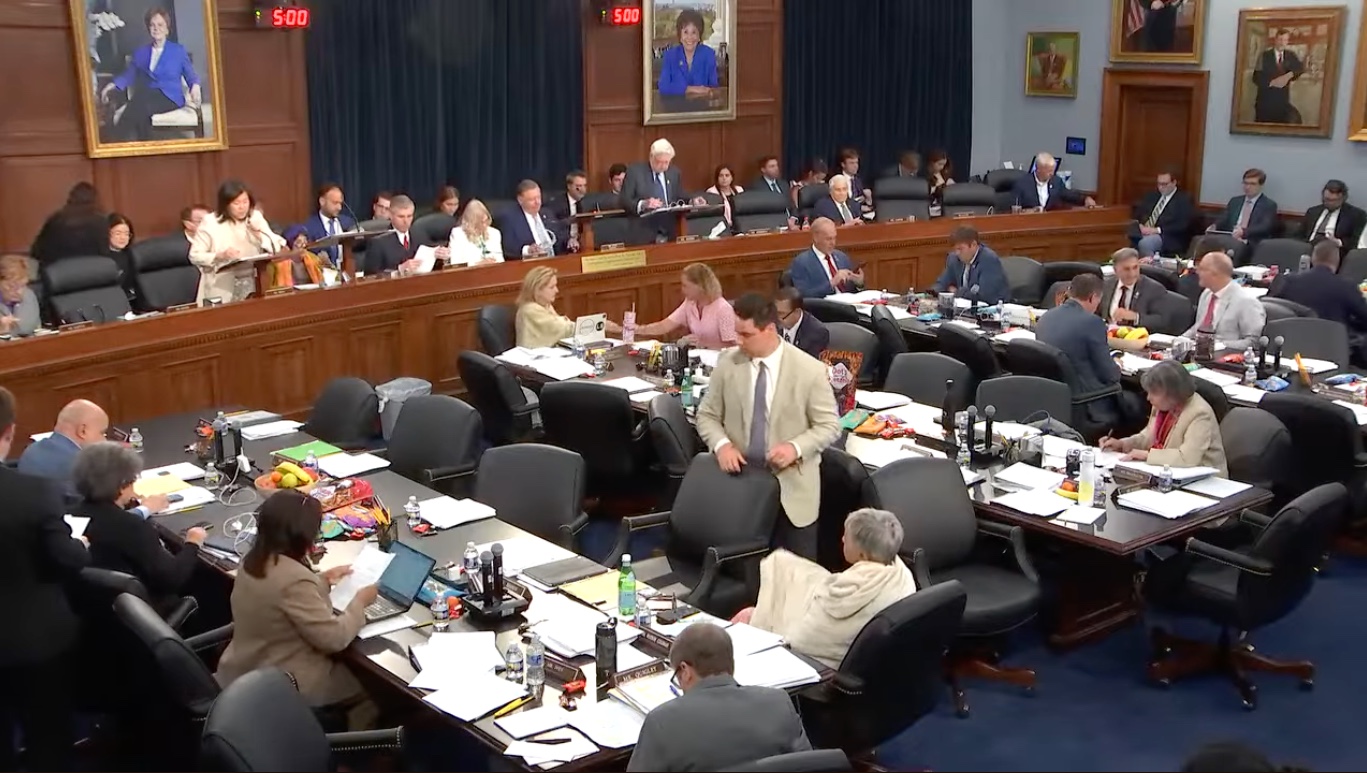

WASHINGTON — The House Appropriations Committee advanced a spending bill May 13 that rejects many of the cuts to NASA proposed by the administration.
The committee voted 32-28 along party lines to send the commerce, justice and science (CJS) appropriations bill to the full House. The vote came at the end of a nine-hour markup session that saw little discussion of the portions of the bill that fund NASA, NOAA and the National Science Foundation.
“The fiscal 2027 bill maintains strong funding for NASA to ensure America remains the leader in space exploration,” said Rep. Hal Rogers, R-Ky., chairman of the CJS appropriations subcommittee, in an opening statement. “This bill sets NASA on a path to return American astronauts to the moon before China and ensures America maintains the competitive edge and advantage.”
The bill, which the CJS subcommittee approved April 30, provides $24.438 billion for NASA in 2027, the same level the agency received in 2026. NASA’s 2027 budget proposal released April 3 proposed a 23% cut to $18.829 billion.
The House bill, though, does not restore funding levels to 2026 for all of its major programs. Exploration gets a $1.1 billion increase compared with 2026, but science funding would be cut by $1.25 billion. That science cut, though, is far smaller than the agency’s proposal, which sought a nearly 50% reduction.
Just before the markup, the committee released the report accompanying the bill, which provides additional details on how the funding would be allocated. In science, the reduced funding would be concentrated in Earth science, with a cut of nearly 40% from 2026 levels. There are smaller reductions in astrophysics and heliophysics, while planetary science remains roughly level.
The report calls on NASA to continue several missions that had been proposed for cancellation in the budget proposal, including the Juno spacecraft at Jupiter, the New Horizons mission in the Kuiper Belt and the OSIRIS-APEX mission to visit the asteroid Apophis. It also calls for continued operation of the Chandra and Fermi observatories and development of the Ultrasat and Ultraviolet Explorer, or UVEX, astrophysics missions.
In space technology, the report directs NASA to spend $110 million on nuclear thermal propulsion, even as the agency is planning a nuclear electric propulsion demonstration mission, SR-1 Freedom. Nuclear electric propulsion would get $50 million, with an additional $5 million allocated to fusion propulsion.
The report includes at least $20 million, and as much as $60 million, for CAPSTONE 02, a smallsat mission it says will “mature rendezvous and proximity operations capabilities in multibody cislunar orbits.” CAPSTONE 02 was briefly mentioned in NASA’s 2027 budget proposal, but the agency has provided few details about it.
For Artemis, the report allocates $2.6 billion for the Space Launch System, more than a billion dollars above the agency’s request, although about $1 billion of that funding is from last year’s budget reconciliation bill. The report prohibits NASA from reallocating SLS funding “until a commercial alternative is proven to meet or exceed the capabilities provided by the SLS and Orion system.”
The committee, though, strongly endorsed NASA’s planned changes to Artemis, including establishing a lunar base and increasing the cadence of lunar landing missions. The report includes $448.1 million for the Commercial Lunar Payload Services program and $1 billion for the program developing lunar spacesuits and rovers.
The report calls on NASA to maintain “at least the same cadence of flights” to the International Space Station in 2027 as it plans for 2026, after cuts the agency proposed would reduce the number of missions there.
The committee included $400 million in the report for NASA’s Commercial Low Earth Orbit Destinations, or CLD, program for future commercial space stations. In a manager’s amendment approved during the markup session, the committee noted NASA’s proposed changes to CLD, including the proposed procurement of a “core module” for the ISS that commercial modules could dock to, and called for regular briefings on those plans.
That manager’s amendment also included a provision ensuring that the Habitable Worlds Observatory space telescope is funded at no less than 2026 levels of $150 million. The 2027 budget proposal sought just $5 million for the mission.










Related Posts
Stay Informed With the Latest & Most Important News
Previous Post
Next Post


Advertisement
-
 01Two Black Holes Observed Circling Each Other for the First Time
 -
 02From Polymerization-Enabled Folding and Assembly to Chemical Evolution: Key Processes for Emergence of Functional Polymers in the Origin of Life
 -
 03Astronomy 101: From the Sun and Moon to Wormholes and Warp Drive, Key Theories, Discoveries, and Facts about the Universe (The Adams 101 Series)
 -
 04True Anomaly hires former York Space executive as chief operating officer
 -
 05Φsat-2 begins science phase for AI Earth images
 -
 06Hurricane forecasters are losing 3 key satellites ahead of peak storm season − a meteorologist explains why it matters
 -
 07Binary star systems are complex astronomical objects − a new AI approach could pin down their properties quickly