
Now Reading: The Influence of Aliphatic Components on the Aromatic Emission Characteristics of Polycyclic Aromatic Hydrocarbons
-
01
The Influence of Aliphatic Components on the Aromatic Emission Characteristics of Polycyclic Aromatic Hydrocarbons

The Influence of Aliphatic Components on the Aromatic Emission Characteristics of Polycyclic Aromatic Hydrocarbons

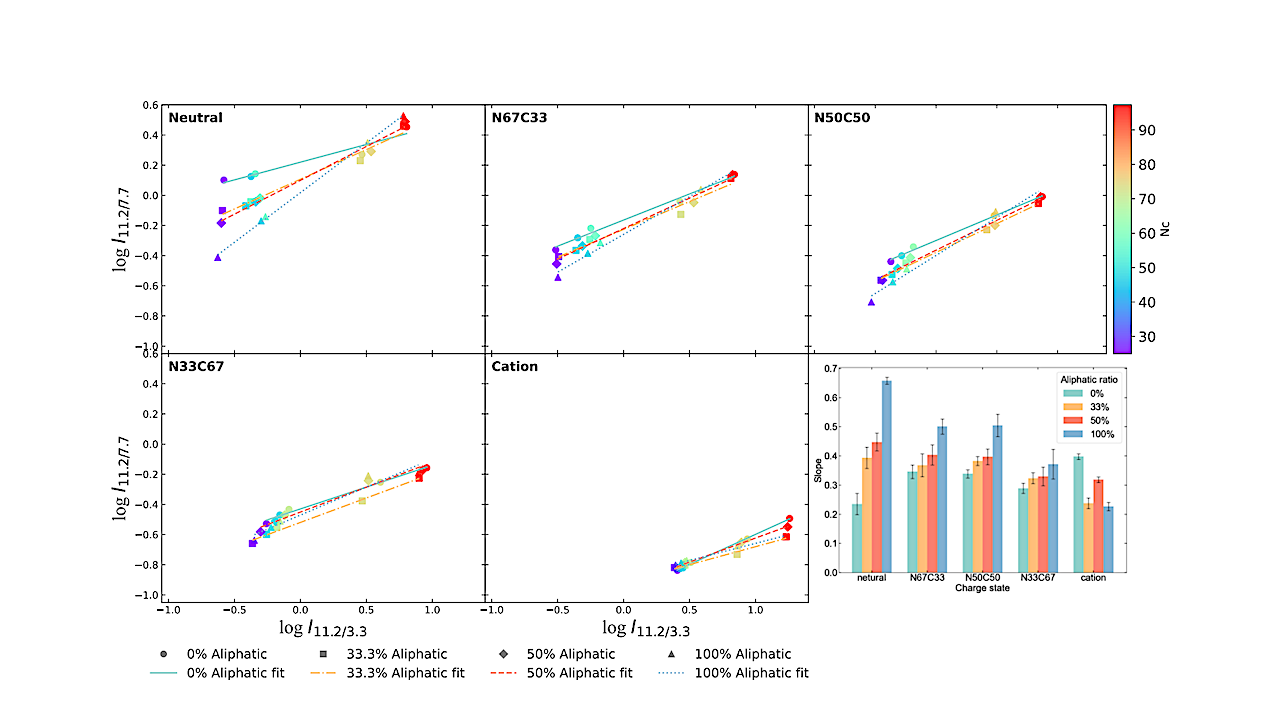
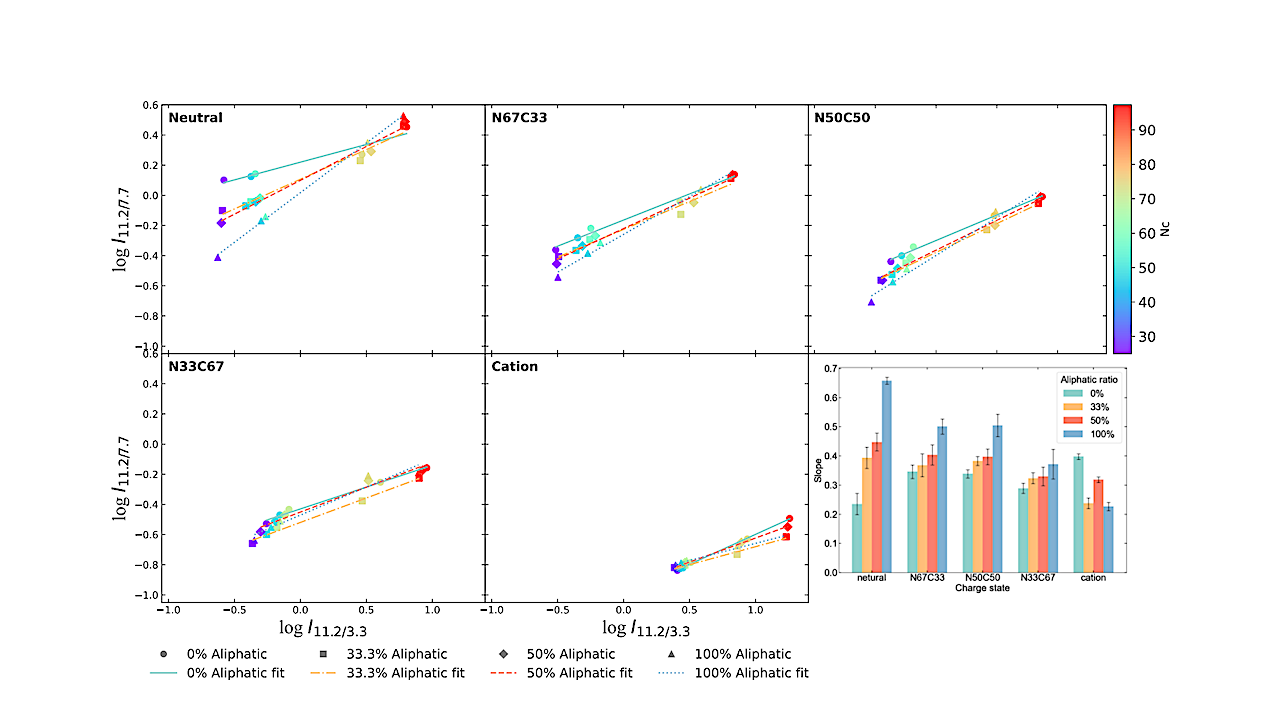
Diagnostic band ratio diagrams extracted from the PAH diagnostic grids (Figure 4), illustrating the influence of varying aliphatic content (0%, 33.3%, 50%, and 100%) at five fixed ionization fractions (Neutral, N67C33, N50C50, N33C67, and Cation). Each panel presents data points representing individual PAH species or mixtures color-coded by their number of carbon atoms (Nc). Linear fits (solid and dashed lines) connect points within each ionization fraction to quantify trends in diagnostic ratios with increasing aliphatic content. The bottom-right panel summarizes these trends by showing the slope distribution histogram of the linear fits across different ionization states, highlighting the systematic increase in slope with aliphatic fraction for all cases except the fully ionized state. — astro-ph.GA
Intensity ratios of aromatic emission features are widely used to diagnose the size and ionization state of polycyclic aromatic hydrocarbons (PAHs) in astronomical environments.
However, PAHs are known to typically carry aliphatic side chains, a structural feature that may compromise the reliability of traditional diagnostic methods. This study systematically investigates the effects of aliphatic components on the aromatic emission properties of PAHs.
Based on theoretical data from the NASA Ames PAH IR Spectroscopic Database, we compare the emission behavior of purely aromatic PAHs with those containing aliphatic substituents, revealing that aliphatic functionalization may modify the intensity ratio of the 11.2 μm band relative to the 7.7 μm and 3.3 μm bands.
This potentially leads to misidentification of their ionization state if molecular structural effects are neglected. Further analysis indicates that the impact of aliphatic components on diagnostic band ratios strongly depends on PAH size: small PAHs exhibit significant emission ratio shifts, deviating from traditional size/ionization trends, while larger PAHs are minimally affected.
Despite these shifts, the classic (I11.2/7.7) versus (I11.2/3.3) diagnostic grid remains largely applicable to mixed aromatic-aliphatic PAHs, although some systematic calibration may be needed.
Our findings emphasize the necessity for caution when interpreting PAH band ratios in aliphatic-rich environments, as variations in PAH molecular composition may distort inferences about physical conditions.
Zhuang Zhang, Yong Zhang
Comments: 17 pages, 11 figures, Accepted for publication in MNRAS
Subjects: Astrophysics of Galaxies (astro-ph.GA); Solar and Stellar Astrophysics (astro-ph.SR)
Cite as: arXiv:2605.10030 [astro-ph.GA] (or arXiv:2605.10030v1 [astro-ph.GA] for this version)
https://doi.org/10.48550/arXiv.2605.10030
Focus to learn more
Related DOI:
https://doi.org/10.1093/mnras/stag751
Focus to learn more
Submission history
From: Zhuang Zhang
[v1] Mon, 11 May 2026 05:56:08 UTC (449 KB)
https://arxiv.org/abs/2605.10030
Astrobiology, Astrochemistry,










Related Posts

Stay Informed With the Latest & Most Important News
Previous Post
Next Post




Advertisement
-
 01Two Black Holes Observed Circling Each Other for the First Time
 -
 02From Polymerization-Enabled Folding and Assembly to Chemical Evolution: Key Processes for Emergence of Functional Polymers in the Origin of Life
 -
 03Astronomy 101: From the Sun and Moon to Wormholes and Warp Drive, Key Theories, Discoveries, and Facts about the Universe (The Adams 101 Series)
 -
 04True Anomaly hires former York Space executive as chief operating officer
 -
 05Φsat-2 begins science phase for AI Earth images
 -
 06Hurricane forecasters are losing 3 key satellites ahead of peak storm season − a meteorologist explains why it matters
 -
 07Binary star systems are complex astronomical objects − a new AI approach could pin down their properties quickly