
Now Reading: Coupling Magma-ocean And Atmospheres In Spectral Retrievals Of Sub-Neptunes
-
01
Coupling Magma-ocean And Atmospheres In Spectral Retrievals Of Sub-Neptunes


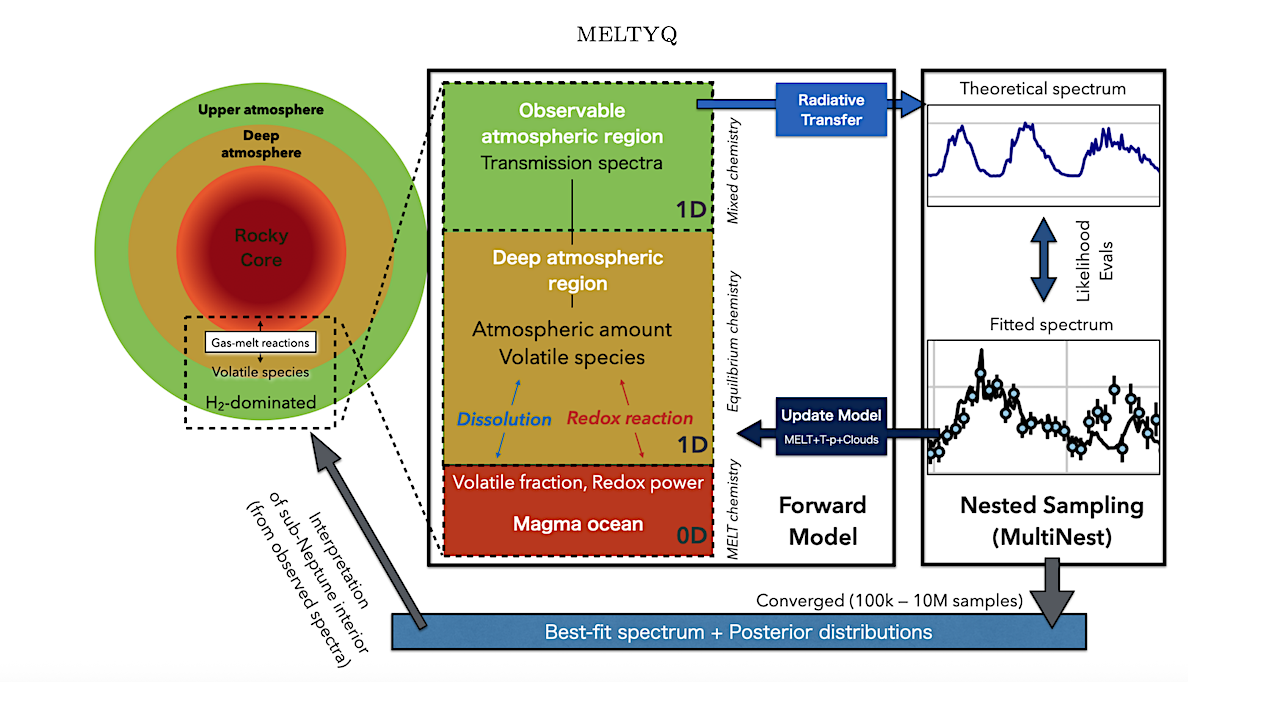
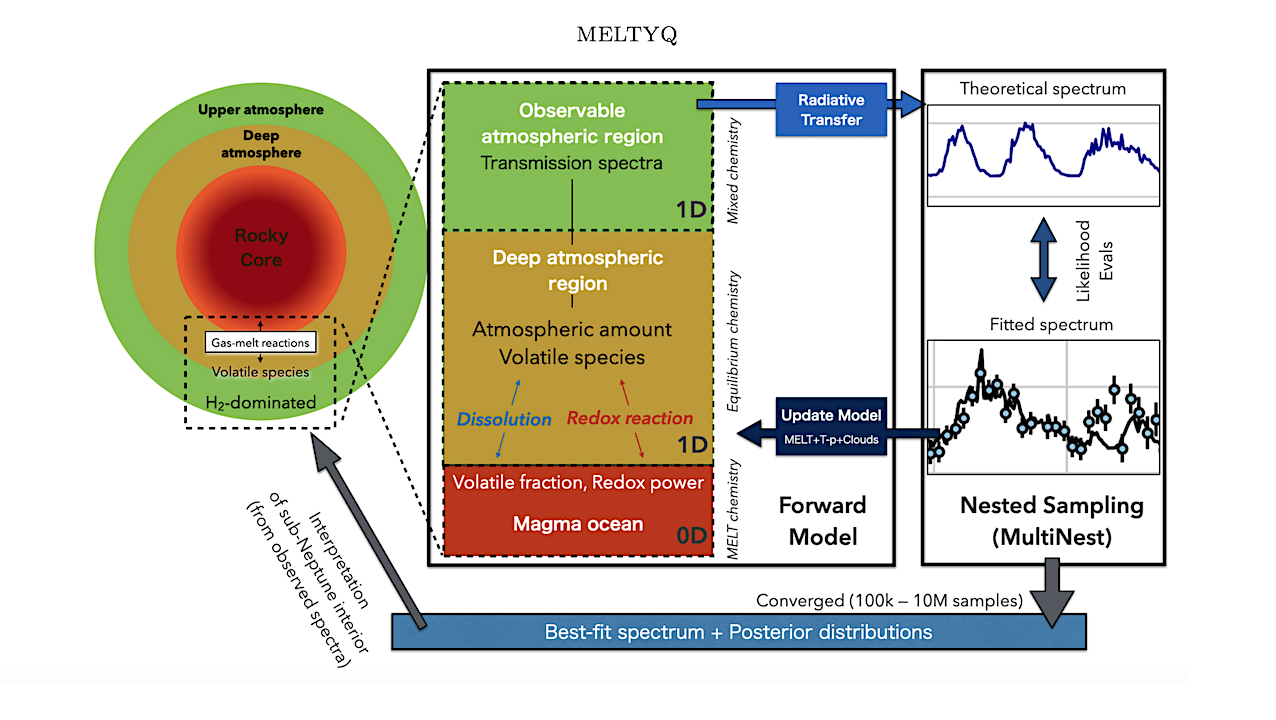
Schematics of the MELTYQ coupled magma-atmosphere retrieval. The model is valid for sub-Neptune hosting a thick H2-rich atmosphere with enough surface temperature to melt rocks. The model splits the planet in three regions: a rocky core, a deep atmosphere, and an upper atmosphere. The chemistry is coupled allowing to retrieve the composition of the rocky magma via it’s influence on the observable atmosphere. — astro-ph.EP
Recent high-precision atmospheric observations with JWST is enabling detailed characterization of sub-Neptune atmospheres and motivating efforts to understand and constrain their interiors.
Theoretical studies suggest that sub-Neptunes possibly host hydrogen-dominated atmospheres that are chemically coupled with an underlying magma ocean. However, a quantitative retrieval framework directly linking atmospheric spectra to magma ocean properties has yet to be established. Here we introduce MELTYQ, a coupled magma-atmosphere retrieval framework that links transmission spectra to the oxidation state and volatile inventory of underlying magma oceans.
MELTYQ combines a magma-atmosphere equilibrium model, which includes the solubility of H-/O-/C-/N-bearing species in the melt and redox reactions, with a Bayesian spectral retrieval scheme. Using simulated retrieval tests, we validate the approach and show that magma redox state and volatile content can be constrained under favorable observational conditions.
As a proof of concept, we apply MELTYQ to JWST transmission spectra of the benchmark sub-Neptunes K2-18 b and TOI-270 d. We find that coupled magma-atmosphere retrievals are generally capable of reproducing the observed spectra of these planets. However, we identify several key limitations in the current framework. Specifically: more flexible free-retrieval approaches remain statistically preferred; the CO/CO2 absorption feature near 4.5 μm for TOI-270 d is not fully captured; and a number of underlying model assumptions may not be strictly valid.
Nevertheless, embedding coupled magma-atmosphere models directly within Bayesian retrievals enables quantitative assessment of degeneracies and sensitivities, establishing a pathway for directly connecting atmospheric spectra to magma composition in this underexplored exoplanet regime.
Yuichi Ito, Quentin Changeat
Comments: 22 pages, 9 figures, accepted in ApJ
Subjects: Earth and Planetary Astrophysics (astro-ph.EP)
Cite as: arXiv:2605.08752 [astro-ph.EP](or arXiv:2605.08752v1 [astro-ph.EP] for this version)
https://doi.org/10.48550/arXiv.2605.08752
Focus to learn more
Submission history
From: Yuichi Ito
[v1] Sat, 9 May 2026 07:27:18 UTC (9,668 KB)
https://arxiv.org/abs/2605.08752
Astrobiology, exoplanet,










Related Posts

Stay Informed With the Latest & Most Important News
Previous Post
Next Post



Advertisement
-
 01Two Black Holes Observed Circling Each Other for the First Time
 -
 02From Polymerization-Enabled Folding and Assembly to Chemical Evolution: Key Processes for Emergence of Functional Polymers in the Origin of Life
 -
 03Astronomy 101: From the Sun and Moon to Wormholes and Warp Drive, Key Theories, Discoveries, and Facts about the Universe (The Adams 101 Series)
 -
 04True Anomaly hires former York Space executive as chief operating officer
 -
 05Φsat-2 begins science phase for AI Earth images
 -
 06Hurricane forecasters are losing 3 key satellites ahead of peak storm season − a meteorologist explains why it matters
 -
 07Binary star systems are complex astronomical objects − a new AI approach could pin down their properties quickly