
Now Reading: Virgin Galactic reaffirms plans to begin commercial service this year
-
01
Virgin Galactic reaffirms plans to begin commercial service this year


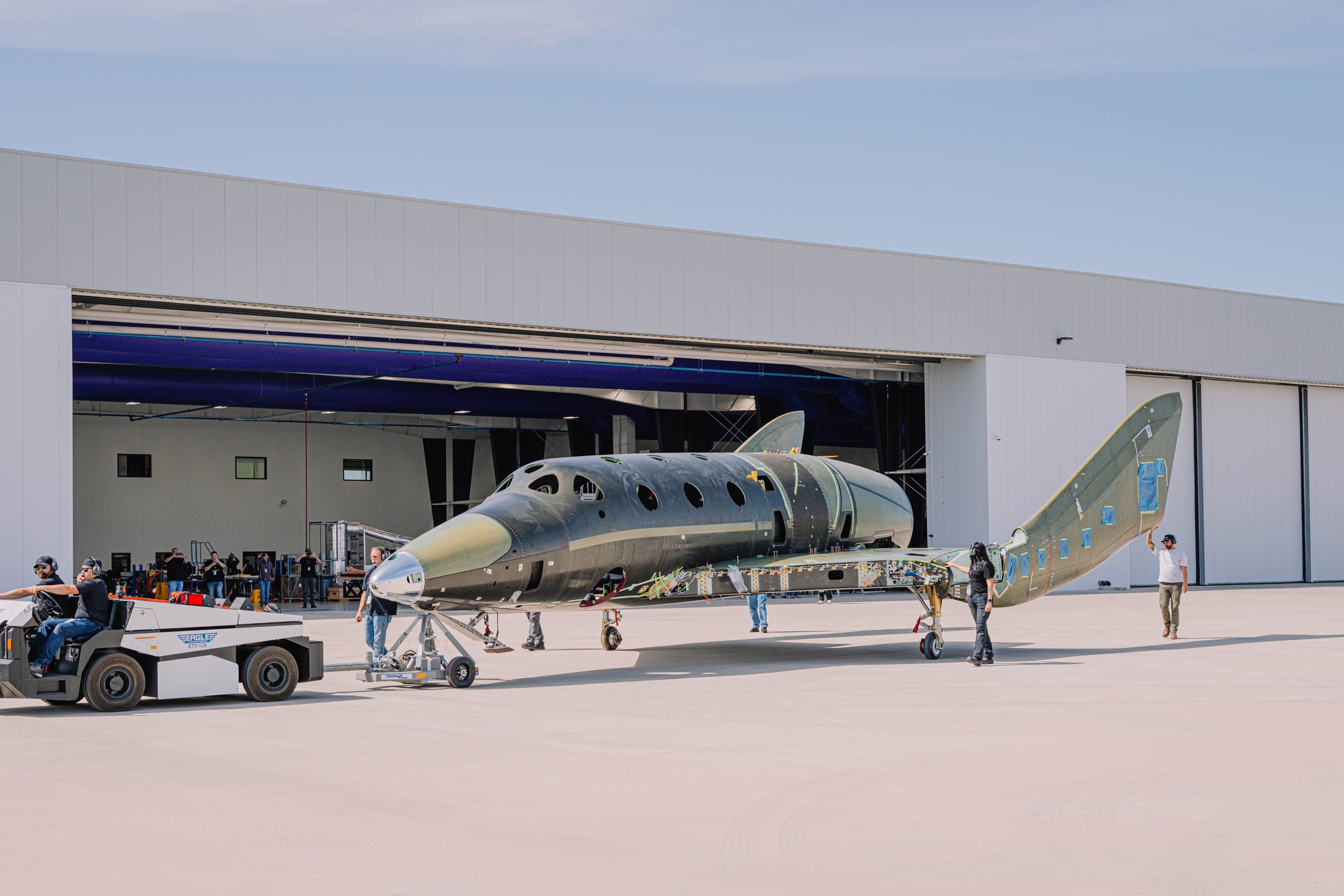

WASHINGTON — Virgin Galactic said May 14 it remains on track, technically and financially, to start commercial flights of its next-generation suborbital spaceplane before the end of the year.
In a first-quarter earnings call, company executives said work on its first SpaceShip vehicle is on schedule, with the completed airframe recently moving from its assembly hangar to a testing hangar at its production facility near Phoenix.
The vehicle will be completed and rolled out by the company’s next earnings call in August, after which it will be transported by Virgin’s Eve carrier aircraft to Spaceport America in New Mexico for flight tests.
“We remain on track to commence flight testing in Q3 and space flight in Q4,” Michael Colglazier, chief executive of Virgin Galactic, said on the call, reiterating a schedule the company provided in its previous earnings call March 30.
The confidence in that schedule, he said, has allowed the company to inform its current base of 650 customers approximately when each of them will fly. Those flights will take place in 2027 and into the first half of 2028.
Doug Ahrens, chief financial officer of Virgin Galactic, said the company expects to fly four times a month in January 2027, ramping up to eight flights a month in the second quarter. The first SpaceShip will be joined by a second, currently being fabricated and scheduled for delivery at the end of this year or early next year.
In the March call, Virgin Galactic announced it would sell 50 tickets at $750,000 each as an initial step to restarting commercial sales. In this call, the company did not disclose how many tickets had been sold but said there was strong interest.
“The response has been strong and global in nature, and we’ve received qualified inquiries from customers across more than 20 countries,” Colglazier said. That interest, he noted, came from individuals, research organizations and government agencies.
“We secured deposits for a meaningful portion of the available seats at this price point, and I expect we will close this limited tranche of spaceflight expeditions at the $750,000 price during our glide flight program in Q3,” he said. Virgin will then pause ticket sales to “begin onboarding” the new customers, later reopening sales, likely at a higher price.
As the company gears up for commercial flights at a higher cadence than when it was flying its Unity vehicle, it is also preparing to increase production of the hybrid rocket motors that power SpaceShip. Colglazier said Virgin has started work on a motor assembly line at its Phoenix facility that should be complete in the fourth quarter. That will allow employees who have been working on assembling vehicles to shift to motor production “without missing a beat.”
Virgin Galactic recorded a net loss of $65 million in the first quarter and had negative free cash flow of $93 million. The company ended the quarter with $251 million in cash and equivalents on hand.
Executives said that is sufficient to keep the company operating through the beginning of commercial service, particularly since expenses will decline as the first vehicles are completed. The company raised $52 million in April through an at-the-market sale of stock, with the ability to sell $87 million more through the same mechanism.
“Spending continues to decline quarter by quarter, debt retirements are being made on or ahead of schedule and cash balances are being maintained at appropriate levels as we work through the final quarters of our pre-revenue phase,” Colglazier said.










Related Posts
Stay Informed With the Latest & Most Important News
Previous Post
Next Post


Advertisement
-
 01Two Black Holes Observed Circling Each Other for the First Time
 -
 02From Polymerization-Enabled Folding and Assembly to Chemical Evolution: Key Processes for Emergence of Functional Polymers in the Origin of Life
 -
 03Astronomy 101: From the Sun and Moon to Wormholes and Warp Drive, Key Theories, Discoveries, and Facts about the Universe (The Adams 101 Series)
 -
 04True Anomaly hires former York Space executive as chief operating officer
 -
 05Φsat-2 begins science phase for AI Earth images
 -
 06Hurricane forecasters are losing 3 key satellites ahead of peak storm season − a meteorologist explains why it matters
 -
 07Binary star systems are complex astronomical objects − a new AI approach could pin down their properties quickly