
Now Reading: Highlighting A Science Strategy For Human Exploration Of Mars
-
01
Highlighting A Science Strategy For Human Exploration Of Mars


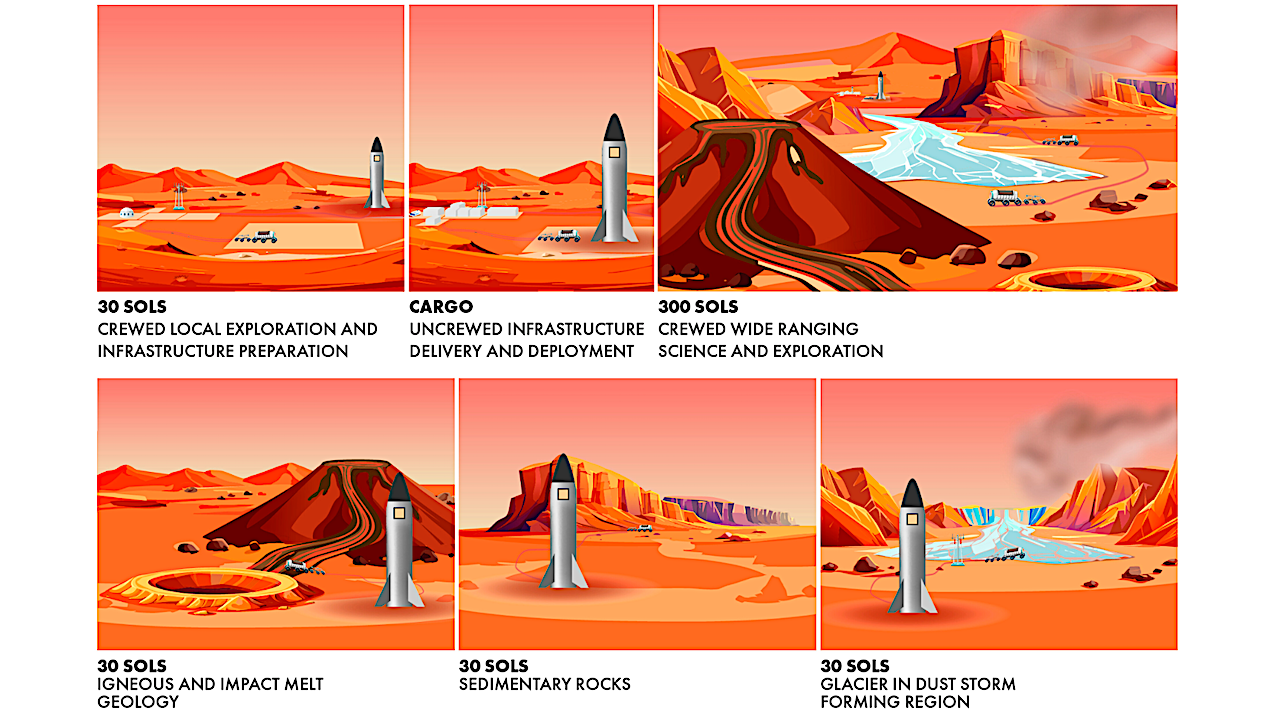
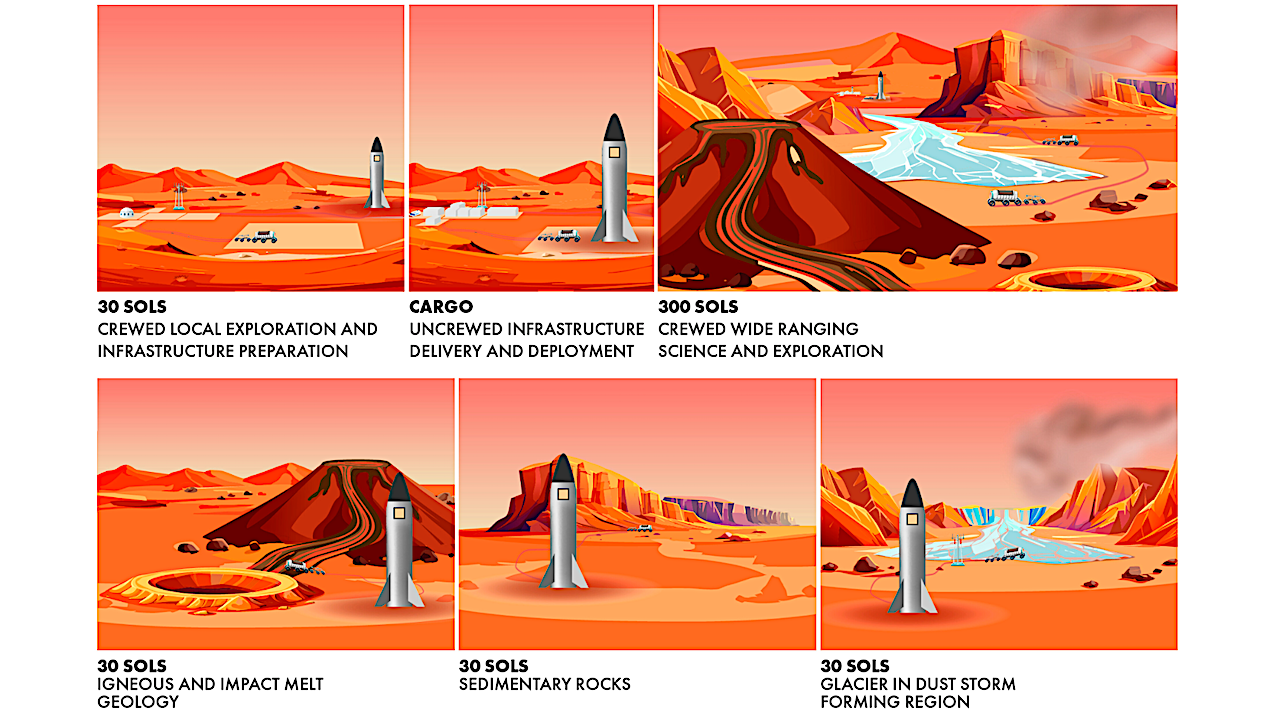
A Science Strategy for Human Exploration of Mars, charts a bold, scientifically based blueprint for humanity’s greatest cosmic adventure—sending explorers to Mars to answer the universe’s most profound questions: Is there life elsewhere? Are there habitable planets? And where do we come from? The cross-disciplinary consensus report spans astrobiology, atmospheric science, space physics, geosciences, and biological and physical sciences as well as human spaceflight.
Eleven high-priority science objectives that will guide the first three crewed landings on Mars are revealed, including the tantalizing search for evidence of past or present life on the red planet.
The report outlines four transformative campaign architectures—each designed to unlock Mars’s secrets across its geology, climate, habitability, and deep subsurface environments. It calls for comprehensive science-driven human-agent exploration (i.e., using rovers, robots, autonomy, and artificial intelligence including machine learning) that will fundamentally reshape our understanding of planetary evolution, the origins of life itself, and humanity’s place in a potentially living cosmos.
With meticulous planning, inspiring vision, and unwavering scientific rigor, human exploration of Mars promises to deliver discoveries that will reverberate through science, society, and humanity for generations to come.
At NASA’s request, the National Academies of Sciences, Engineering, and Medicine convened an ad hoc committee to address the topic of “High Priority Science Campaigns for Human Explorers on the Surface of Mars.”
The National Academies have also been commissioned by NASA to conduct a sister study for the Moon, “Key Non-Polar Destinations Across the Moon to Address Decadal-Level Science Objectives with Human Explorers.” Human exploration on Mars will be guided by the highest priority science objectives, as stated in NASA’s Moon to Mars Strategy and Objectives Development:
A Blueprint for Sustained Presence and Exploration Throughout the Solar System, “…pursuit of scientific knowledge—exploring and understanding the universe—is integral to the human space exploration endeavor…” The initial human exploration campaigns to the surface of Mars presented in this report are designed to focus on science across and within disciplines.
The steering committee was supported by four panels: the Panel on Astrobiology, the Panel on Atmospheric Science and Space Physics, the Panel on Biological and Physical Sciences and Human Factors, and the Panel on Geosciences.
The committee’s tasks comprise three topics:
- What science should humans pursue first on Mars?
- Which mission campaigns (defined as the first three human-scale landings on Mars) achieve that science?
- How do these science objectives and campaigns align and synergize with NASA’s Moon-to-Mars strategy?
Astrobiology,










Related Posts

Stay Informed With the Latest & Most Important News
Previous Post
Next Post


Advertisement
-
 01Two Black Holes Observed Circling Each Other for the First Time
 -
 02From Polymerization-Enabled Folding and Assembly to Chemical Evolution: Key Processes for Emergence of Functional Polymers in the Origin of Life
 -
 03Astronomy 101: From the Sun and Moon to Wormholes and Warp Drive, Key Theories, Discoveries, and Facts about the Universe (The Adams 101 Series)
 -
 04True Anomaly hires former York Space executive as chief operating officer
 -
 05Φsat-2 begins science phase for AI Earth images
 -
 06Hurricane forecasters are losing 3 key satellites ahead of peak storm season − a meteorologist explains why it matters
 -
 07Binary star systems are complex astronomical objects − a new AI approach could pin down their properties quickly