
Now Reading: Latitudinal Variations In Neptune’s Temperature Profile Observed With ALMA
-
01
Latitudinal Variations In Neptune’s Temperature Profile Observed With ALMA


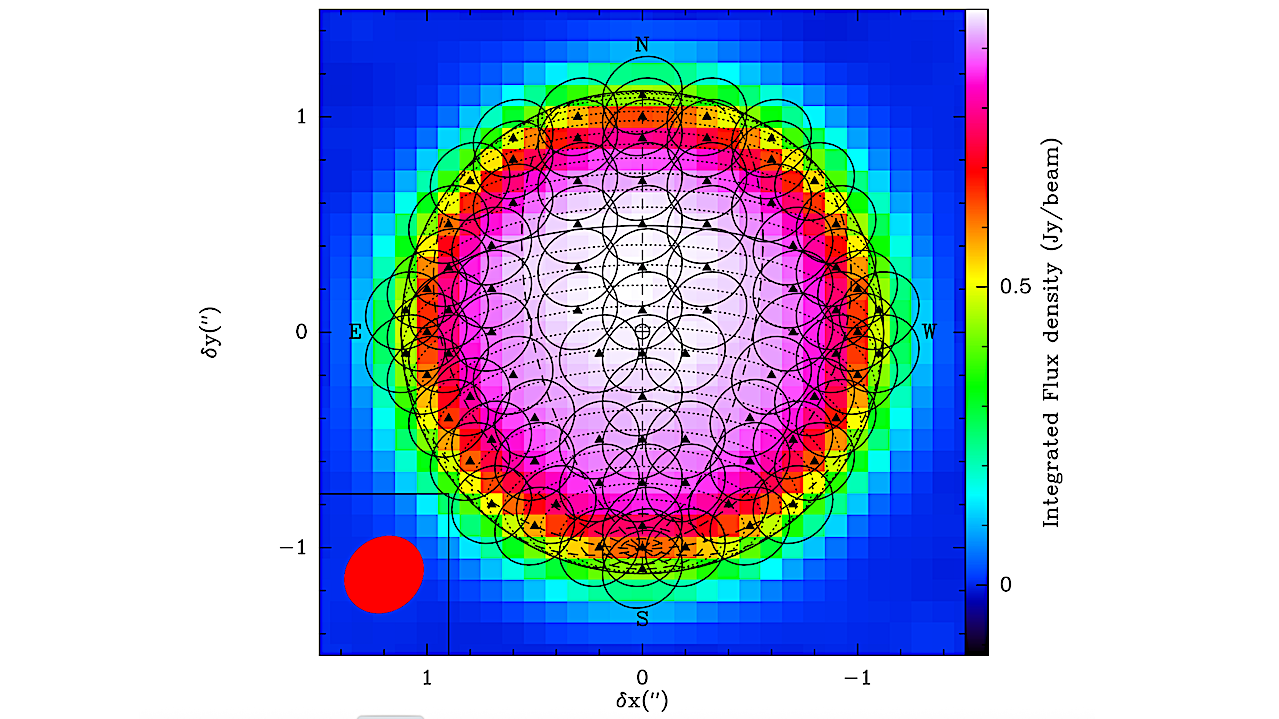
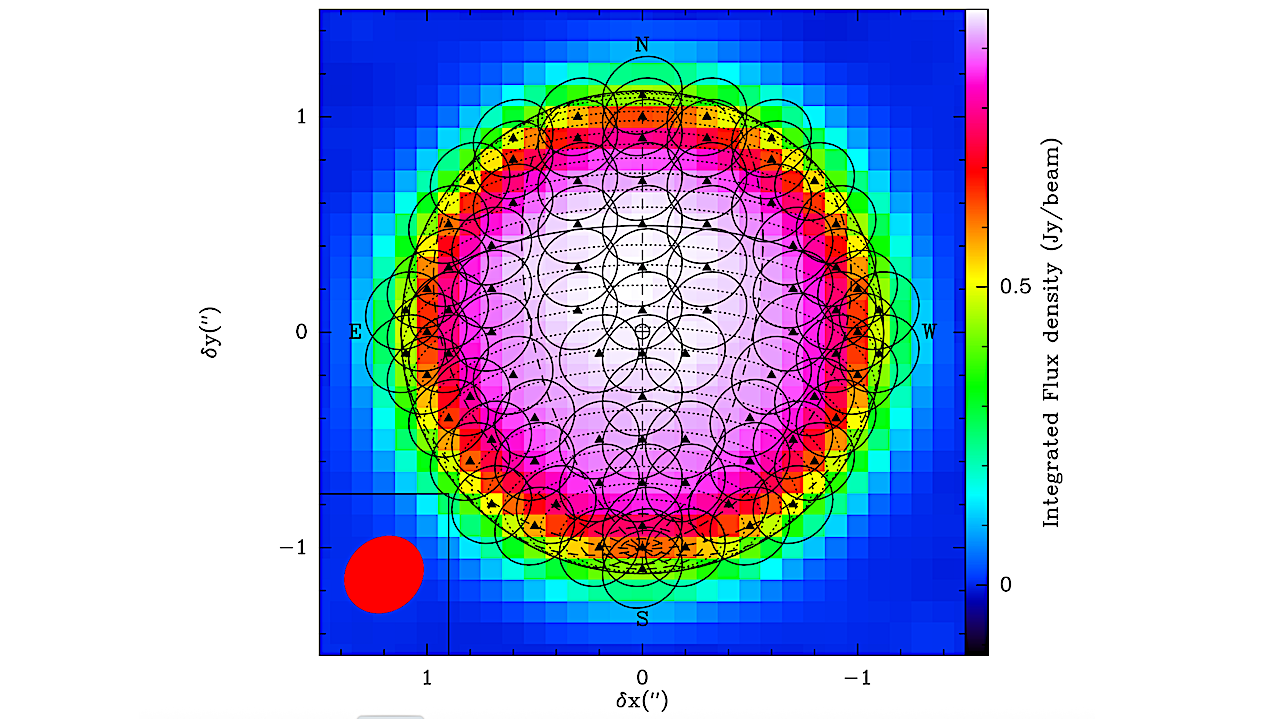
Integrated flux for ALMA’s CO(3-2) line measurement. Superposed as black circles on Neptune’s map are the beam positions observed onto the planet and used for the spatially resolved retrievals. The filled red circle in the lower-left corner indicates the size and orientation of the beam. — astro-ph.EP
Despite the low solar irradiation it receives, Neptune shows a very active atmosphere with some of the most intense dynamics observed in Solar System atmospheres. Characterizing the atmospheric temperature profiles of the planet is a key to understand these observed processes.
In this work, we derived the Neptune pressure-latitude thermal field, using 2016 ALMA measurements of the CO(3-2) spectral line at 345.796 GHz, with a spatial resolution of about 0.37″ on Neptune’s 2.24″ disk. To analyse the data, we developed MCMC retrieval methods to derive both the temperature profiles and the CO abundance profile. We find that our data probes the upper troposphere and the lower stratosphere of the planet, between 2 bar and 0.1 mbar.
Although temperature and CO profile are strongly correlated, simultaneous retrievals of both parameters for disk-integrated observations reveal a factor of 2-3 larger CO abundance in the stratosphere than in the troposphere, reinforcing the hypothesis of CO delivery by a recent cometary impact. CO retrievals with fixed temperature profile do not fit the spatially-resolved observations, implying underlying temperature variations.
By performing temperature retrievals with spatially constant CO, we find distinct trends of the thermal profile between the southern polar region, mid-latitudes and the equator. At 10–100 mbar, this structure is consistent with that observed by Voyager 2 in 1989, i.e. colder mid-latitudes, with a warmer equator and south polar regions. At 300-600 mbar, however, we find a cold layer of about 45 K at Southern polar regions (-80°) which disappears towards mid-latitudes and the equator.
By probing pressure levels not easily accessible to other observing methods e.g. infrared sounding, submillimeter observations offer a new view of the complex thermal structure in the upper troposphere and lower stratosphere of the Icy Giants.
Óscar Carrión-González, Raphael Moreno, Emmanuel Lellouch, Thibault Cavalié, Sandrine Guerlet, Gwenaël Milcareck, Noé Clément, Jérémy Leconte
Comments: Accepted for publication in A&A. 10 pages, 7 Figures + Appendix
Subjects: Earth and Planetary Astrophysics (astro-ph.EP)
Cite as: arXiv:2605.19875 [astro-ph.EP] (or arXiv:2605.19875v1 [astro-ph.EP] for this version)
https://doi.org/10.48550/arXiv.2605.19875
Focus to learn more
Submission history
From: Óscar Carrión-González
[v1] Tue, 19 May 2026 14:06:49 UTC (1,937 KB)
https://arxiv.org/abs/2605.19875
Astrobiology, Exoplanet,










Related Posts
Stay Informed With the Latest & Most Important News
Previous Post
Next Post


Advertisement
-
 01Two Black Holes Observed Circling Each Other for the First Time
 -
 02From Polymerization-Enabled Folding and Assembly to Chemical Evolution: Key Processes for Emergence of Functional Polymers in the Origin of Life
 -
 03Astronomy 101: From the Sun and Moon to Wormholes and Warp Drive, Key Theories, Discoveries, and Facts about the Universe (The Adams 101 Series)
 -
 04True Anomaly hires former York Space executive as chief operating officer
 -
 05Φsat-2 begins science phase for AI Earth images
 -
 06Hurricane forecasters are losing 3 key satellites ahead of peak storm season − a meteorologist explains why it matters
 -
 07Binary star systems are complex astronomical objects − a new AI approach could pin down their properties quickly