
Now Reading: A Revised Mass and Period for the Habitable Zone super-Earth GJ 3378b: A Planet Straddling the Cosmic Shoreline
-
01
A Revised Mass and Period for the Habitable Zone super-Earth GJ 3378b: A Planet Straddling the Cosmic Shoreline

A Revised Mass and Period for the Habitable Zone super-Earth GJ 3378b: A Planet Straddling the Cosmic Shoreline

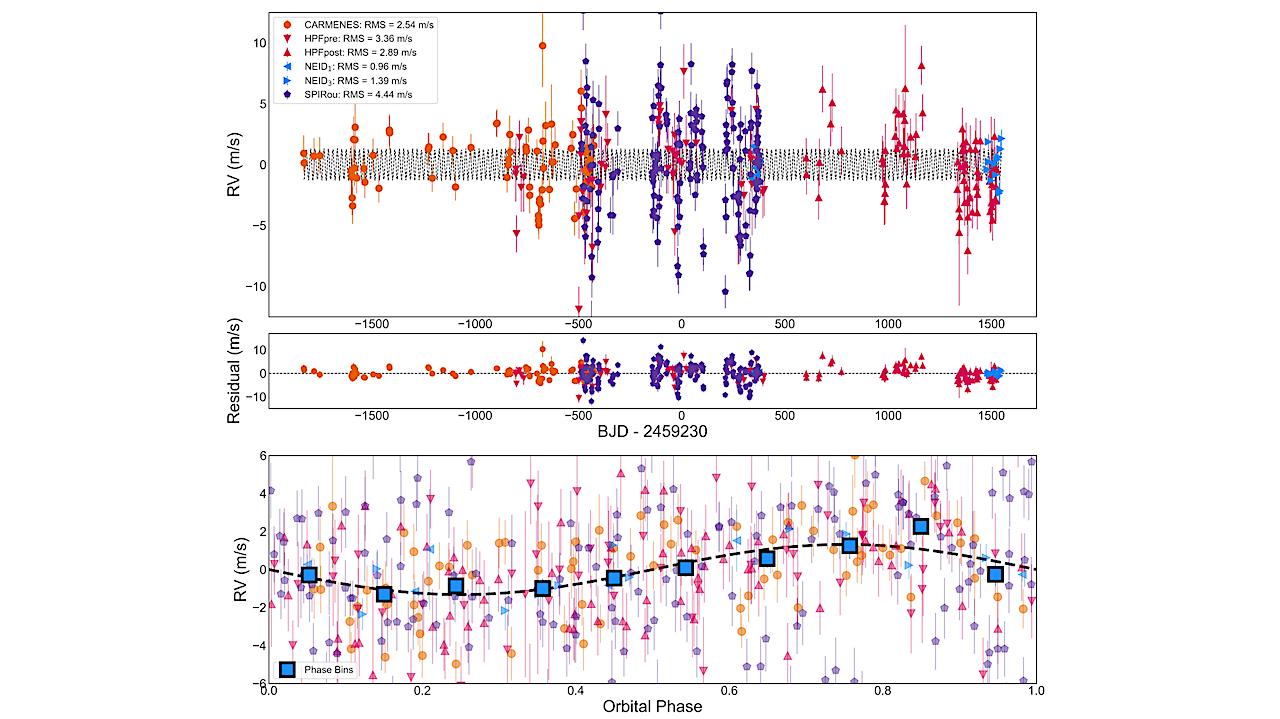
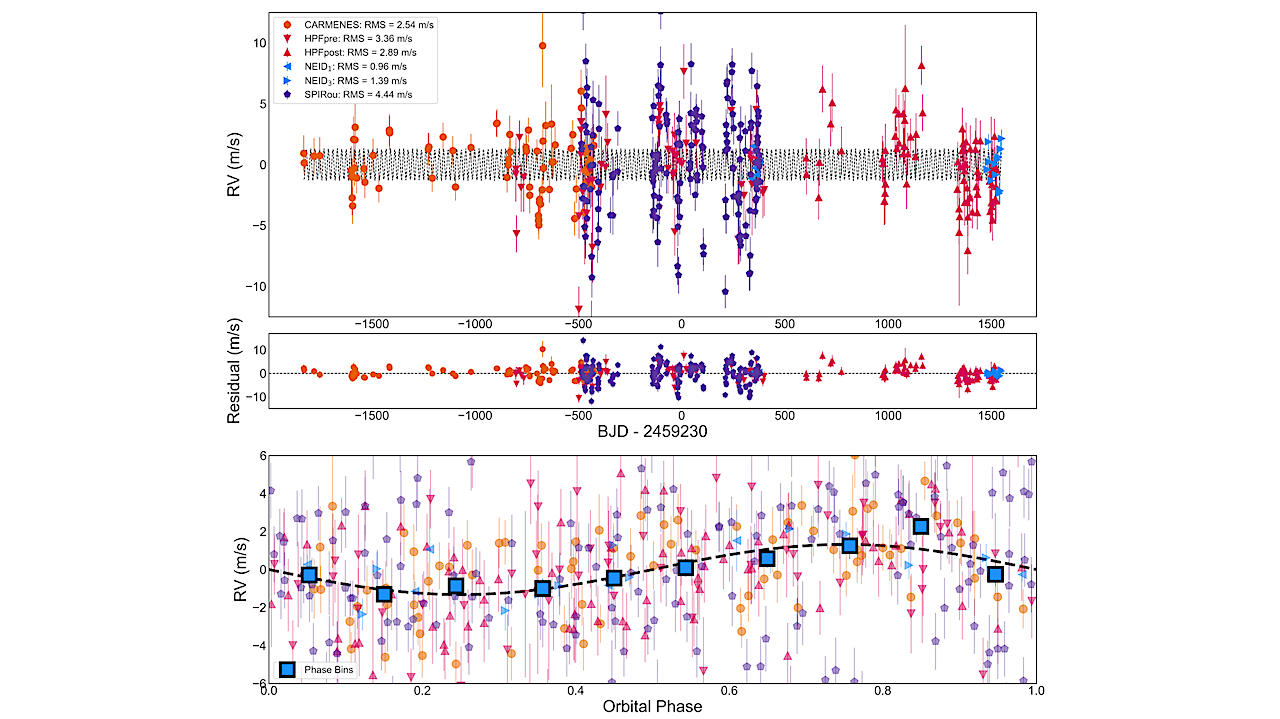
Radial velocity data for GJ 3378. Top: the combined RV time series. The orbit model is shown as a dashed line. Middle: RV residuals to a 1-planet model. Bottom: RVs phase-folded to the period of the exoplanet. Phase-binned RVs are shown as squares. — astro-ph.EP
The nearby (d=7.7 pc) M4V star GJ~3378 is a target of our radial velocity (RV) exoplanet survey of fully convective stars in the Solar neighborhood with the near-infrared spectrograph HPF on the Hobby-Eberly Telescope (HET) at McDonald Observatory.
Recently, Moutou et al.~(2024) announced the discovery of an msini=5.26+0.94−0.97M⊕ planet, GJ 3378b, with an orbital period of 24.73±0.06 days, based on SPIRou RV data. Here, we present our HPF RVs for GJ 3378, as well as additional Doppler spectroscopy from the extreme precision NEID Spectrometer on the WIYN telescope at Kitt Peak National Observatory.
We have analyzed the HPF+NEID RVs jointly with the published RVs from the CARMENES and SPIRou spectrometers. We present an orbital model for GJ 3378b that differs significantly from the Moutou et al.~solution. The joint RV model reduces the orbital period to P=21.45±0.01d and the minimum mass to msini=2.3±0.4M⊕. The shortened orbital distance remains within the conservative circumstellar liquid-water habitable zone (HZ), while the reduced mass increases the likelihood that the planet has a terrestrial composition.
The revised planet properties place it near the “cosmic shoreline,” where planets in the HZs of M dwarfs may lose their atmospheres due to radiative stripping.
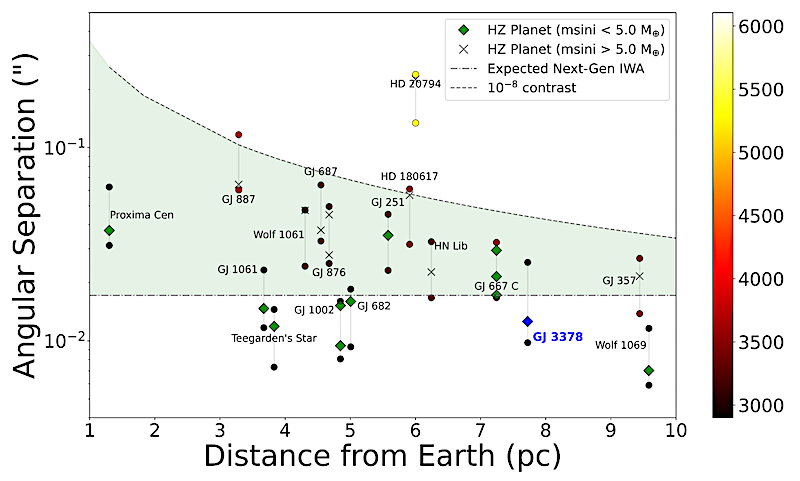
Angular extents of the optimistic HZ (R. K. Kopparapu et al. 2013) for nearby stars hosting exoplanets. The inner and outer HZ limits are marked with circles colored by stellar effective temperature (in K), and known exoplanets are indicated as diamonds at their projected angular separations. The green shaded region indicates where planets might be accessible to imaging facilities on 30 m-class telescopes, limited by inner working angle (IWA) and 10−8 -level contrast. The HZ of GJ 3378 is partially accessible to future imagers, but imaging GJ 3378b will require them to achieve better IWAs than 2λ/D. — astro-ph.EP
Paul Robertson, Michael Endl, William D. Cochran, Gudmundur Stefánsson, Suvrath Mahadevan, Caleb I. Cañas, Gogod James, Roan Arendtsz, Ryan C. Terrien, Chad F. Bender, Scott A. Diddams, Mark R. Giovinazzi, Arvind F. Gupta, Samuel Halverson, Shubham Kanodia, Daniel M. Krolikowski, Sarah E. Logsdon, Joe P. Ninan, Claire J. Rogers, Arpita Roy, Christian Schwab
Comments: Accepted for publication in AJ
Subjects: Earth and Planetary Astrophysics (astro-ph.EP)
Cite as: arXiv:2605.16499 [astro-ph.EP] (or arXiv:2605.16499v1 [astro-ph.EP] for this version)
https://doi.org/10.48550/arXiv.2605.16499
Focus to learn more
Submission history
From: Paul Robertson
[v1] Fri, 15 May 2026 18:00:14 UTC (8,984 KB)
https://arxiv.org/abs/2605.16499
Astrobiology,










Related Posts

Stay Informed With the Latest & Most Important News
Previous Post
Next Post

Advertisement
-
 01Two Black Holes Observed Circling Each Other for the First Time
 -
 02From Polymerization-Enabled Folding and Assembly to Chemical Evolution: Key Processes for Emergence of Functional Polymers in the Origin of Life
 -
 03Astronomy 101: From the Sun and Moon to Wormholes and Warp Drive, Key Theories, Discoveries, and Facts about the Universe (The Adams 101 Series)
 -
 04True Anomaly hires former York Space executive as chief operating officer
 -
 05Φsat-2 begins science phase for AI Earth images
 -
 06Hurricane forecasters are losing 3 key satellites ahead of peak storm season − a meteorologist explains why it matters
 -
 07Binary star systems are complex astronomical objects − a new AI approach could pin down their properties quickly