
Now Reading: A Search For Wide-orbit Planets Around M-dwarfs Using Deep MIRI 15-micron Images
-
01
A Search For Wide-orbit Planets Around M-dwarfs Using Deep MIRI 15-micron Images


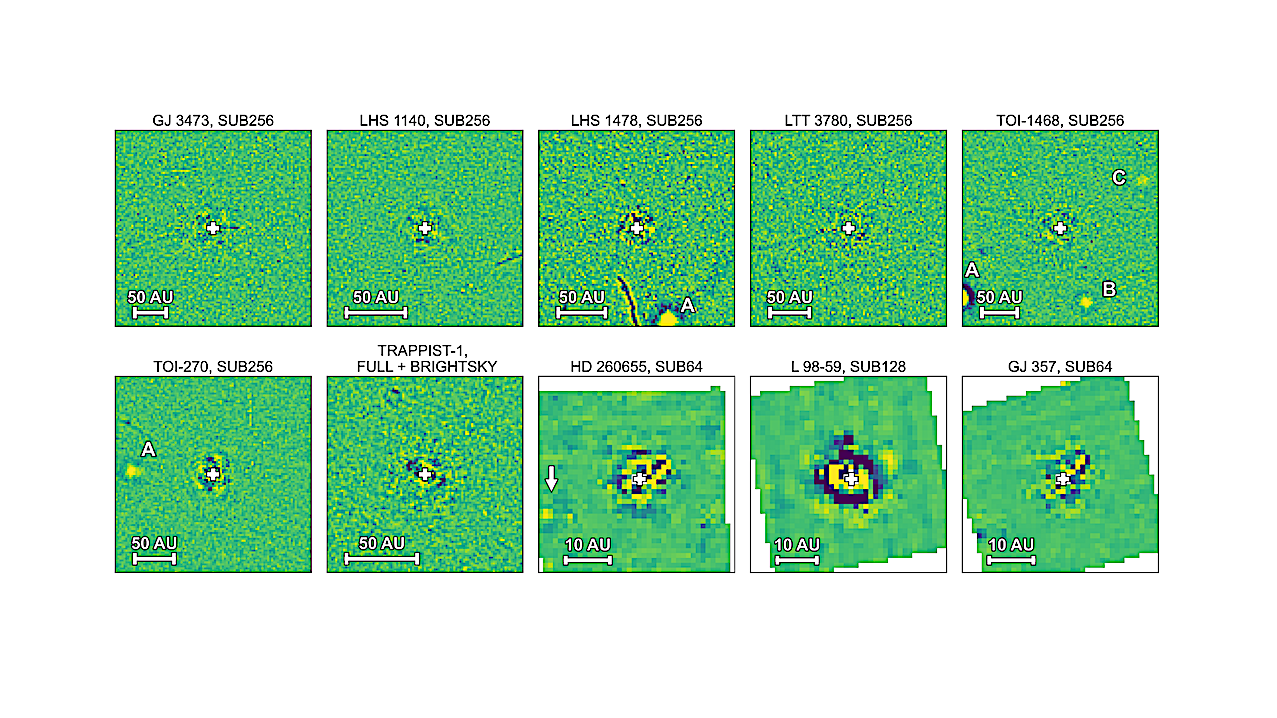
PSF-subtracted images of all targets. The observation subarray of each target is indicated. The first seven images are zoomed in to area of 11.0” × 11.0” for clearer view of the central regions. For the last three targets, the small size (4.4” × 4.4”) is due to the choice of the observation subarray. The location of the star PSF center is denoted by the white cross. Sources around LHS 1478, TOI-1468, and TOI-270 are labeled with letters, which are likely background sources. The arrow near HD 260655 indicates a low-S/N identification of possible close companion. We further examined this detection in Section 4.4. North is up and east is to the left. — astro-ph.EP
Wide-orbit (>10 AU) gas giant planets shape the architecture of planetary systems, yet their occurrence rate remains poorly constrained.
JWST has obtained the deepest mid-infrared images of nearby stars to date through substantial MIRI time-series observations of transiting planets, providing sensitive probes for wide-orbit companions.
Here we leverage 15 micron observations from four programs targeting ten M-dwarf systems to search for such planets. By applying reference differential imaging for precise PSF subtraction, we achieve a median 5σ contrast of 8.9×10⁻⁴−6.2×10⁻³ (median sensitivity in apparent magnitude of 15.8-16.8 mag) at a separation of 1″ and 1.2−9.1×10⁻⁴ (17.5-19.0 mag) at separations ≳3″.
The sensitivity is converted to planet detection probability for each system as a function of planet mass versus semimajor axis. Assuming solar metallicity and a clear atmosphere, we are sensitive to Jupiter-sized planets with an effective temperature of ∼170 K at separations beyond 35 AU in systems at 12.5 pc.
Additionally, we catalog the nearby sources and estimate their possible impact on future observations assuming they are background sources.
Our results demonstrate that archival MIRI time-series imaging data is a powerful window into the population of wide-orbit gas giants around M-dwarfs.
Yihan Li, Yifan Zhou, Rachel Bowens-Rubin, Mary Anne Limbach, Hannah Diamond-Lowe, Cassidy E. Walker, Kevin B. Stevenson, Andrew Vanderburg, Giovanni Strampelli, Gregory J. Herczeg
Comments: Accepted for publication on AJ
Subjects: Earth and Planetary Astrophysics (astro-ph.EP)
Cite as: arXiv:2604.07703 [astro-ph.EP] (or arXiv:2604.07703v1 [astro-ph.EP] for this version)
https://doi.org/10.48550/arXiv.2604.07703
Focus to learn more
Submission history
From: Yihan Li
[v1] Thu, 9 Apr 2026 01:45:59 UTC (5,739 KB)
https://arxiv.org/abs/2604.07703
Astrobiology, exoplanet,











Related Posts
Stay Informed With the Latest & Most Important News



Advertisement
-
 01Two Black Holes Observed Circling Each Other for the First Time
 -
 02From Polymerization-Enabled Folding and Assembly to Chemical Evolution: Key Processes for Emergence of Functional Polymers in the Origin of Life
 -
 03Astronomy 101: From the Sun and Moon to Wormholes and Warp Drive, Key Theories, Discoveries, and Facts about the Universe (The Adams 101 Series)
 -
 04True Anomaly hires former York Space executive as chief operating officer
 -
 05Φsat-2 begins science phase for AI Earth images
 -
 06Hurricane forecasters are losing 3 key satellites ahead of peak storm season − a meteorologist explains why it matters
 -
 07Binary star systems are complex astronomical objects − a new AI approach could pin down their properties quickly