
Now Reading: Amazon Leo passes 300 satellites with Atlas and Ariane launches
-
01
Amazon Leo passes 300 satellites with Atlas and Ariane launches



WASHINGTON — A pair of launches this week has pushed the number of Amazon Leo satellites deployed to more than 300, but the company is still far short of a looming milestone in its FCC license.
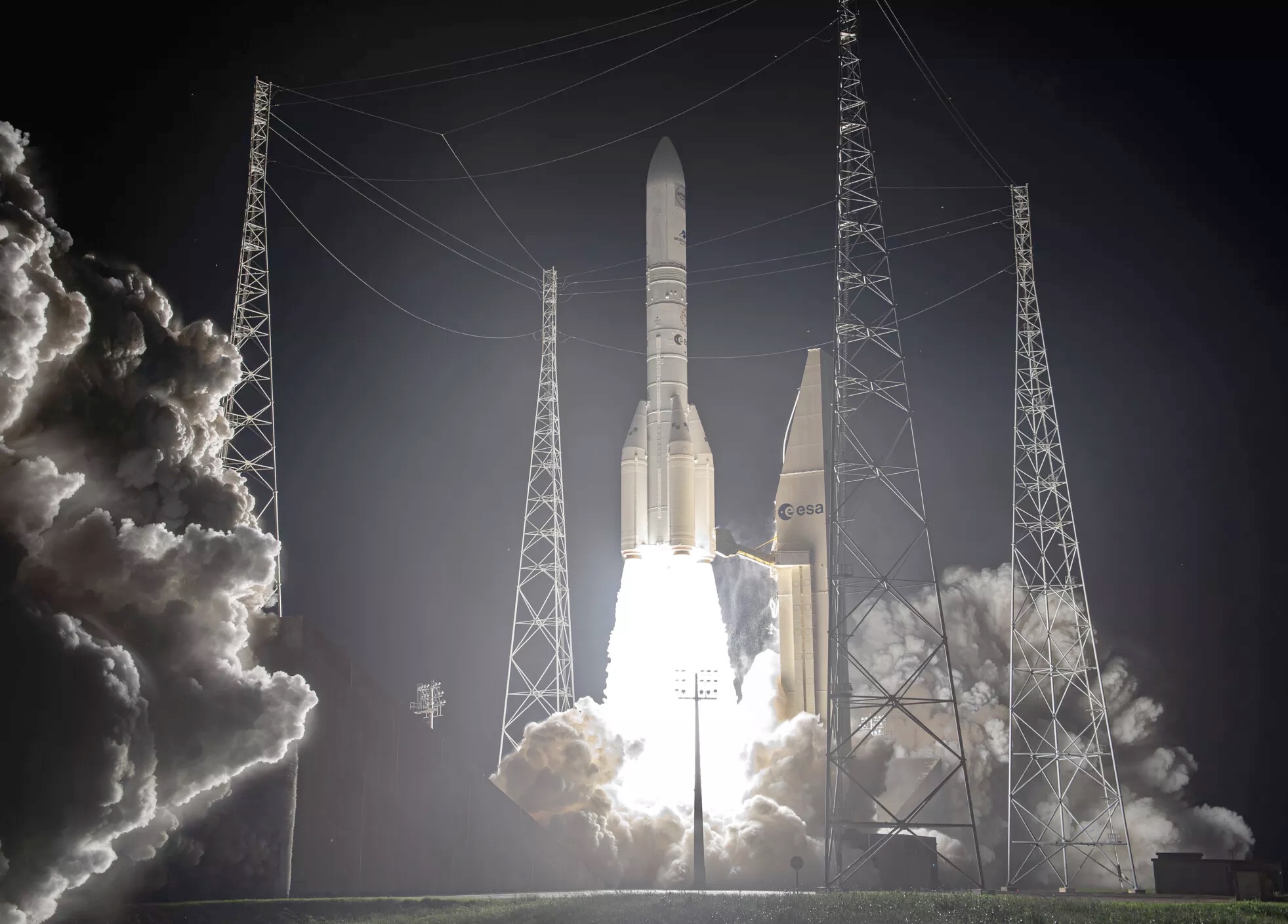
An Ariane 64 lifted off from Kourou, French Guiana, at 4:57 a.m. Eastern April 30 on a mission designated VA 268 by launch operator Arianespace and LE-02 by its customer, Amazon. The vehicle successfully deployed 32 Amazon Leo satellites into a 465-kilometer parking orbit nearly two hours later.
That launch followed the liftoff of an Atlas 5 551 from Cape Canaveral, Florida, at 8:53 p.m. Eastern April 27. That rocket placed into orbit 29 Amazon Leo satellites on what Amazon called the LA-06 mission.
With the two launches, Amazon has launched 302 satellites for its broadband constellation, previously known as Project Kuiper. That is less than 10% of the 3,232 satellites planned for the network.
The company is facing a July 30 deadline in its FCC license to have half the constellation deployed. In January, Amazon filed a request with the FCC to either extend that deadline by two years or waive it entirely, citing “a near-term shortage in launch capacity.” Amazon said it was not requesting an extension of its July 2029 deadline for deploying the entire constellation.
Amazon announced in March it was redoubling its efforts to launch satellites, saying it would double its annual launch rate to more than 20 flights. Vehicle upgrades would also increase the number of satellites launched on Atlas 5 and Ariane 6 missions. In its FCC request, Amazon also disclosed it had acquired 10 additional Falcon 9 launches.
The company, though, is still suffering from that near-term launch shortage, exacerbated by recent incidents. ULA’s Vulcan rocket has been grounded since an incident on a February launch where one of its four solid rocket boosters shed debris. ULA has not announced when it expects Vulcan to resume launches.
Blue Origin’s New Glenn suffered an upper stage failure on an April 19 launch, stranding an AST SpaceMobile satellite in a low, unrecoverable orbit. Dave Limp, chief executive of Blue Origin, said April 20 that one of the two BE-3U engines in the upper stage failed to produce sufficient thrust on a second burn.
Both New Glenn and Vulcan are critical to deploying the Amazon Leo constellation. In 2022, Amazon signed contracts for 38 Vulcan launches, each of which can carry at least 40 Amazon Leo satellites, and 12 New Glenn launches, each carrying at least 48 satellites. The New Glenn contract included options for 15 more launches and, in its January FCC filing, Amazon said it now had 24 New Glenn launches under contract.
Amazon said its next launch will be on another Atlas 5, scheduled for May 22. It added that its next Ariane 6 launch will be the first to use upgraded solid rocket motors, called P160C, that will increase the vehicle’s performance. That will enable the vehicle to carry more satellites, but neither Amazon nor Arianespace disclosed the number of additional satellites on that and subsequent launches.










Related Posts
Stay Informed With the Latest & Most Important News
Previous Post
Next Post





Advertisement
-
 01Two Black Holes Observed Circling Each Other for the First Time
 -
 02From Polymerization-Enabled Folding and Assembly to Chemical Evolution: Key Processes for Emergence of Functional Polymers in the Origin of Life
 -
 03Astronomy 101: From the Sun and Moon to Wormholes and Warp Drive, Key Theories, Discoveries, and Facts about the Universe (The Adams 101 Series)
 -
 04True Anomaly hires former York Space executive as chief operating officer
 -
 05Φsat-2 begins science phase for AI Earth images
 -
 06Hurricane forecasters are losing 3 key satellites ahead of peak storm season − a meteorologist explains why it matters
 -
 07Binary star systems are complex astronomical objects − a new AI approach could pin down their properties quickly