
Now Reading: As Above, Not So Below: Ion Fractionation In Planetary Analog Ices
-
01
As Above, Not So Below: Ion Fractionation In Planetary Analog Ices


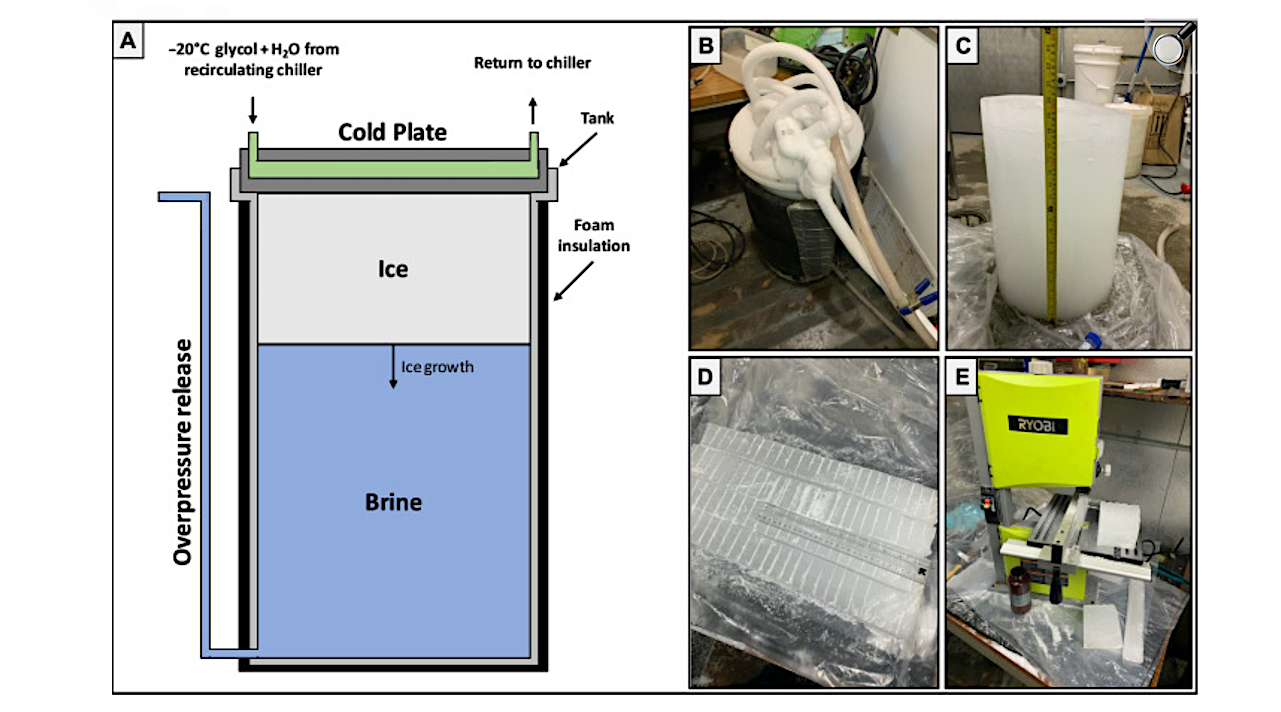
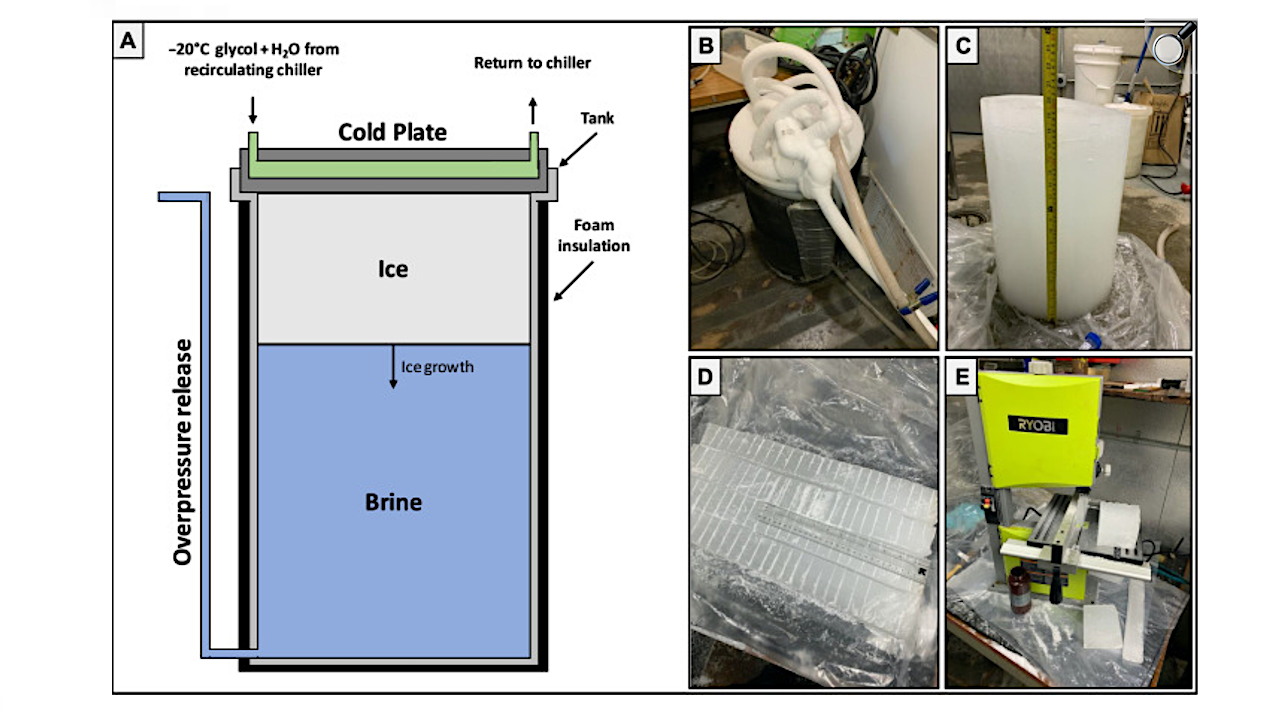
(A) Schematic of the ice growth apparatus. (B) Image of the ice growth apparatus shortly after the onset of an experiment. (C) The ~50-cm-thick Europa 2 ice column immediately after extraction. The column is placed upside down to reduce brine loss from the highly porous basal region of the ice. (D) Ice columns subsectioned into smaller, more easily workable pieces and scored at 2-cm intervals in preparation for vertical partitioning. (E) The scored subsections in (D) were cut using an electric band saw, and the 2-cm layers were placed into 500-ml high-density polyethylene amber Nalgene sample bottles. These samples were subsequently melted, filtered, and processed via IC, ICP-OES, and NDIR spectroscopy to acquire our ionic composition and ionic fractionation profiles. — Science Advances via PubMed
The geophysical evolution and astrobiological potential of ocean worlds are indelibly linked to the chemical compositions of their oceans and ice shells.
In the absence of direct measurements, empirical estimates of subsurface ocean compositions have relied on the assumption that the ionic compositions of ice shell surfaces are representative of their underlying ocean compositions.
Here, we present experimental results demonstrating that ion fractionation—the differential entrainment of ion species in forming ices—is likely a prevalent process on ocean worlds, suggesting that planetary ice shell compositions do not directly reflect their underlying ocean compositions.
We measure in-ice depletions and amplifications of relative ion concentrations ranging between −40 and +77%, compared to the parent fluid composition. Although this may complicate the interpretation of spacecraft data, ion fractionation provides a mechanism for generating compositionally diverse ices that could help explain the geological complexity of planetary ice shells.
Astrobiology, Astrogeology, Astrochemistry,










Related Posts
Stay Informed With the Latest & Most Important News
Previous Post
Next Post
Advertisement
-
 01Two Black Holes Observed Circling Each Other for the First Time
 -
 02From Polymerization-Enabled Folding and Assembly to Chemical Evolution: Key Processes for Emergence of Functional Polymers in the Origin of Life
 -
 03Astronomy 101: From the Sun and Moon to Wormholes and Warp Drive, Key Theories, Discoveries, and Facts about the Universe (The Adams 101 Series)
 -
 04True Anomaly hires former York Space executive as chief operating officer
 -
 05Φsat-2 begins science phase for AI Earth images
 -
 06Hurricane forecasters are losing 3 key satellites ahead of peak storm season − a meteorologist explains why it matters
 -
 07Binary star systems are complex astronomical objects − a new AI approach could pin down their properties quickly