
Now Reading: Astrochemical Inheritance of Terrestrial Planets Water from Local Wet Silicates
-
01
Astrochemical Inheritance of Terrestrial Planets Water from Local Wet Silicates


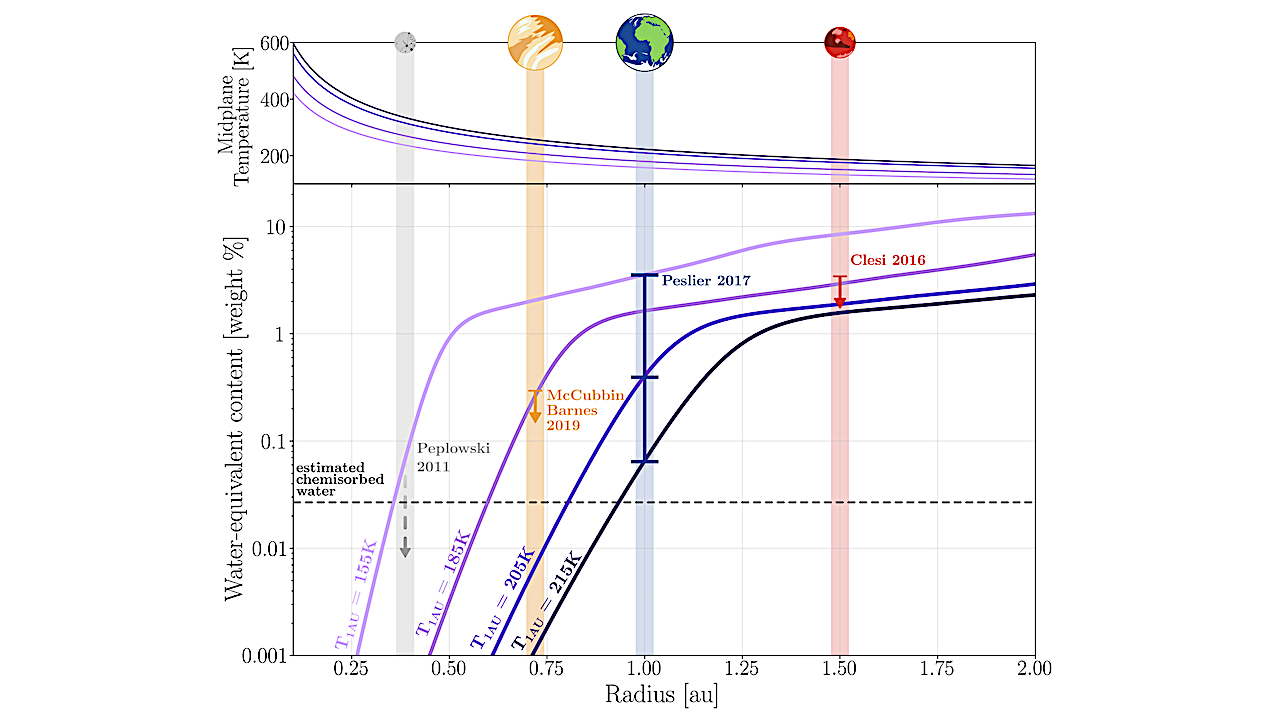

Model prediction for the water budget of the 4 terrestrial planets : Mercury in grey, Venus in yellow, the Earth in blue and Mars in red. Upper Panel: Midplane temperature (K) across the PSN following Eq. (7) with T1 AU = 160, 190, 215 and 225 K from the lowest (light green) to the highest (dark green) curve. Lower Panel: Mass fraction of water remaining frozen on the grains as a function of the distance from the Sun, according to our desorption model. Each curve show a different snowline depending on the temperature profile set by T1 AU, with colours matching the profiles of the upper panel. Upper limits for the planets water contents are represented as downward arrows, using values from references cited in Section 4.1. The Earth’s water estimate is more constrained, and its range is represented as a vertical bar. The curves with T1 AU =160, 215 and 225 K meet the upper, median and lower values of the Earth’s water estimate respectively. The dashed horizontal line shows the estimate of deprotonated water, chemisorbed to the forsterite surface (not taken into account in our diffuse snowlines). – MNRAS
The delivery of water to the inner Solar System rocky planets, including Earth, remains debated, as standard models assume that they formed from dry grains, inside the snowline of the protosolar nebula.
However, a recent work showed that a not-negligible amount of water formed during the prestellar phase could have been retained by pebbles and planetesimals at the Earth’s orbit in enough quantities to reproduce its water content. This study was based based on quantum mechanics (QM) calculations of the binding energy (BE) of water on amorphous ice and on a kinetic approach.
Here, we present new QM calculations of the BE of water frozen on the surface of silicate grains, and show that it is on average about twice larger than that on the amorphous ice. The contribution of this first layer of frozen water increases the dust temperature at which frozen water can be retained. This provides a local source of water not only for the Earth, but also for the inner rocky planets.
The predictions from our model are in agreement with the available estimates of water content in terrestrial planets. This suggests that water delivery from the outer Solar System may not be required.
Astrochemical Inheritance of Terrestrial Planets Water from Local Wet Silicates, Monthly Notices of the Royal Astronomical Society (open access)
Astrobiology,










Related Posts

Stay Informed With the Latest & Most Important News
Previous Post
Next Post

Advertisement
-
 01Two Black Holes Observed Circling Each Other for the First Time
 -
 02From Polymerization-Enabled Folding and Assembly to Chemical Evolution: Key Processes for Emergence of Functional Polymers in the Origin of Life
 -
 03Astronomy 101: From the Sun and Moon to Wormholes and Warp Drive, Key Theories, Discoveries, and Facts about the Universe (The Adams 101 Series)
 -
 04True Anomaly hires former York Space executive as chief operating officer
 -
 05Φsat-2 begins science phase for AI Earth images
 -
 06Hurricane forecasters are losing 3 key satellites ahead of peak storm season − a meteorologist explains why it matters
 -
 07Binary star systems are complex astronomical objects − a new AI approach could pin down their properties quickly