
Now Reading: CETI / SETI: The Phonology Of Sperm Whale Coda Vowels
-
01
CETI / SETI: The Phonology Of Sperm Whale Coda Vowels




Sperm whales (Physeter macrocephalus) communicate using series of clicks known as codas. In previous research, sperm whale codas have been shown to resemble human vowels acoustically.
Based on the number of formants, two different coda quality categories have been described: a-codas and i-codas. In the present paper, we demonstrate that sperm whale codas not only resemble human vowels acoustically but also pattern like them along several linguistic dimensions.
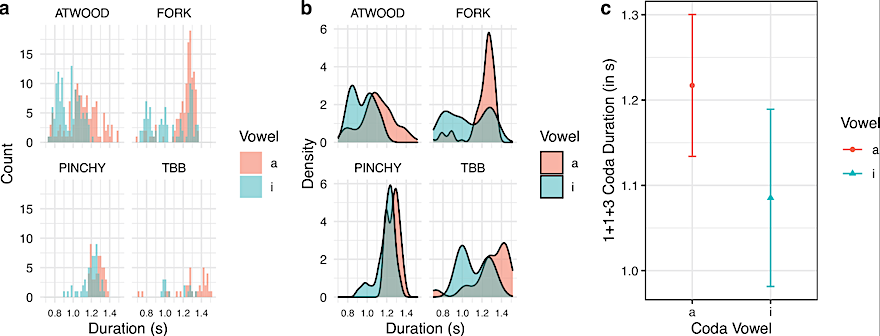
A histogram (a) and a density plot (b) of raw coda durations (in seconds) of the 1+1+3 coda for four whales. Estimates of the mixed-effects linear regression model are from electronic supplementary material, table S2, with 95% CIs (c). — Royal Society Proceedings B
First, traditional count- and timing-based coda types interact with coda ‘vowel’ quality (a versus i). Second, a-codas are generally longer than i-codas. Third, the duration of i-codas has a bimodal distribution, showing a contrast between short i-codas and long ī-codas. Fourth, the baseline coda length differs across whales.
And fifth, edge clicks mismatching their coda often match an adjacent coda, a phenomenon that resembles human coarticulation. All five properties have close parallels in the phonetics and phonology of human languages, suggesting independent evolution.
Sperm whale coda vocalizations are thus highly complex and represent one of the closest parallels to human phonology of any analysed animal communication system.
The Phonology Of Sperm Whale Coda Vowels, Royal Society Proceedings B (open access)
Astrobiology, SETI,











Related Posts
Stay Informed With the Latest & Most Important News
Previous Post
Next Post

Advertisement
-
 01Two Black Holes Observed Circling Each Other for the First Time
 -
 02From Polymerization-Enabled Folding and Assembly to Chemical Evolution: Key Processes for Emergence of Functional Polymers in the Origin of Life
 -
 03Astronomy 101: From the Sun and Moon to Wormholes and Warp Drive, Key Theories, Discoveries, and Facts about the Universe (The Adams 101 Series)
 -
 04True Anomaly hires former York Space executive as chief operating officer
 -
 05Φsat-2 begins science phase for AI Earth images
 -
 06Hurricane forecasters are losing 3 key satellites ahead of peak storm season − a meteorologist explains why it matters
 -
 07Binary star systems are complex astronomical objects − a new AI approach could pin down their properties quickly