
Now Reading: Chemical Signatures Of Planetary Systems In Their Host Stars. Near-infrared Spectroscopy Of Four Planet-hosting Wide Binaries
-
01
Chemical Signatures Of Planetary Systems In Their Host Stars. Near-infrared Spectroscopy Of Four Planet-hosting Wide Binaries

Chemical Signatures Of Planetary Systems In Their Host Stars. Near-infrared Spectroscopy Of Four Planet-hosting Wide Binaries

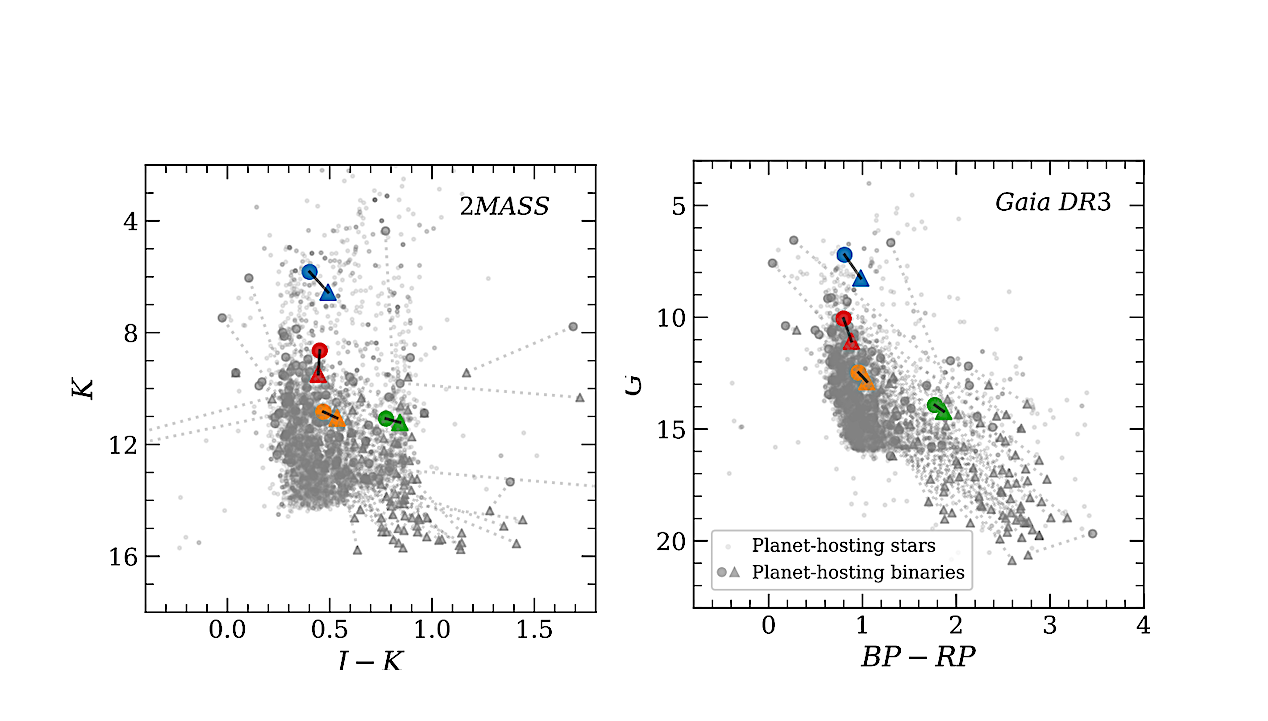
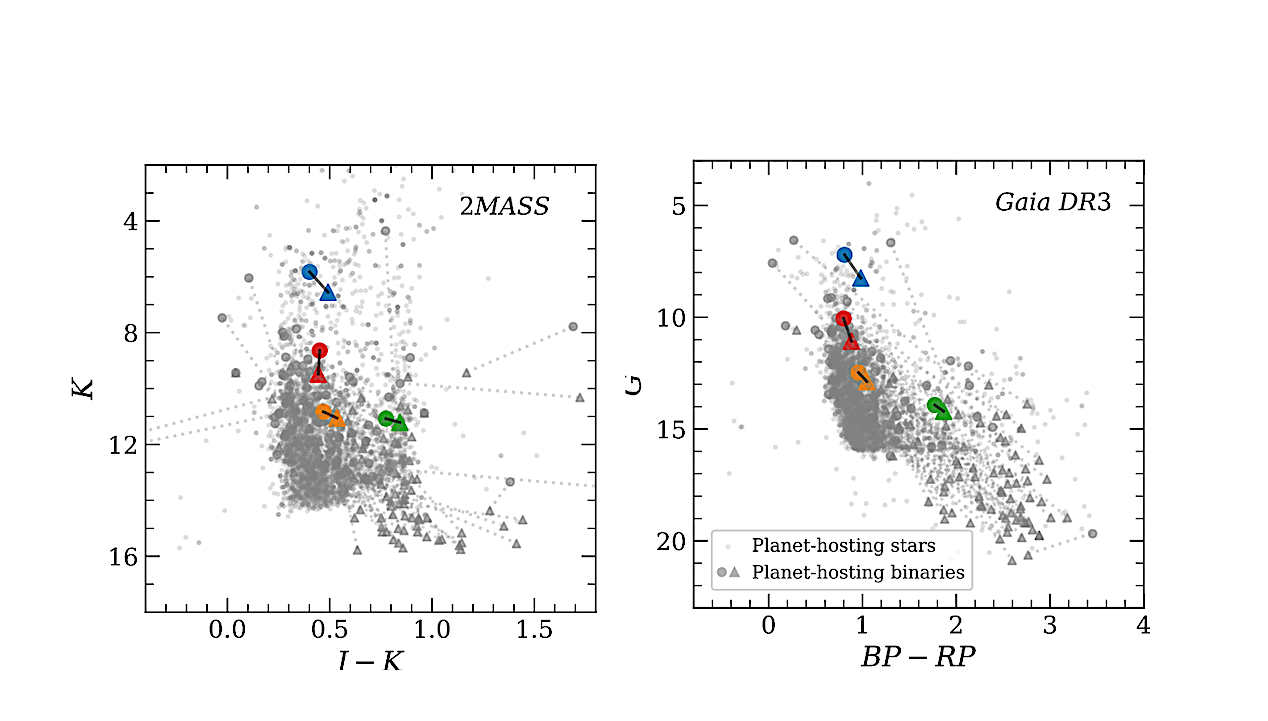
Our target wide binaries are marked with colored circles (primaries) and triangles (secondaries) in the 2MASS (K, J − K) and Gaia (G, BP − RP) CMDs. Blue, orange, green, and red denote HD 20782/HD 20781, WASP-160 A/WASP-160 B, K2-54/K2-54 B, and WASP-127/TYC 4916-897-1 pairs, respectively, with the same color scheme adopted in subsequent figures. Grey circles and triangles indicate our initial candidate systems of planet-hosting wide binaries, while the smaller background symbols represent all reported planet-hosting stars to date. The two components of each binary are connected with solid and dotted lines. — astro-ph.SR
An important open question in exoplanet studies is whether planets leave detectable chemical fingerprints on their host stars. While several studies have suggested possible planetary chemical signatures in planet-hosting stars, their origin remains debated because of stellar birth conditions and evolutionary effects.
Wide binaries, whose components share a common formation environment, provide an ideal testbed for identifying planetary signatures. Such signatures are often characterized by differential abundance trends with condensation temperature (Tc), which traces the partitioning between gaseous and rocky planetary material.
We investigate whether these trends are associated with planetary architectures in wide binaries. We obtained high-resolution NIR spectra of four planet-hosting wide binaries. We measured abundances for both components and analyzed differential abundances in each system. We also compiled literature measurements for planet-hosting and non-hosting wide binaries and compared their Tc trends. WASP-160 A/B and WASP-127/TYC 4916-897-1 exhibit significant abundance trends with Tc, while HD 20782/HD 20781 shows a weaker correlation and K2-54/K2-54 B is consistent with a flat relation.
The trends are diverse, including both volatile- and refractory-enhanced patterns in planet-hosting stars. Literature comparisons indicate that extreme Tc slopes may occur more frequently among planet-hosting wide binaries, particularly at large separations, although the statistics remain limited by sample size and definition.
Our results indicate that chemical signatures in planet-hosting wide binaries are not universal but vary across systems. While planetary architectures may be associated with some host-star abundance patterns, multiple processes are likely to contribute. Larger samples are essential for disentangling planetary signatures from stellar and binary effects.
Dongwook Lim, Sol Yun, Andreas J. Koch-Hansen, Sang-Hyun Chun, Young Sun Lee, Young-Wook Lee
Comments: 19 pages, 9 figures, accepted for publication in A&A
Subjects: Solar and Stellar Astrophysics (astro-ph.SR); Earth and Planetary Astrophysics (astro-ph.EP)
Cite as: arXiv:2605.11095 [astro-ph.SR] (or arXiv:2605.11095v1 [astro-ph.SR] for this version)
https://doi.org/10.48550/arXiv.2605.11095
Focus to learn more
Submission history
From: Dongwook Lim
[v1] Mon, 11 May 2026 18:02:43 UTC (508 KB)
https://arxiv.org/abs/2605.11095
Astrobiology










Related Posts
Stay Informed With the Latest & Most Important News
Previous Post
Next Post



Advertisement
-
 01Two Black Holes Observed Circling Each Other for the First Time
 -
 02From Polymerization-Enabled Folding and Assembly to Chemical Evolution: Key Processes for Emergence of Functional Polymers in the Origin of Life
 -
 03Astronomy 101: From the Sun and Moon to Wormholes and Warp Drive, Key Theories, Discoveries, and Facts about the Universe (The Adams 101 Series)
 -
 04True Anomaly hires former York Space executive as chief operating officer
 -
 05Φsat-2 begins science phase for AI Earth images
 -
 06Hurricane forecasters are losing 3 key satellites ahead of peak storm season − a meteorologist explains why it matters
 -
 07Binary star systems are complex astronomical objects − a new AI approach could pin down their properties quickly