
Now Reading: China launches test direct-to-device satellites for multiple projects
-
01
China launches test direct-to-device satellites for multiple projects



HELSINKI — China capped a busy month of launches by sending four new satellite internet test satellites into orbit with a workhorse hypergolic rocket.
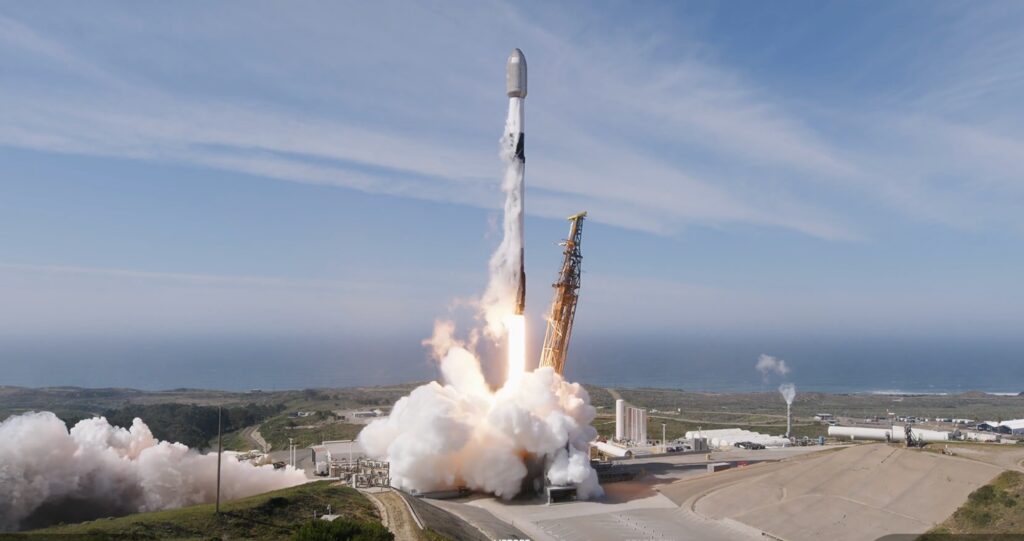
The Long March 2D lifted off at 2:07 p.m. Eastern May 30 (1807 UTC) from Xichang Satellite Launch Center in southwest China. Orange exhaust briefly illuminated the launch infrastructure before the hypergolic-propellant rocket climbed into the night sky.
CASC Commercial Rocket Co., state-owned CASC’s domestic commercial launch services arm, declared the launch successful, delivering four satellites to orbit.
Few details were provided. CASC and its affiliates generally stated that the satellites will primarily be used for experimental verification of technologies such as direct broadband connection to mobile phones via satellite and the integration of space and ground networks, according to CASC. There were, however, further clues as to the origin of the spacecraft.
CASC developed at least one of the satellites, according to a commercial satellite affiliate, potentially linking it to the national Guowang broadband megaconstellation, while another came from the Space Engineering Department of China Aerospace Science and Industry Corporation (CASIC), a giant space and defense contractor and “sister” entity in relation to CASC.
A Beijing Yizhuang government post stated that one of the satellites was developed by launch service provider Landspace’s satellite subsidiary, Hongqing Technology. The company filed a notification with the ITU for a constellation comprising 10,000 satellites in 2024.
The launch is the latest in a line of diverse and opaque test satellite internet satellites launched in recent years, with the previous such launch in April via Jielong-3 solid rocket.
The Long March 2D for the Saturday launch was provided by CASC’s Shanghai Academy of Space Technology (SAST). The rocket debuted in August 1992 and has flown more than 100 times. The launch followed a series of Chinese missions in recent weeks, including the launch of the Shenzhou-23 crewed spacecraft to Tiangong space station May 24.
Previous launches included a Kinetica-1 solid rocket from CAS Space May 15, launching from Jiuquan Satellite Launch Center and sending five satellites into orbit. These were Taijing-3 05A and 05B from MinoSpace, providing 0.5m optical remote sensing imagery, Tianyi-50 from Spacety, Tianyan-27, and Jilin-1 Gaofen 03D55 for Changguang Satellite’s Jilin-1 remote sensing constellation.
Following this, 18 further satellites for the Qianfan, or Thousand Sails, constellation reached orbit via a Long March 8 rocket launching from Hainan commercial spaceport May 17. The group of polar orbit satellites takes the constellation to 162 satellites overall at time of launch. It followed the previous batch launched May 12 via a Long March 6A rocket lifting off from Taiyuan spaceport, north China.
This was followed May 26 by the launch of a Long March 7A rocket to geostationary transfer orbit of the classified TJS-24 satellite. The Communication Technology Experiment Satellite-24 is primarily used to verify multi-band, high-speed satellite communication technologies, Xinhua reported. The TJS series mainly operates in geostationary orbit (GEO). It is seen by Western analysts as potentially carrying out classified missions including signals intelligence, early warning missions and satellite inspection activities to support the People’s Liberation Army (PLA).
Saturday’s Long March 2D launch was China’s 8th launch of May and the 34th of 2026 overall, which includes three failures. The country appears to be targeting more than 100 launches in a calendar year for the first time, and is two launches ahead of its tally at the end of May in 2025. China launched 92 times last year.










Related Posts
Stay Informed With the Latest & Most Important News
Previous Post
Next Post


Advertisement
-
 01Two Black Holes Observed Circling Each Other for the First Time
 -
 02From Polymerization-Enabled Folding and Assembly to Chemical Evolution: Key Processes for Emergence of Functional Polymers in the Origin of Life
 -
 03Astronomy 101: From the Sun and Moon to Wormholes and Warp Drive, Key Theories, Discoveries, and Facts about the Universe (The Adams 101 Series)
 -
 04True Anomaly hires former York Space executive as chief operating officer
 -
 05Φsat-2 begins science phase for AI Earth images
 -
 06Hurricane forecasters are losing 3 key satellites ahead of peak storm season − a meteorologist explains why it matters
 -
 07Binary star systems are complex astronomical objects − a new AI approach could pin down their properties quickly