
Now Reading: Chinese startup Mega Engine advances reusable staged-combustion rocket engine
-
01
Chinese startup Mega Engine advances reusable staged-combustion rocket engine


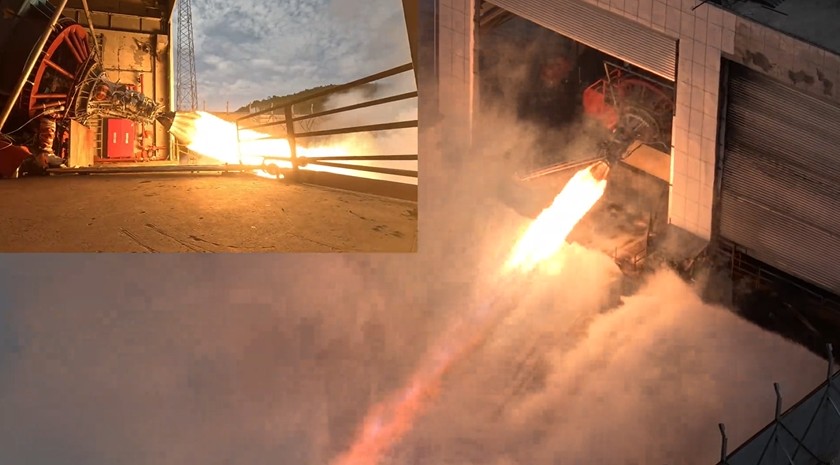

HELSINKI — A new Chinese commercial rocket engine startup has conducted a successful long-duration hot fire test of a closed-cycle kerosene-liquid oxygen engine.
Xi’an-based Mega Engine Technology announced successful tests of its “Chi” engine in a Chinese social media post May 25, with a single engine accumulating 1,000 seconds of run time at rated conditions, with total program test accumulation reaching 2,000 seconds.
The company said the high-pressure oxygen-rich staged combustion cycle kerolox engine demonstrated rapid startup, stable operation, and passed post-test inspection with hardware intact.
The engine is designed to produce throttleable thrust at sea-level of 35–75 tons or 87 tons of thrust in vacuum. Sea-level specific impulse is 302 seconds, rising to 350 seconds at altitude.
The Chi engine, which can be translated to “blazing,” has the ability to be reused with variable thrust and multiple restarts, making it an ideal choice for high-altitude propulsion for medium and large rockets, Mega Engine claimed in its statement. It can also be used as the first-stage propulsion for small and medium-sized rockets.
The successful tests signal the emergence of a new propulsion supplier within China’s rapidly expanding commercial space sector, targeting becoming a supplier of engines for second and upper stages of launch companies.
Mega Engine appears to have begun operations in early 2024, yet has already demonstrated a functioning oxygen-rich staged-combustion engine with long-duration hot fire tests. A 2025 conference summary published by co-organizer Zhongshang Fund identifies Zhang Chenxing as a co-founder of the company, with a PhD from MIT. Zhang’s prior institutional affiliation was not stated, while the company statement notes only that the core team is a group of experts focused on the development of advanced liquid rocket engines. As of the April 2025 conference, Zhang said the company had completed development and partial testing of its first staged combustion engine.
State-owned CASC’s Academy of Aerospace Propulsion Technology (AALPT), China’s main liquid rocket propulsion house, is present in Xi’an. It developed China’s YF engines series, including kerolox and methalox engines, including the YF-100 and YF-100K oxygen-rich staged combustion engines, as well as the somewhat comparable but open-cycle YF-102 kerolox engine for commercial customers, which has flown on Space Pioneer’s Tianlong-2 and CAS Space’s Kinetica-2. Chi’s staged combustion cycle may offer a meaningful specific impulse advantage over the open-cycle YF-102.
The highly specialized nature of oxygen-rich staged combustion technology, which in China has been developed almost exclusively within AALPT’s Xi’an institutes, suggests the founding team carries direct experience from the state propulsion sector. The rapid development timeline and technical maturity of the company’s plans appears consistent with China’s broader civil-military fusion policy, under which the government actively encourages expertise and knowledge to flow from state defense-industrial institutions into commercial ventures.
Mega Engine also has more ambitious plans targeting heavy-lift. The company states it aims to introduce the much more powerful “Yan” engine, described as a 200-ton-class closed-cycle kerolox engine, in 2026. The company described the development of high-pressure closed-cycle engines as the “deep water zone” of Chinese commercial liquid propulsion, referring to a technically demanding frontier that most commercial entrants have avoided. While China’s commercial rocket sector has grown rapidly, the handful of companies that have developed liquid engines have largely gravitated toward less complex propellant combinations and engine cycles, with high-pressure staged combustion being developed by state-owned institutions.
Many Chinese commercial startups have pursued liquid oxygen-methane, including Landspace, engine maker Jiuzhou Yunjian, and iSpace, while Space Pioneer is using its kerolox TH-12 staged combustion engine on its Tianlong-3 rocket.
Together, Chi and Yan are intended to form a complete reusable LOX/kerosene engine family covering a range of vehicle sizes, with the company stating its aim to provide advanced new propulsion options for China’s commercial rockets and support the development of China’s commercial space industry.
China has committed to a number of megaconstellation projects, namely Guowang and Qianfan (Thousand Sails) while also taking an interest in orbital data centers. The country is supporting commercial space, in part to help greatly boost its launch cadence and tonnage to orbit in an attempt to make these projects viable. Serving launch companies contracted for these projects could provide Mega Engine with its clearest near-term market.










Related Posts
Stay Informed With the Latest & Most Important News




Advertisement
-
 01Two Black Holes Observed Circling Each Other for the First Time
 -
 02From Polymerization-Enabled Folding and Assembly to Chemical Evolution: Key Processes for Emergence of Functional Polymers in the Origin of Life
 -
 03Astronomy 101: From the Sun and Moon to Wormholes and Warp Drive, Key Theories, Discoveries, and Facts about the Universe (The Adams 101 Series)
 -
 04True Anomaly hires former York Space executive as chief operating officer
 -
 05Φsat-2 begins science phase for AI Earth images
 -
 06Hurricane forecasters are losing 3 key satellites ahead of peak storm season − a meteorologist explains why it matters
 -
 07Binary star systems are complex astronomical objects − a new AI approach could pin down their properties quickly