
Now Reading: Constraining the Lifespan of Intelligent Technological Civilization in the Galaxy
-
01
Constraining the Lifespan of Intelligent Technological Civilization in the Galaxy


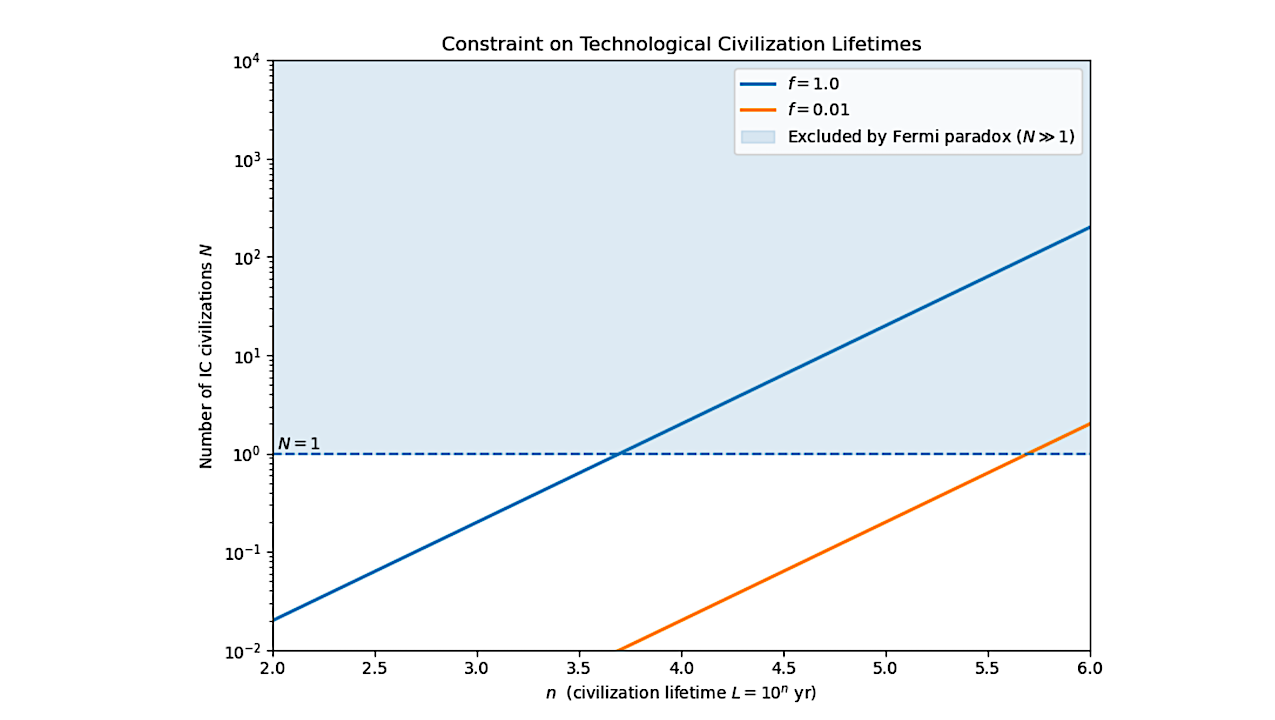
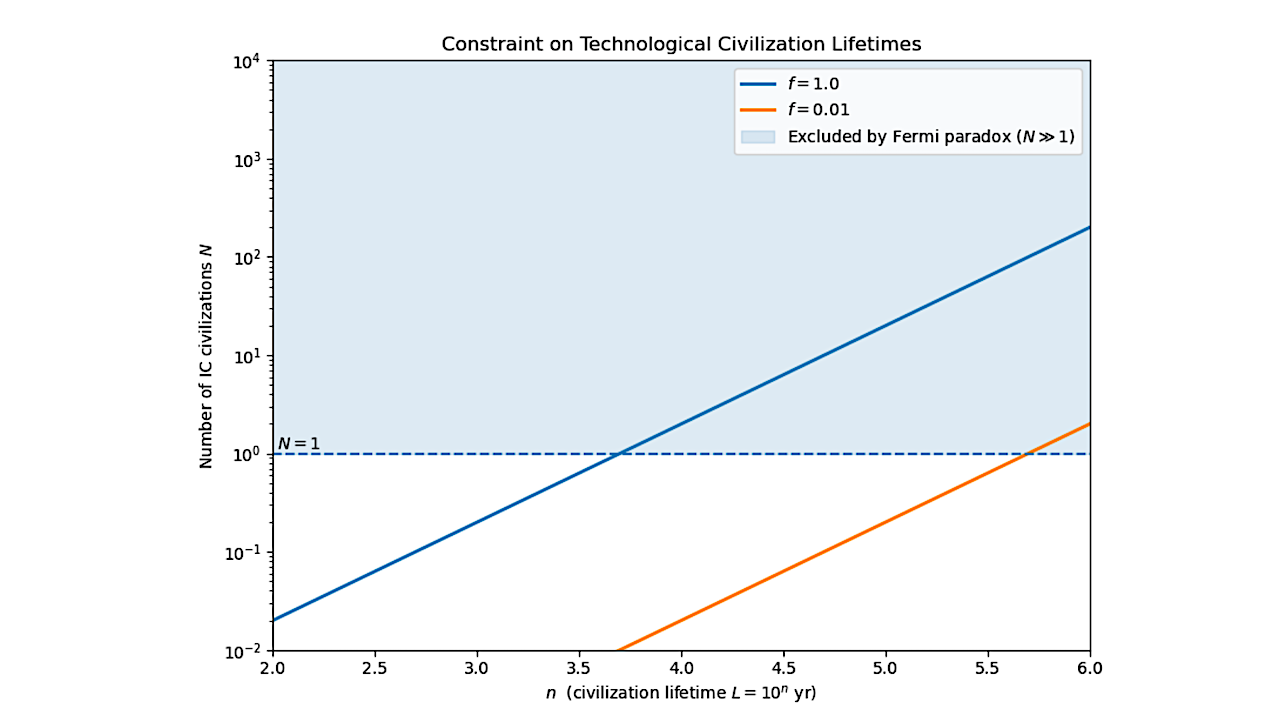
Constraint on the lifetime 𝐿 = 10𝑛 of intelligent technological civilizations derived from the Fermi paradox. The expected number of coexisting civilizations 𝑁 is shown as a function of the civilization lifetime for different assumptions about the probability 𝑓 that a habitable planet produces a technological civilization. The shaded region corresponds to values for which 𝑁 ≫ 1, which are observationally excluded by the absence of detected extraterrestrial civilizations. The dashed line indicates the boundary 𝑁 = 1 and is shown for reference. — astro-ph.GA
In this work, we explore constraints on the emergence and longevity of technologically intelligent civilizations in our Galaxy, considering the Fermi paradox.
We argue that under optimistic assumptions about the probability of life and intelligence emerging on Earth-like planets, the absence of contact with extraterrestrial civilizations imposes limits on their lifespan.
Our analysis suggests that if intelligent life is common, technological civilizations must be relatively short-lived, with lifetimes constrained to ≲5×10³ years under our most optimistic scenario.
Considering electromagnetic communication, we note that our current light cone encompasses the entire Galactic history over the past ∼105 years, making the lack of detected signals particularly puzzling for long-lived civilizations. We emphasize that these results should be interpreted as upper bounds derived from the Fermi paradox, not as predictions of actual lifespans.
Sohrab Rahvar, Shahin Rouhani
Comments: 4 pages, 1 figure, accepted in MNRAS Letters
Subjects: Astrophysics of Galaxies (astro-ph.GA); Earth and Planetary Astrophysics (astro-ph.EP); Popular Physics (physics.pop-ph)
Cite as: arXiv:2602.22252 [astro-ph.GA] (or arXiv:2602.22252v1 [astro-ph.GA] for this version)
https://doi.org/10.48550/arXiv.2602.22252
Focus to learn more
Submission history
From: Sohrab Rahvar
[v1] Tue, 24 Feb 2026 20:57:21 UTC (90 KB)
https://arxiv.org/abs/2602.22252
Astrobiology











Related Posts
Stay Informed With the Latest & Most Important News
Previous Post
Next Post

Advertisement
-
 01Two Black Holes Observed Circling Each Other for the First Time
 -
 02From Polymerization-Enabled Folding and Assembly to Chemical Evolution: Key Processes for Emergence of Functional Polymers in the Origin of Life
 -
 03Astronomy 101: From the Sun and Moon to Wormholes and Warp Drive, Key Theories, Discoveries, and Facts about the Universe (The Adams 101 Series)
 -
 04True Anomaly hires former York Space executive as chief operating officer
 -
 05Φsat-2 begins science phase for AI Earth images
 -
 06Hurricane forecasters are losing 3 key satellites ahead of peak storm season − a meteorologist explains why it matters
 -
 07Binary star systems are complex astronomical objects − a new AI approach could pin down their properties quickly