
Now Reading: Direct Imaging Constraints on Binary Planets and Exomoons around Epsilon Indi A b
-
01
Direct Imaging Constraints on Binary Planets and Exomoons around Epsilon Indi A b


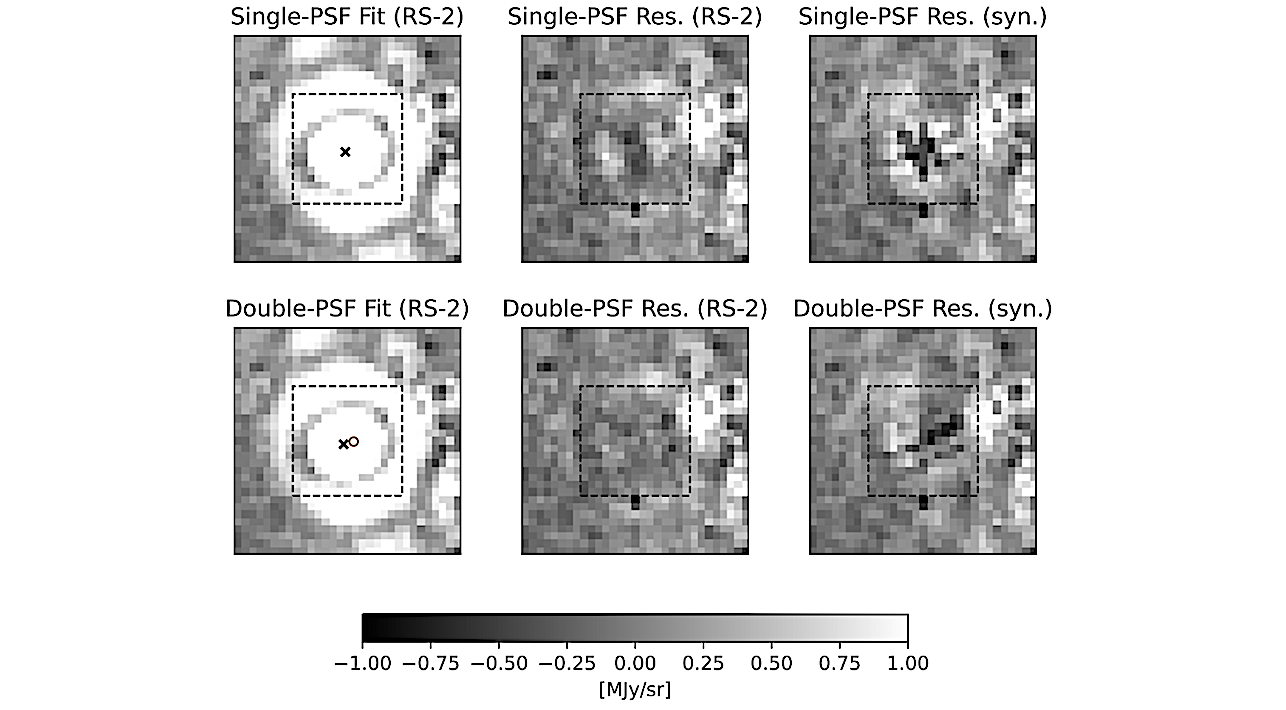
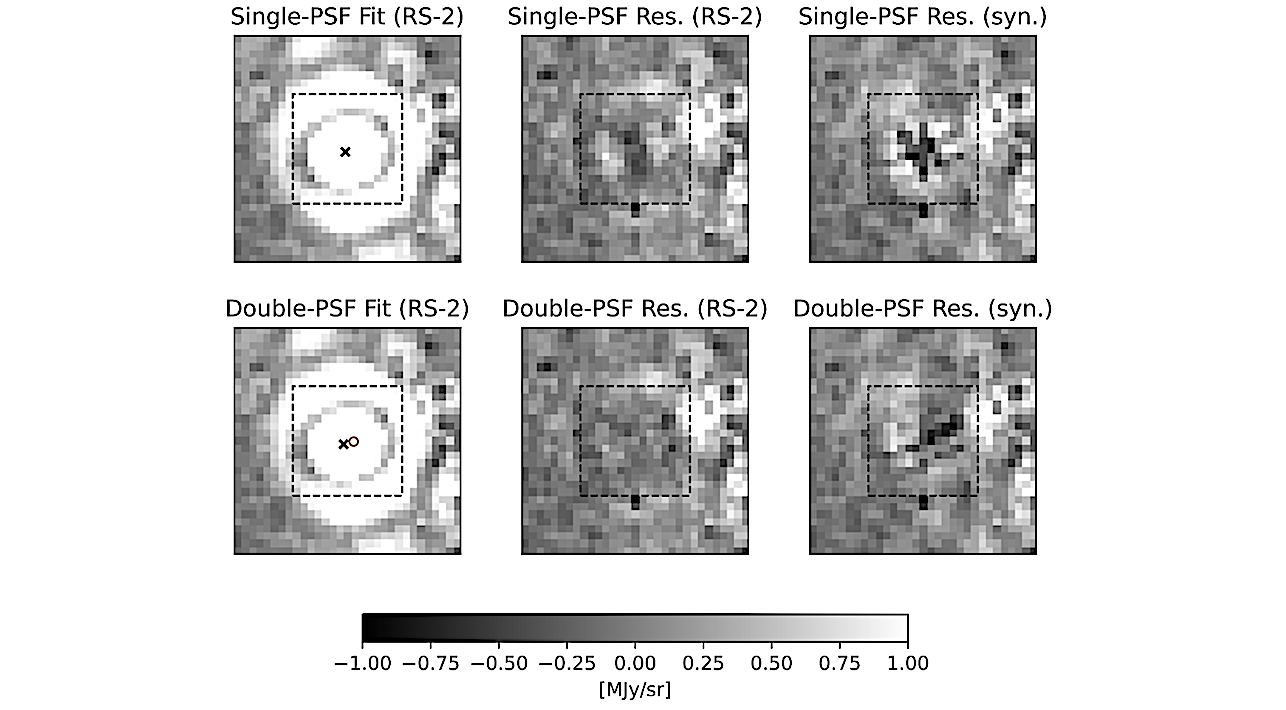
Fits and residuals of stage 3 F1550C data subtracted using the results of PyMultiNest single- and double-PSF fitting. Each panel indicates the 31×31 pixel cropped regions, while the dashed box indicates the 15×15 pixel test region used in fitting. The residuals are significantly reduced when a double-PSF fit is applied. In the left two panels, the injected data are shown, with a black cross and brown circle indicating the fitted locations of the primary and secondary, respectively (using RS-2 as a PSF model). The residuals of these fits are shown in the middle panels. The right panels show the residuals of fits using a synthetic StPSF model; these residuals are visibly larger than those of the reference star model. — astro-ph.EP
Epsilon Indi A b is a directly imaged ∼6MJup exoplanet orbiting a nearby (3.6 pc) K-dwarf at ∼30 AU.
We analyze archival JWST/MIRI 15 μm coronagraphic imaging of this planet to search for directly imaged satellites orbiting Eps Ind A b. Within the planet’s Hill sphere (radius RH≈2.3 AU or 1.3λ/D), we compare single- and double-PSF models using Bayesian evidence. We find that a double-PSF (binary planet) fit is preferred.
This apparent preference can most plausibly be explained by systematics, although follow-up observations would be required to fully rule out a binary planet interpretation. We construct a contrast curve of the exoplanet after removing this feature, demonstrating sensitivity to companions as faint as 0.03× the F1550C flux of Eps Ind A b (equivalent to T=130 K, 1.3MJup) at large separations (>2 AU).
We also demonstrate sensitivity to brighter companions 0.2× the F1550C flux of Eps Ind A b (equivalent to T=180 K, 2.5MJup) down to separations of 0.52 AU (1.3 pixels; 0.29λ/D; 144 mas). This study demonstrates that JWST/MIRI can directly detect exomoons or binary planets inside the Hill sphere of directly imaged exoplanets orbiting neighboring stars.
Matson Garza (1), Mary Anne Limbach (2), Rachel Bowens-Rubin (2 and 3), Matthew De Furio (4), Elisabeth C. Matthews (5), Kyle Franson (6), Sarah C. Millholland (1), Logan A. Pearce (2), Andrew Vanderburg (7) ((1) Department of Physics, Massachusetts Institute of Technology, (2) Department of Astronomy, University of Michigan, (3) Eureka Scientific Inc., (4) Department of Astronomy, The University of Texas at Austin, (5) Max Planck Institute for Astronomy, (6) Department of Astronomy and Astrophysics, The University of California, Santa Cruz, (7) Center for Astrophysics, Harvard & Smithsonian)
Comments: Accepted to AJ, 14 pages with 5 figures
Subjects: Earth and Planetary Astrophysics (astro-ph.EP)
Cite as: arXiv:2604.23448 [astro-ph.EP] (or arXiv:2604.23448v1 [astro-ph.EP] for this version)
https://doi.org/10.48550/arXiv.2604.23448
Focus to learn more
Submission history
From: Matson Garza
[v1] Sat, 25 Apr 2026 21:33:52 UTC (275 KB)
https://arxiv.org/abs/2604.23448
Astrobiology, exoplanet,










Related Posts
Stay Informed With the Latest & Most Important News
Previous Post
Next Post



Advertisement
-
 01Two Black Holes Observed Circling Each Other for the First Time
 -
 02From Polymerization-Enabled Folding and Assembly to Chemical Evolution: Key Processes for Emergence of Functional Polymers in the Origin of Life
 -
 03Astronomy 101: From the Sun and Moon to Wormholes and Warp Drive, Key Theories, Discoveries, and Facts about the Universe (The Adams 101 Series)
 -
 04True Anomaly hires former York Space executive as chief operating officer
 -
 05Φsat-2 begins science phase for AI Earth images
 -
 06Hurricane forecasters are losing 3 key satellites ahead of peak storm season − a meteorologist explains why it matters
 -
 07Binary star systems are complex astronomical objects − a new AI approach could pin down their properties quickly