
Now Reading: PEEPSS: Photonic-Enabled ExoPlanet Spectroscopic Sensor for the Habitable Worlds Observatory
-
01
PEEPSS: Photonic-Enabled ExoPlanet Spectroscopic Sensor for the Habitable Worlds Observatory

PEEPSS: Photonic-Enabled ExoPlanet Spectroscopic Sensor for the Habitable Worlds Observatory

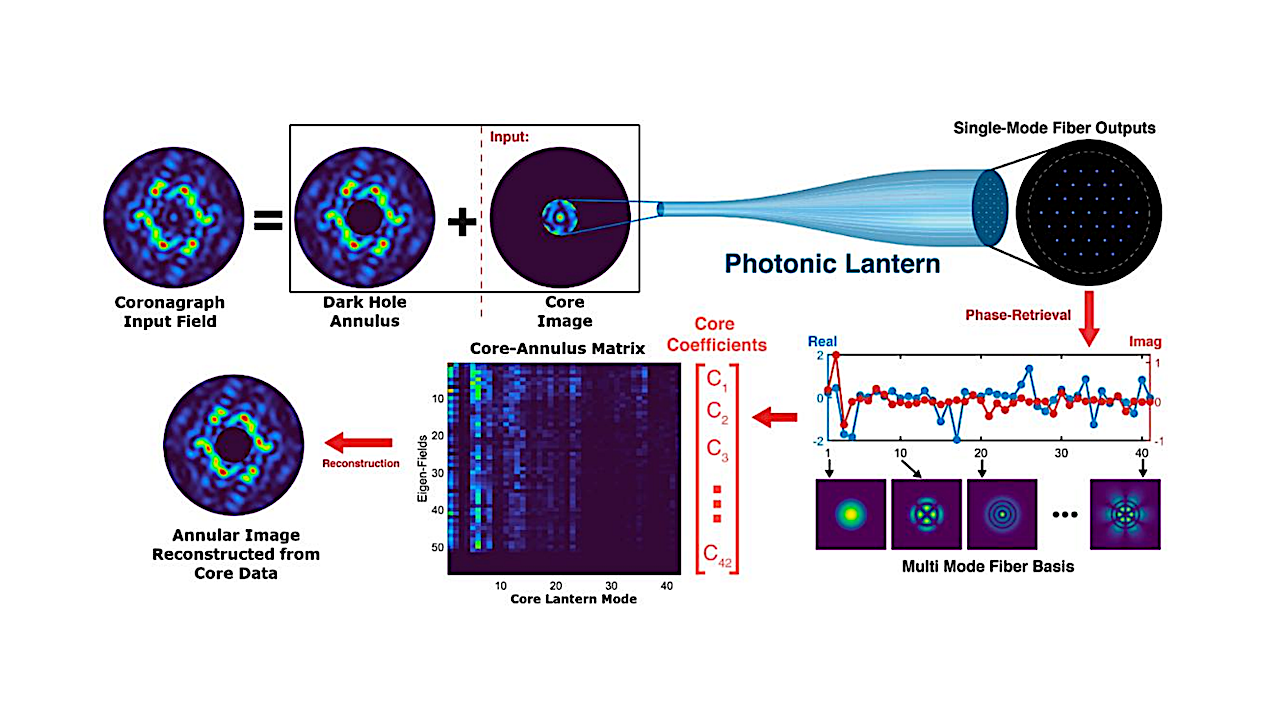

The complete proposed wavefront sensing process. (Starting from the top left and going around clockwise) The full coronagraph input field is separated into the dark hole and the core. A standard lantern splits the core region into spatial mode outputs, upon which we can perform a phase retrieval, giving us the phase and amplitude for each spatial mode. Using a previously calculated matrix to relate the core and the “eigenfields” (which describe the dark hole modes), we reconstruct the dark hole modes and light field based solely on the light in the core. Note that the “Dark Hole Annulus” and the “Annular Image Reconstructed from Core Data” are very similar, but the latter was reconstructed without any information contained in the original dark hole. — astro-ph.IM
The next few years will be critical for technology development for Habitable Worlds Observatory (HWO) in its mission to search for and characterize extrasolar planets.
To achieve its stated goals with contrasts of one part in ten billion, HWO will require outstanding stability and precision, particularly in measuring and controlling the wavefront of the light propagate through the telescope and coronagraph system.
We present simulations for the Photonic-Enabled ExoPlanet Spectroscopic Sensor (PEEPSS), which uses a set of photonic lanterns to efficiently couple light from the “dark hole” in the coronograph focal plane (where the exoplanets are expected to lie) into single-mode fibers and the main spectrograph.
PEEPSS uses rejected host star light from the region interior to the dark hole to aid in the wavefront sensing; this has the advantage of doing the sensing in the coronograph focal plane, eliminating non-common-path errors between the wavefront sensing and science channels. The photonics lanterns allow us to combine our science channel and wavefront sensor into a single system. PEEPSS will be particularly advantageous provide in the near-infrared (NIR) bandpass, which is of particular interest for HWO.
Because the limiting inner working angle (IWA) of a coronagraph scales as wavelength over diameter, exoplanet imaging in the NIR becomes a major challenge as the IWA can exceed the exoplanet orbital radius. PEEPSS will enable NIR coronagraphic observations at smaller IWA than other approaches, increasing the observational parameter space HWO can probe in the search for exoplanets.
Genevieve Markees, Stephen S. Eikenberry, Rodrigo Amezcua-Correa, Miguel Bandres, Rebecca Jensen-Clem, Sergio Leon-Saval, Laurent Pueyo, Raphaël Pourcelot
Subjects: Instrumentation and Methods for Astrophysics (astro-ph.IM)
Cite as: arXiv:2604.23126 [astro-ph.IM] (or arXiv:2604.23126v1 [astro-ph.IM] for this version)
https://doi.org/10.48550/arXiv.2604.23126
Focus to learn more
Related DOI:
https://doi.org/10.1117/12.3064610
Focus to learn more
Submission history
From: Genevieve Markees
[v1] Sat, 25 Apr 2026 03:48:22 UTC (525 KB)
https://arxiv.org/abs/2604.23126
Astrobiology, Exoplanet, Astronomy,










Related Posts
Stay Informed With the Latest & Most Important News
Previous Post
Next Post




Advertisement
-
 01Two Black Holes Observed Circling Each Other for the First Time
 -
 02From Polymerization-Enabled Folding and Assembly to Chemical Evolution: Key Processes for Emergence of Functional Polymers in the Origin of Life
 -
 03Astronomy 101: From the Sun and Moon to Wormholes and Warp Drive, Key Theories, Discoveries, and Facts about the Universe (The Adams 101 Series)
 -
 04True Anomaly hires former York Space executive as chief operating officer
 -
 05Φsat-2 begins science phase for AI Earth images
 -
 06Hurricane forecasters are losing 3 key satellites ahead of peak storm season − a meteorologist explains why it matters
 -
 07Binary star systems are complex astronomical objects − a new AI approach could pin down their properties quickly