
Now Reading: ESA astronaut reserve completes training programme
-
01
ESA astronaut reserve completes training programme



21/05/2026
279 views
7 likes
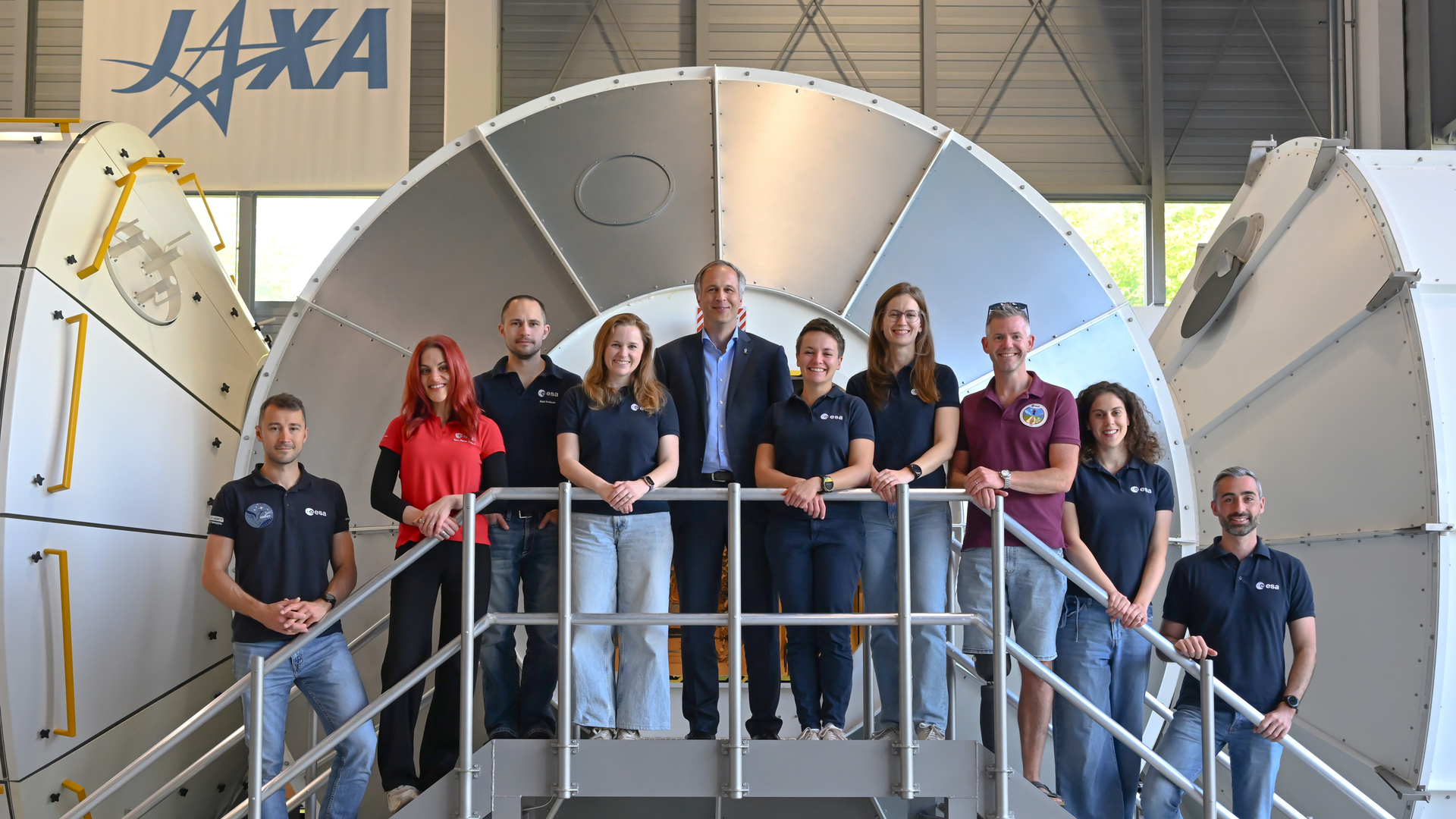
ESA’s astronaut reserve members have completed their Astronaut Reserve Training (ART) programme, marking a key milestone in Europe’s human spaceflight ambitions.
Since late 2024, and across three training blocks of around two months each, members of the reserve Sara García Alonso from Spain, Meganne Christian and John McFall from the UK, Anthea Comellini and Andrea Patassa from Italy, Carmen Possnig from Austria, Arnaud Prost from France, Amelie Schoenenwald from Germany and Aleš Svoboda from Czechia have developed a broad range of skills across technical, operational and scientific domains.
Following a staggered approach, they trained in smaller groups during certain phases before coming together at key stages. The final phase at the European Astronaut Centre (EAC) in Cologne, Germany, brought all members of the reserve together once more.
With this milestone, they now transition from training to readiness, prepared to support ESA missions when called upon.
From training to readiness
Based on modules from ESA’s basic astronaut training, the ART programme began in October 2024 with a focus on core astronaut competencies. During this initial phase, the astronaut reserve members built a foundation in ESA and International Space Station programmes as well as European space industry and institutions. Other key areas included human behaviour and performance, medical training, scientific operations and spacecraft systems, including flight engineering and life support.
They were also introduced to robotics and spacewalk familiarisation by scuba diving in the Neutral Buoyancy Facility to simulate microgravity underwater. Scientific training included biology and laboratory techniques, alongside physical training and public engagement activities.
The group also undertook survival exercises in winter conditions, preparing them for extreme environments they may encounter if their spacecraft lands in remote locations.
Building skills across disciplines
In the next phase, from early September to late October 2025, both groups came together at EAC for eight weeks of joint training. The focus expanded to how space missions are designed and carried out, covering topics such as propulsion, orbital mechanics and spacecraft systems.
Training then shifted to life aboard the International Space Station, including onboard operations, experiment handling and the use of cameras and video equipment. Scenario-based exercises and teamwork became increasingly important, strengthening coordination and decision-making under pressure.
The programme also included sea survival training, firefighting exercises and further work in the Neutral Buoyancy Facility, preparing the reserve members for emergency situations and spacewalk basics.
Scientific training deepened with modules on human physiology, science for exploration and payloads, while media and communication training supported their role as public representatives of ESA. Sessions on space law and policy provided additional context on the wider space environment.
A highlight of the programme was the patch ceremony, held at the end of the second training block in September 2025.
Final training block
The third and final training block at EAC started in March 2026 with eight more weeks of staggered training for two groups. Training included additional sessions in the Neutral Buoyancy Facility, Space Station systems, communications andonboard procedures, and robotics training using virtual reality to build spatial awareness for systems such as the Space Station’s Canadarm2 robotic arm.
The members of the reserve also gained insight into launch operations and the broader mission lifecycle, alongside scientific and Earth observation training to support work in orbit. Together, these elements consolidated their knowledge and brought everyone to a common level of readiness.
By completing ART, ESA’s astronaut reserve now forms a flexible pool of trained individuals, equipped with the skills, knowledge and teamwork needed to contribute to Europe’s space ambitions through missions in low Earth orbit, commercial spaceflight and future exploration beyond Earth orbit.
Members of ESA’s astronaut reserve reflect on their training
Sara García Alonso
Looking back, what stands out is how everything connects – from scientific research to operations. It has been particularly challenging to absorb such a vast amount of knowledge across so many different and diverse disciplines in a short time. Yet, what truly made this experience incredible was the people. From my fellow astronauts and instructors to the interns and the entire EAC staff, every phase added a new piece. By the end, you really see how your own background contributes to a much bigger mission. It’s a very rewarding perspective.
Meganne Christian
There were some real highlights during this session, including robotics training and the “Move Dive” around a mock-up in the Neutral Buoyancy Facility. But the best part was being able to share that with my colleagues. We have learnt from each other, shared experiences, and come together as a strong team. It’s exciting to now feel ready to contribute to future missions in a meaningful way.
Anthea Comellini
Being part of ESA’s Astronaut Reserve is an incredible opportunity. The training is intense but highly rewarding, not only building skills for spaceflight but also challenging us to grow on a personal level. It has been a chance to learn more about us, push our limits and take pride in what we can achieve. Working within such a diverse group has made that journey even more meaningful and strengthened how we contribute to Europe’s future in space.
John McFall
This programme really highlights how many different elements come together in human spaceflight. From science to operations and communication, everything plays a role. Learning to integrate those aspects has been a key part of the experience.
Andrea Patassa
This training has been about continuous progression. Every block brought new challenges and skills, but thanks to our diverse backgrounds, we were able to complement each other and learn from our classmates as much as from the instructors. We now look forward to putting into practice what we have learned!
Carmen Possnig
By the end of ART, you feel a real shift from learning to applying. Having worked in extreme environments on Earth, I recognise the value of this training and its meaningful contribution to preparing us for space. Whether in survival exercises or operational scenarios, the key is staying adaptable and working closely as a team. ART brings those elements together in a very focused way.
Arnaud Prost
The final phase really brought everything together. You begin to understand how systems, procedures and teamwork all interact in a real mission scenario. Each phase challenged us to adapt — not only to new technical systems, but also to different roles within a team. By the end, you see how important that flexibility is for operating effectively in space, thanks to the guidance and support of the EAC trainers throughout the programme.
Amelie Schoenenwald
What stays with me most is the unique combination of scientific depth, operational precision and teamwork throughout the training. Every experience challenged us to keep learning, adapting and supporting one another. I feel grateful for the experience and equipped to continue this journey with even greater motivation and respect for everyone involved in human spaceflight.
Aleš Svoboda
Following the training step by step, from the fundamentals to more complex, integrated scenarios, gives you a real sense of how space missions come together. Experiences like working underwater to simulate microgravity or diving deeper into engineering and operations make the whole process much more tangible. It really highlights both the complexity and the responsibility of what we are preparing for.










Related Posts

Stay Informed With the Latest & Most Important News
Previous Post
Next Post


Advertisement
-
 01Two Black Holes Observed Circling Each Other for the First Time
 -
 02From Polymerization-Enabled Folding and Assembly to Chemical Evolution: Key Processes for Emergence of Functional Polymers in the Origin of Life
 -
 03Astronomy 101: From the Sun and Moon to Wormholes and Warp Drive, Key Theories, Discoveries, and Facts about the Universe (The Adams 101 Series)
 -
 04True Anomaly hires former York Space executive as chief operating officer
 -
 05Φsat-2 begins science phase for AI Earth images
 -
 06Hurricane forecasters are losing 3 key satellites ahead of peak storm season − a meteorologist explains why it matters
 -
 07Binary star systems are complex astronomical objects − a new AI approach could pin down their properties quickly