
Now Reading: European Space Agency Unveils First Prototype of Innovative Space Rider Spacecraft
-
01
European Space Agency Unveils First Prototype of Innovative Space Rider Spacecraft

European Space Agency Unveils First Prototype of Innovative Space Rider Spacecraft

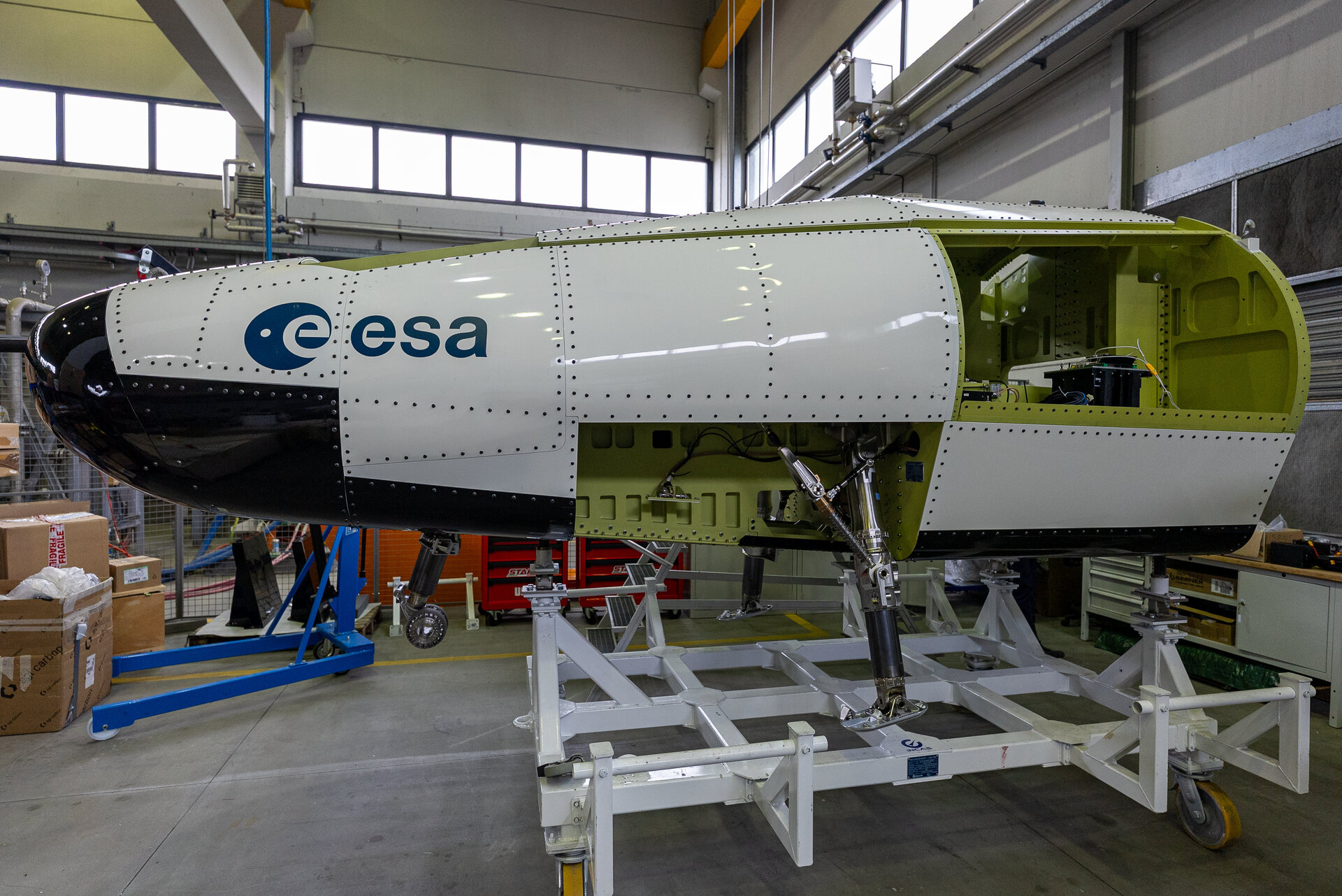

The European Space Agency announced that the first full-scale prototype of its Space Rider spacecraft has been completed. The model was constructed at the Italian Aerospace Research Centre in Capua, Italy, and is tailored for future testing as part of the development of Europe’s inaugural reusable space transportation system.
Set to function as an uncrewed robotic laboratory, Space Rider is scheduled to remain in low Earth orbit for approximately two months per mission. Its cargo bay is designed to support a diverse array of scientific experiments and missions. At the conclusion of its operations, the spacecraft will re-enter the atmosphere and descend via a parafoil, gliding to a runway for a targeted touchdown—an innovative feature that has not been tested before in operational spacecraft.
The drop-test model originated from Romania’s National Institute for Aerospace Research ‘Elie Carafoli’ (INCAS) in Craiova, where it was assembled before being transported to CIRA for further integration. The upcoming tests will involve dropping the model from a helicopter as part of preparations for simulating the final landing phase from orbit.
The spacecraft’s avionics system, described as its “brain,” was installed in early March. This advanced computer system will handle the guidance, navigation, and control algorithms crucial for steering the parafoil, with the ability to adjust for variable wind conditions during its descent. The drop-test model, roughly resembling a mini-van in size, represents the true dimensions of the Space Rider’s 4.6-meter reentry module.
Integrating the parafoil—a significant component of the descent procedure—was a meticulous process, taking three weeks to accomplish with the aid of custom machinery. Measuring 27 meters long and 10 meters wide, the parafoil must safely support the spacecraft’s weight of nearly 2,950 kilograms as it glides back to Earth. Two winches will control the steering lines of the parafoil autonomously, with no human intervention during the descent.
Aldo Scaccia, the Space Segment manager at ESA, expressed excitement over the progress of the Space Rider project. “It is wonderful to see the reentry module taking shape,” he noted. “The teams cannot wait to put this model through its paces and see it fly and glide.” Testing is slated to commence later this year over the Salto di Quirra test range in Sardinia, Italy, with the model being airlifted from heights up to three kilometers. Thales Alenia Space Italy and Avio are leading the industrial efforts for the Space Rider Program.










Related Posts


Stay Informed With the Latest & Most Important News
Previous Post
Next Post





Advertisement
-
 01Two Black Holes Observed Circling Each Other for the First Time
 -
 02From Polymerization-Enabled Folding and Assembly to Chemical Evolution: Key Processes for Emergence of Functional Polymers in the Origin of Life
 -
 03Astronomy 101: From the Sun and Moon to Wormholes and Warp Drive, Key Theories, Discoveries, and Facts about the Universe (The Adams 101 Series)
 -
 04True Anomaly hires former York Space executive as chief operating officer
 -
 05Φsat-2 begins science phase for AI Earth images
 -
 06Hurricane forecasters are losing 3 key satellites ahead of peak storm season − a meteorologist explains why it matters
 -
 07Binary star systems are complex astronomical objects − a new AI approach could pin down their properties quickly