
Now Reading: First Interstellar Detection of Methyl Carbamate: A New Observational Anchor for Glycine Chemistry
-
01
First Interstellar Detection of Methyl Carbamate: A New Observational Anchor for Glycine Chemistry

First Interstellar Detection of Methyl Carbamate: A New Observational Anchor for Glycine Chemistry

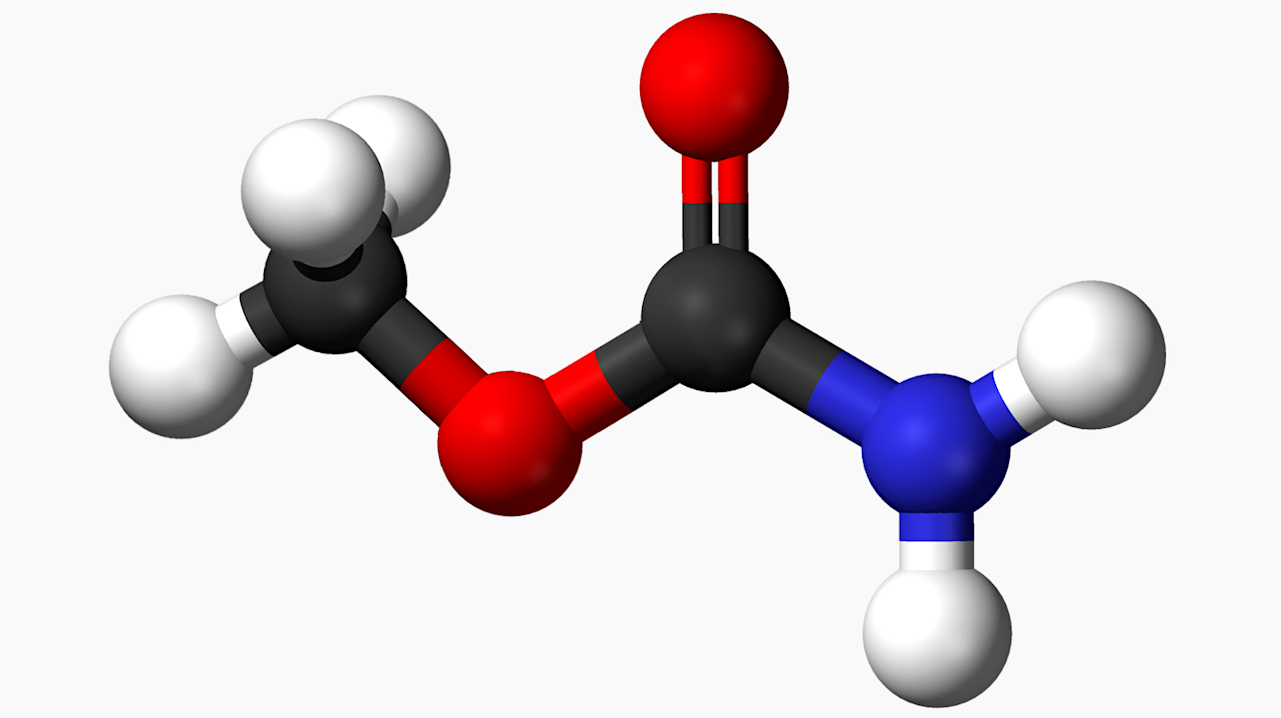

Methyl Carbamate — WIkipedia
Glycine-the simplest amino acid-has remained undetected in the interstellar medium despite decades of sensitive searches, motivating alternative approaches to constrain its astrochemical origin.
A promising strategy is to investigate the broader C2H5O2N isomer family and identify detectable members that can serve as observational anchors for glycine-related chemistry. Herein, we report the first robust interstellar detection of methyl carbamate toward the hot molecular core G358.93-0.03 MM1 using ALMA 1 mm observations.

Ten unblended rotational transitions are identified, yielding a column density of (4.21±0.84)×1015cm−2 and an excitation temperature of 204±10 K. We also searched for other C2H5O2N isomers with available rotational spectroscopic data, including glycine, but none were detected, allowing us to derive upper limits on their column densities. The resulting abundance pattern deviates significantly from the Minimum Energy Principle predictions, highlighting that the C2H5O2N family is shaped primarily by kinetic chemical process rather than thermodynamic equilibrium.
The observed methyl carbamate abundance is consistent with a grain-surface formation scenario involving radical-radical recombination (CH3O + NH2CO), further supported by its correlated abundances with its proposed precursors, methanol and formamide, across diverse astrophysical environments.
This detection establishes methyl carbamate as a new observational anchor for glycine chemistry, providing critical constraints on the formation pathways of amino-acid-related molecules in star-forming regions.
Chunguo Duan, Fengwei Xu, Jun Kang, Qian Gou, Xuefang Xu, Laurent Pagani, Jiaxin Du, Xi Chen
Comments: 14 pages, 6 figures, 3 tables, accepted for publication in ApJL
Subjects: Astrophysics of Galaxies (astro-ph.GA)
Cite as: arXiv:2605.07159 [astro-ph.GA] (or arXiv:2605.07159v1 [astro-ph.GA] for this version)
https://doi.org/10.48550/arXiv.2605.07159
Focus to learn more
Submission history
From: Chunguo Duan
[v1] Fri, 8 May 2026 02:45:14 UTC (15,684 KB)
https://arxiv.org/abs/2605.07159
Astrobiology, Astrochemistry,










Related Posts
Stay Informed With the Latest & Most Important News
Previous Post
Next Post



Advertisement
-
 01Two Black Holes Observed Circling Each Other for the First Time
 -
 02From Polymerization-Enabled Folding and Assembly to Chemical Evolution: Key Processes for Emergence of Functional Polymers in the Origin of Life
 -
 03Astronomy 101: From the Sun and Moon to Wormholes and Warp Drive, Key Theories, Discoveries, and Facts about the Universe (The Adams 101 Series)
 -
 04True Anomaly hires former York Space executive as chief operating officer
 -
 05Φsat-2 begins science phase for AI Earth images
 -
 06Hurricane forecasters are losing 3 key satellites ahead of peak storm season − a meteorologist explains why it matters
 -
 07Binary star systems are complex astronomical objects − a new AI approach could pin down their properties quickly