
Now Reading: Hancom InSpace gains hyperspectral sensor
-
01
Hancom InSpace gains hyperspectral sensor


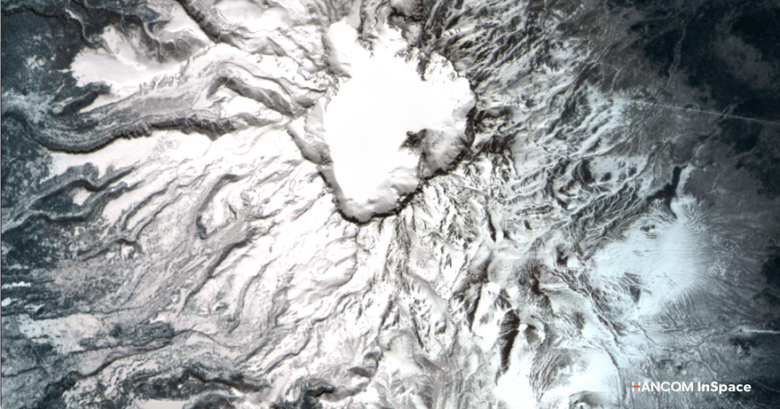
DENVER – South Korea’s Hancom InSpace is expanding its Earth-observation constellation with Sejong-3, a cubesat with a hyperspectral sensor, launched in March on a SpaceX Transporter rideshare and currently undergoing commissioning.
“Sejong-3 is an important addition to our Sejong constellation because it brings hyperspectral capability alongside the multispectral imaging already provided by Sejong-2 and Sejong-4,” Seeung-chan “Wesley” Heo, Hancom InSpace overseas business manager, told SpaceNews. “This supports a broader range of Earth observation applications such as vegetation monitoring, mineral monitoring, soil observations, and environmental analysis.”

Hancom InSpace, a spinoff of the Korea Aerospace Research Institute was acquired in 2020 by South Korean technology conglomerate Hancom Group to fuse space and airborne data for decision-support services.
For Sejong-1, launched in 2022, and Sejong-2, launched in June 2025, Hancom InSpace multispectral instruments were mounted on Spire Global cubesats. South Korea’s Nuri Korean Space Launch Vehicle sent another Hancom InSpace electro-optical satellite, Sejong-4, into low-Earth orbit in November. Spire also provided the satellite, launch and operations for Sejong-3.
Hancom InSpace is “in the early stage of development” of Sejong-5, a satellite currently being developed that may be equipped with a chip-scale atomic clock.
Hancom InSpace plans “to continue expanding the Sejong series in order to provide Earth observation data more frequently and precisely, strengthening our overall service capabilities, Heo said.










Related Posts
Stay Informed With the Latest & Most Important News
Previous Post
Next Post

Advertisement
-
 01Two Black Holes Observed Circling Each Other for the First Time
 -
 02From Polymerization-Enabled Folding and Assembly to Chemical Evolution: Key Processes for Emergence of Functional Polymers in the Origin of Life
 -
 03Astronomy 101: From the Sun and Moon to Wormholes and Warp Drive, Key Theories, Discoveries, and Facts about the Universe (The Adams 101 Series)
 -
 04True Anomaly hires former York Space executive as chief operating officer
 -
 05Φsat-2 begins science phase for AI Earth images
 -
 06Hurricane forecasters are losing 3 key satellites ahead of peak storm season − a meteorologist explains why it matters
 -
 07Binary star systems are complex astronomical objects − a new AI approach could pin down their properties quickly