
Now Reading: How much water on exoplanets does life need?
-
01
How much water on exoplanets does life need?


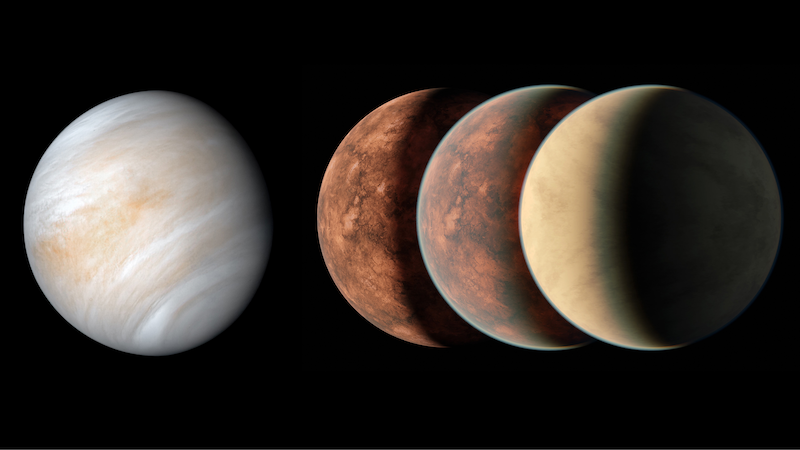
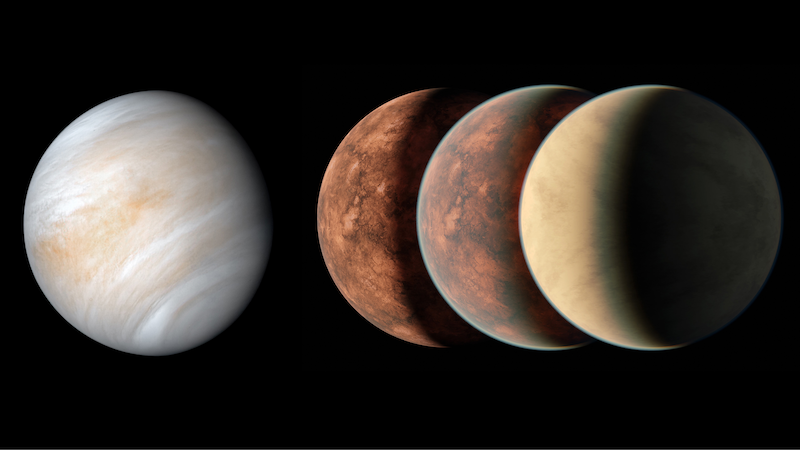
- Life as we know it needs water to exist. But how much water does an exoplanet need to be habitable in the long term?
- More water than previously thought is the answer suggested by a new study.
- At least 20 to 50% of the water on Earth would be required. Otherwise, the planet might start losing water on its surface and become arid.
How much water does an exoplanet need to stay habitable?
Astronomers consider water to be essential for life as we know it to form on a given planet. But, unfortunately, not all watery worlds stay watery. Venus, according to some studies, once had as much water as Earth does … but is now scorching hot, arid, and lifeless.
A new study from researchers at the University of Washington in Seattle suggests that Venus starting out with slightly less water than Earth could have made all the difference. The researchers said on April 15, 2026, that this lack of water could have destabilized the cycle of carbon between the planet’s atmosphere and interior. This would have caused carbon dioxide to build up in the air, raising temperatures and causing more water to evaporate.
So how much water does a world need to stay habitable? The study suggests that a rocky Earth-sized planet would need at least 20 to 50% of the water in Earth’s oceans to avoid this fate. That should be enough to maintain the crucial carbon cycle, keeping water on the surface long enough to potentially give water-based life time to develop.
This applies to planets in the habitable zone of their stars in particular. That’s the region where temperatures could allow liquid water to exist to begin with.
The researchers – lead author Haskelle Trigue White-Gianella and co-author Joshua Krissansen-Totton – published their new peer-reviewed results in The Planetary Science Journal on April 15, 2026.
The habitable zone
Scientists have long focused on the habitable zone around stars in the search for life. That’s because this is where liquid water could exist on rocky planets. But that depends on other factors, too, such as the composition of the atmosphere (if there is one) and the planet itself. White-Gianella said:
When you are searching for life in the broad landscape of the universe with limited resources, you have to filter out some planets.
Carbon Cycle Imbalances on Arid Terrestrial Planets with Implications for Venus: iopscience.iop.org/article/10.3… -> Planets need more water to support life than scientists previously thought: www.washington.edu/news/2026/04…
Arid planets with little water
To try to determine how much water a planet needs to be habitable, the study focused on arid planets that likely only have a little water. White-Gianella explained:
We were interested in arid planets with very limited surface water inventory, far less than one Earth ocean. Many of these planets are in the habitable zone of their star, but we weren’t sure if they could actually be habitable.
The carbon cycle
Since some of those planets are in the habitable zone, could they be habitable even with less water?
The researchers found that it depends on something called the carbon cycle. This cycle, driven by water, exchanges carbon between the atmosphere and interior of the planet, over millions of years. This process helps stabilize temperatures on the surface of the planet.
How does it work? Volcanoes emit carbon dioxide. The carbon dioxide accumulates in the atmosphere. Eventually it falls back to Earth in rain. Subsequently, the rain erodes and chemically reacts with rocks. The runoff in rivers brings the carbon back to the ocean, where it sinks down to the seafloor. Carbon-rich oceanic plates then move below the continental plates. Finally, millions of years later, the carbon comes back up to the surface in the form of mountains.
Low water levels
But there’s a catch. What if water levels drop too low for rainfall to occur? The carbon removal segment of the cycle – erosion by rain – can no longer keep up with carbon emissions from volcanoes. As a result, carbon dioxide builds up in the atmosphere. And this could create a runaway greenhouse effect, with temperatures becoming too hot to sustain life. This is what scientists say happened with Venus. As White-Gianella noted:
So that, unfortunately, makes these arid planets within habitable zones unlikely to be good candidates for life.
Krissanen-Totton said:
This has implications for a lot of the potentially habitable real estate out there.

Updating previous carbon models
The new carbon model of the study, focusing on arid planets, is an update to previous models. Those models focused more on water and cooler planets. They included factors such as evaporation from sunlight. But they neglected other factors, such as wind. Krissanen-Totton explained:
These sophisticated, mechanistic models of the carbon cycle have emerged from people trying to understand how Earth’s thermostat has worked – or hasn’t – to regulate temperature through time.
The new results show that even if a planet starts out with lots of surface water, it can lose it later on if the carbon cycle is interrupted.
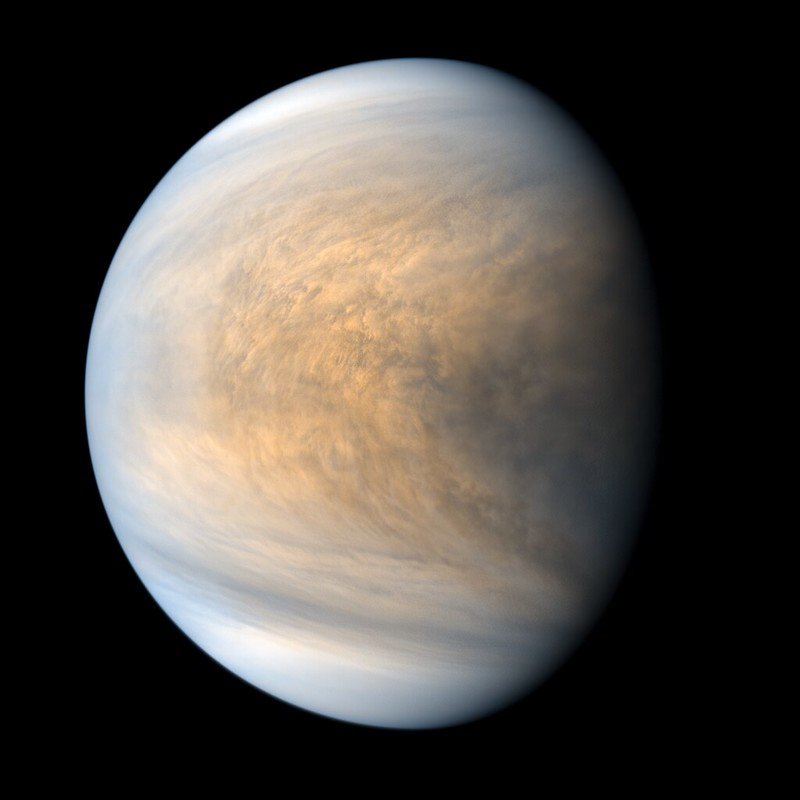
Venus as an exoplanet analog
We already know of one such planet, and it’s in our own solar system: Venus. Scientists think Venus once had much more water, maybe even oceans. But Venus has since lost that water. Why?
Today, Venus is scorching hot on its surface, too hot for life. The dense carbon dioxide atmosphere traps heat so it can’t escape.
The researchers in the new study suggest that Venus might have had slightly less water than Earth early on. This caused an imbalance in the carbon cycle. And as the carbon dioxide accumulated in the atmosphere, the temperature kept rising.
Venus is a good analog for the kinds of exoplanets the researchers studied. As White-Gianella noted:
It’s very unlikely that we will land something on the surface of an exoplanet in our lifetime, but Venus – our next-door neighbor – is arguably the best exoplanet analog.
Speaking of Venus, another study, from 2025, suggests that Venus actually has more water in its atmosphere than previously thought. It’s still fire and brimstone on the surface, but perhaps this water could help sustain microbes that scientists have postulated could survive higher up in the atmosphere.
Bottom line: How much water on exoplanets does life need? A new study suggests at least 20 to 50% of the water on Earth.
Source: Carbon Cycle Imbalances on Arid Terrestrial Planets with Implications for Venus
Read more: Water on exoplanets is mostly hidden deep inside
Read more: New study says water in Venus’ clouds surprisingly abundant
The post How much water on exoplanets does life need? first appeared on EarthSky.










Related Posts
Stay Informed With the Latest & Most Important News
Previous Post
Next Post




Advertisement
-
 01Two Black Holes Observed Circling Each Other for the First Time
 -
 02From Polymerization-Enabled Folding and Assembly to Chemical Evolution: Key Processes for Emergence of Functional Polymers in the Origin of Life
 -
 03Astronomy 101: From the Sun and Moon to Wormholes and Warp Drive, Key Theories, Discoveries, and Facts about the Universe (The Adams 101 Series)
 -
 04True Anomaly hires former York Space executive as chief operating officer
 -
 05Φsat-2 begins science phase for AI Earth images
 -
 06Hurricane forecasters are losing 3 key satellites ahead of peak storm season − a meteorologist explains why it matters
 -
 07Binary star systems are complex astronomical objects − a new AI approach could pin down their properties quickly