
Now Reading: European-Chinese Smile mission rescheduled for May 2026 launch to study solar wind effects on Earth’s atmosphere
-
01
European-Chinese Smile mission rescheduled for May 2026 launch to study solar wind effects on Earth’s atmosphere

European-Chinese Smile mission rescheduled for May 2026 launch to study solar wind effects on Earth’s atmosphere

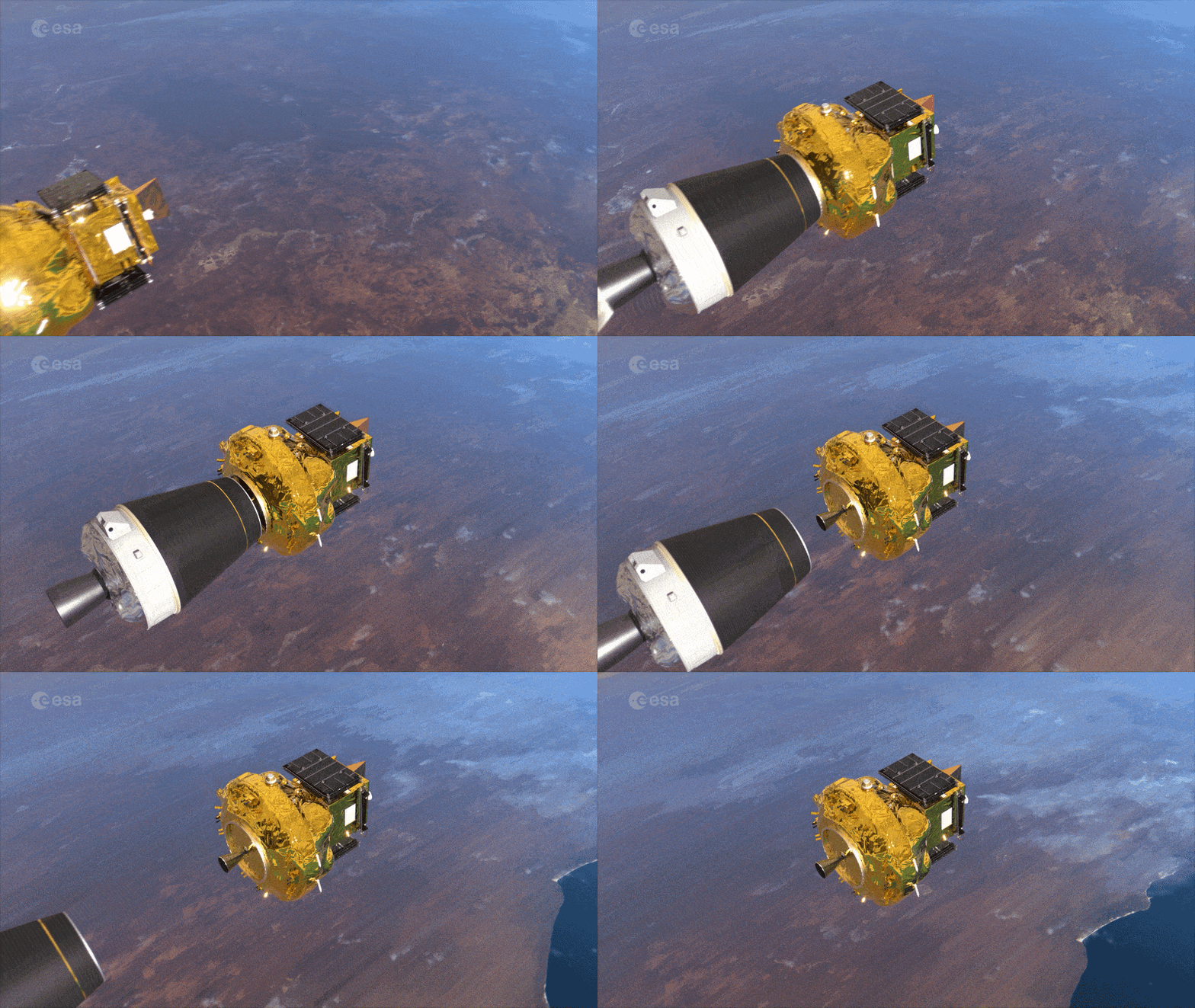

The European-Chinese Smile mission is set to launch on May 19, 2026, at 05:52 CEST, aboard a Vega-C rocket from French Guiana. This decision came after the original launch date was pushed back due to a technical issue detected in the production line of a subsystem component on the rocket. After thorough investigations, both the Smile spacecraft and the Vega-C rocket were confirmed to be stable and safe, leading to the new launch schedule.
Smile, which stands for Solar wind Magnetosphere Ionosphere Link Explorer, is a collaborative project between the European Space Agency (ESA) and the Chinese Academy of Sciences (CAS). The mission aims to enhance our understanding of how Earth’s atmosphere reacts to the solar wind and solar radiation. It will use advanced instruments—an X-ray camera to conduct the first observations of Earth’s magnetic field through X-ray imaging, and an ultraviolet camera to continuously monitor the auroras for durations of up to 45 hours.
Preparations for the launch are underway, with Smile having already been fuelled and integrated with its rocket adapter, then secured within the rocket’s fairing. During the liftoff, the Vega-C will undergo a series of separations over a 57-minute flight before releasing Smile into low-Earth orbit. Following this, the spacecraft will unfold its solar panels approximately six minutes later, a critical milestone signaling a successful launch. From its initial orbit, Smile will maneuver to reach its final elliptical orbit, approximately 121,000 kilometers above the North Pole and descending to about 5,000 kilometers over the South Pole for data relay.
The Smile mission, an integral part of ESA’s Cosmic Vision program, addresses key questions regarding the mechanics of our Solar System by using four scientific instruments to study various aspects of space weather, thereby improving our overall knowledge of geomagnetic storms and solar activity. ESA is responsible for the spacecraft’s payload module and several scientific instruments, while CAS manages the remaining instruments and the spacecraft operations once in orbit.
To keep up with the latest developments regarding the Smile mission, interested individuals can visit dedicated online resources and follow ESA’s social media channels for ongoing updates.










Related Posts
Stay Informed With the Latest & Most Important News
Previous Post
Next Post

Advertisement
-
 01Two Black Holes Observed Circling Each Other for the First Time
 -
 02From Polymerization-Enabled Folding and Assembly to Chemical Evolution: Key Processes for Emergence of Functional Polymers in the Origin of Life
 -
 03Astronomy 101: From the Sun and Moon to Wormholes and Warp Drive, Key Theories, Discoveries, and Facts about the Universe (The Adams 101 Series)
 -
 04True Anomaly hires former York Space executive as chief operating officer
 -
 05Φsat-2 begins science phase for AI Earth images
 -
 06Hurricane forecasters are losing 3 key satellites ahead of peak storm season − a meteorologist explains why it matters
 -
 07Binary star systems are complex astronomical objects − a new AI approach could pin down their properties quickly