
Now Reading: Latvia joins the Artemis Accords
-
01
Latvia joins the Artemis Accords


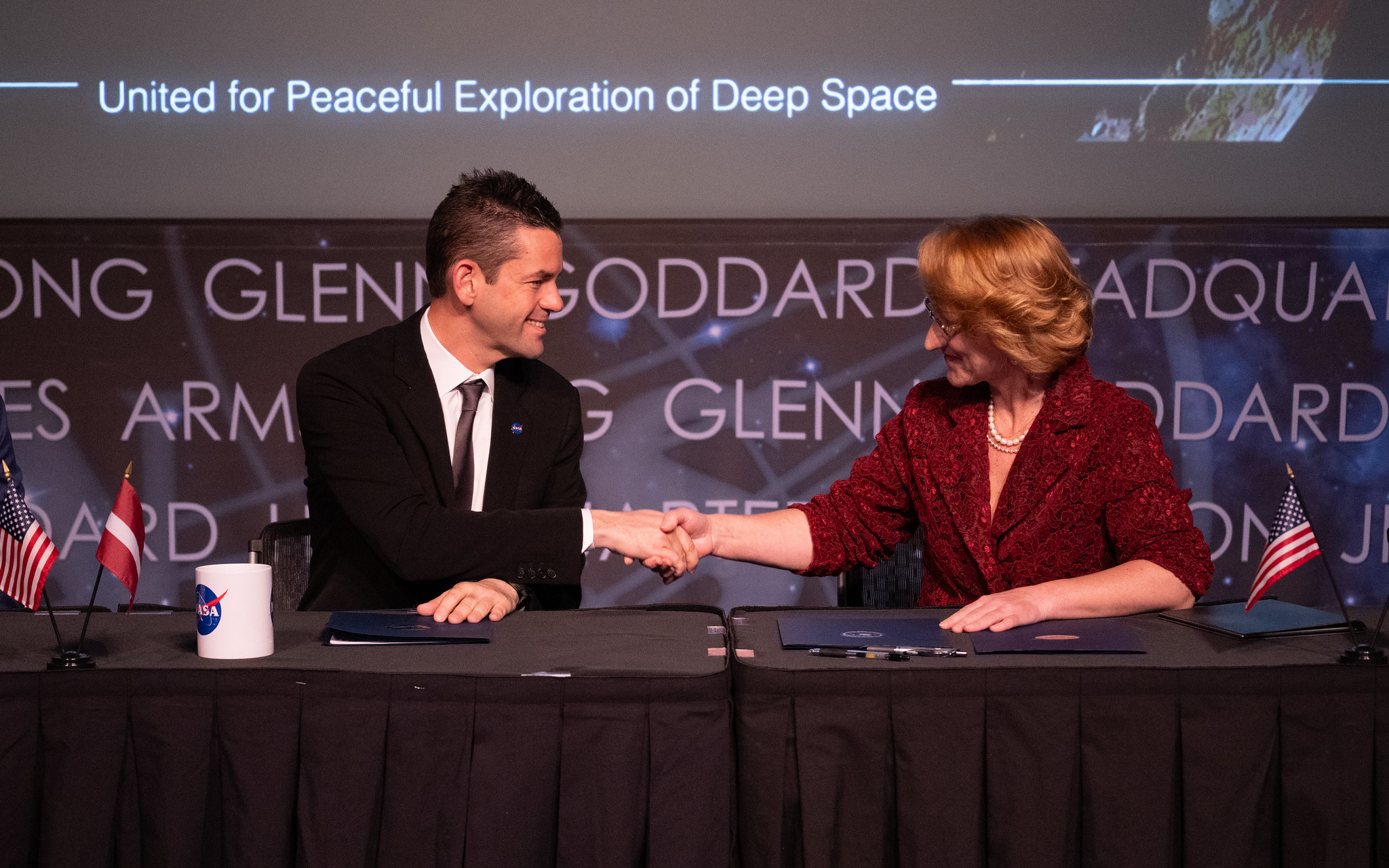

WASHINGTON — Latvia is the latest country to sign the Artemis Accords as part of a new push to use the Accords to foster cooperation on NASA’s lunar exploration ambitions.
In a ceremony at NASA Headquarters April 20, Dace Melbārde, Latvia’s minister for education and science, signed the Accords on behalf of the country. Latvia is the 62nd country to sign the Accords overall and the third this year, after Oman and Portugal.
Latvia had signaled its intent to sign the Accords in October, with Melbārde stating at the time that the country was doing so to demonstrate its commitment “to exploring and using space responsibly and sustainably.” Neither she nor other officials explained why the country waited half a year to sign.
“Latvia is proud to join this multilateral framework, confirming our unwavering commitment to the peaceful, transparent and rules-based exploration of outer space,” she said at the signing ceremony.
The United States announced the Artemis Accords in 2020 to build upon principles outlined in the Outer Space Treaty and other agreements, establishing best practices for the safe and sustainable exploration of outer space. Its principles range from transparency and interoperability to deconfliction of space activities and utilization of space resources.
“By joining the Artemis Accords, we are declaring something, I think, very simple, but also very, very powerful. We are declaring that the future of space exploration is based on trust, cooperation and shared principles,” said Jānis Beķeris, chargé d’affaires at the Embassy of the Republic of Latvia to the United States, at the ceremony.
He noted, though, that signing the Accords meant more for the country than signaling support for its various principles. “It also opens up new opportunities for our scientists and entrepreneurs to take part in joint projects to innovate and to contribute to the global space economy.”
The signing comes shortly after the Artemis 2 mission as well as NASA’s Ignition event March 24, where the agency outlined new exploration initiatives, including development of a lunar base over the next decade. That base offers new opportunities for countries that have signed the Accords to cooperate on Artemis.
Representatives of 42 countries were at the Ignition event despite a “tight window” for confirming their attendance, said Kathleen Karika, senior adviser in NASA’s Office of International and Interagency Relations, during a presentation at the 41st Space Symposium April 14.
“We were able to gather that group so quickly because we have been talking about it for so long together, and now we finally have the programs where we’re going to go and collaborate on the moon,” she said.
An example of that, she said, was a joint statement of intent NASA signed after the event with the Italian space agency ASI regarding a lunar base habitat module. “We are so thrilled to have strong support from our international partners as we rolled out this moon base concept and plans.”
“Latvia is joining at a critical moment. The success of the Artemis 2 mission was the opening act of humanity’s grand return to the lunar surface,” NASA Administrator Jared Isaacman said at the signing ceremony. “Our Artemis allies can and will make real investments in the hardware that will build humanity’s enduring presence on the lunar surface.”
Work also continues among signatories to further define the elements of the Accords. “Signing the Accords is really just the beginning,” said John Thompson, senior bureau official in the State Department’s Bureau of Oceans and International Environmental and Scientific Affairs, at the Space Symposium. “This really is a very active community that cares deeply about defining and implementing the Artemis Accords and thinking through tricky issues.”
That includes monthly virtual meetings as well as an annual in-person workshop, the next of which will take place in Peru this spring. That’s led to the development of a set of mission data parameters countries that have signed the Accords have agreed to share to aid in deconfliction of lunar activities.
For countries like Latvia, the Artemis 2 mission has provided a concrete example of what cooperation could offer. “The whole world has been following the very successful Artemis 2 mission,” said Beķeris, who previously was press secretary for Latvia’s foreign ministry. “I envy my successors as press secretary in the foreign ministry back home, because it’s going to be very easy for them to explain to our public what it exactly is that we are doing today here.”










Related Posts

Stay Informed With the Latest & Most Important News
Previous Post
Next Post


Advertisement
-
 01Two Black Holes Observed Circling Each Other for the First Time
 -
 02From Polymerization-Enabled Folding and Assembly to Chemical Evolution: Key Processes for Emergence of Functional Polymers in the Origin of Life
 -
 03Astronomy 101: From the Sun and Moon to Wormholes and Warp Drive, Key Theories, Discoveries, and Facts about the Universe (The Adams 101 Series)
 -
 04True Anomaly hires former York Space executive as chief operating officer
 -
 05Φsat-2 begins science phase for AI Earth images
 -
 06Hurricane forecasters are losing 3 key satellites ahead of peak storm season − a meteorologist explains why it matters
 -
 07Binary star systems are complex astronomical objects − a new AI approach could pin down their properties quickly