
Now Reading: Modelling The Effect Of Stellar Metallicity On The XUV Evolution Of Low-mass Stars and its Impact on Exoplanet Atmospheres/habitability
-
01
Modelling The Effect Of Stellar Metallicity On The XUV Evolution Of Low-mass Stars and its Impact on Exoplanet Atmospheres/habitability

Modelling The Effect Of Stellar Metallicity On The XUV Evolution Of Low-mass Stars and its Impact on Exoplanet Atmospheres/habitability

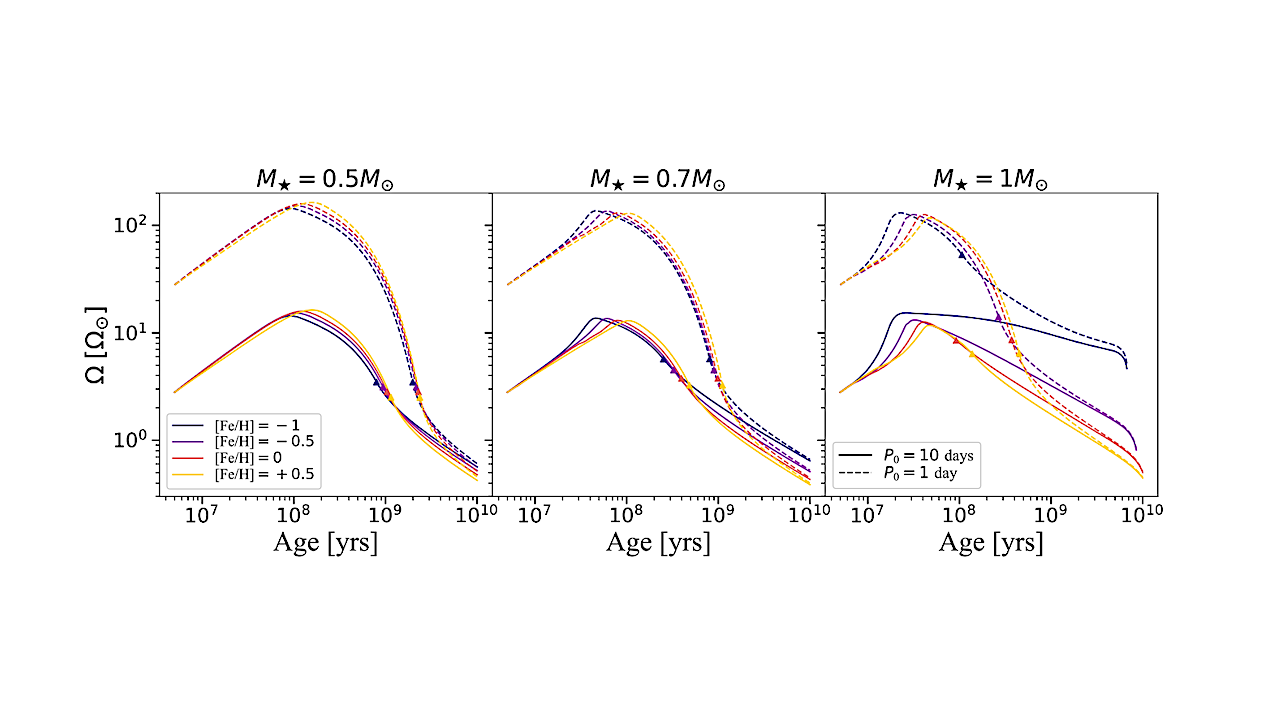

The modelled angular velocity evolution of stars of different masses, initial rotation periods and metallicities. The masses considered are 0.5𝑀 (left panel), 0.7𝑀 (middle panel) and 1𝑀 (right panel). The initial periods considered are 1 day (dashed lines) and 10 days (solid lines). The metallicities considered are -1 dex (dark blue lines), -0.5 dex (purple lines), 0 dex (orange lines) and +0.5 dex (yellow lines). The point at which the star transitions from the saturated to unsaturated regime (at Rocrit = 0.2) is indicated by a triangle along each track. — astro-ph.EP
Understanding how exoplanet atmospheres evolve is a key question in the context of habitability. One key process governing this evolution is atmospheric evaporation by stellar X-ray and EUV emission (collectively, XUV).
As such, the evolution of exoplanet atmospheres is closely tied to the evolution of the host star’s magnetic activity. Many studies have modelled the combined evolution of exoplanet atmospheres and their host stars. However, to date, the impact of the host star’s metallicity on stellar activity/exoplanet atmosphere evolution has not been explored.
In this work, we investigate how stellar metallicity affects the rotation and activity evolution of solar-like stars as well as the corresponding exoplanet atmospheric evolution.
We reconfirm previous results that metal-rich stars spin down more rapidly than metal-poor stars. We also find that the XUV flux that an exoplanet in the habitable zone of its host star receives is larger when the host star is more metal-rich. As such, the atmospheres of exoplanets in the habitable zones of metal-rich stars are evaporated more rapidly than exoplanets in the habitable zones of metal-poor stars.
Lastly, we find that the atmospheric evolution is most sensitive to the host star metallicity when the host star has a higher mass. In the highest mass solar-stars, the metallicity can have a larger influence on the atmospheric evolution than the initial rotation period of the star.
Victor See, Charlotte Fairman, Louis Amard, Oliver Hall
Comments: 12 pages, 7 figures, accepted for publication in MNRAS
Subjects: Earth and Planetary Astrophysics (astro-ph.EP); Solar and Stellar Astrophysics (astro-ph.SR)
Cite as: arXiv:2509.21276 [astro-ph.EP] (or arXiv:2509.21276v1 [astro-ph.EP] for this version)
https://doi.org/10.48550/arXiv.2509.21276
Focus to learn more
Submission history
From: Victor See
[v1] Thu, 25 Sep 2025 15:01:47 UTC (428 KB)
https://arxiv.org/abs/2509.21276
Astrobiology, astronomy,











Related Posts
Stay Informed With the Latest & Most Important News
Previous Post
Next Post





Advertisement
-
 01Two Black Holes Observed Circling Each Other for the First Time
 -
 02From Polymerization-Enabled Folding and Assembly to Chemical Evolution: Key Processes for Emergence of Functional Polymers in the Origin of Life
 -
 03Astronomy 101: From the Sun and Moon to Wormholes and Warp Drive, Key Theories, Discoveries, and Facts about the Universe (The Adams 101 Series)
 -
 04True Anomaly hires former York Space executive as chief operating officer
 -
 05Φsat-2 begins science phase for AI Earth images
 -
 06Hurricane forecasters are losing 3 key satellites ahead of peak storm season − a meteorologist explains why it matters
 -
 07Binary star systems are complex astronomical objects − a new AI approach could pin down their properties quickly