
Now Reading: Moon base update! NASA unveils next steps
-
01
Moon base update! NASA unveils next steps


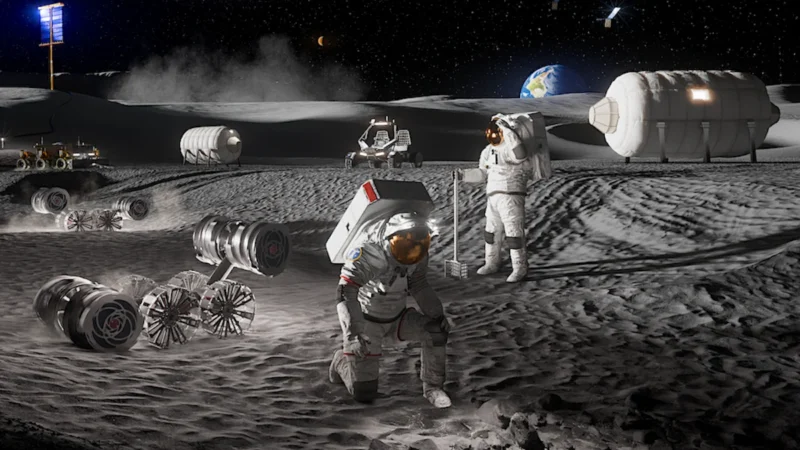
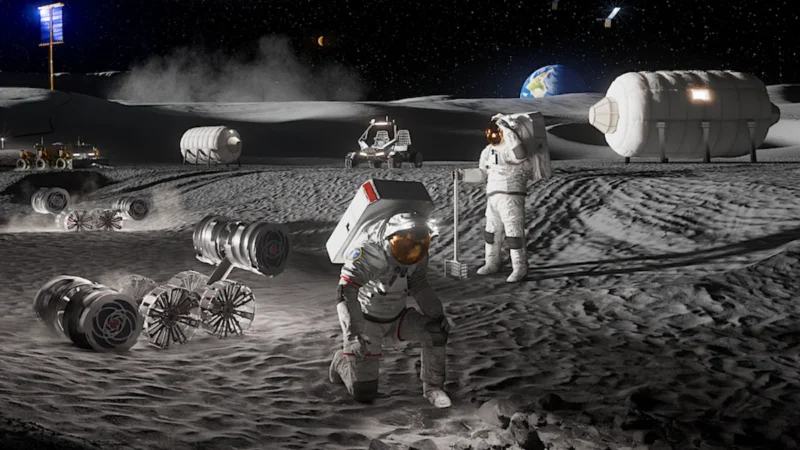
- NASA has announced exciting updates to its plan to construct a moon base.
- The announcement included details about lunar rovers, cargo landers, and the MoonFall drones that are set to scout the lunar south pole in 2028.
- The moon base is set to span hundreds of square miles, NASA announced.
NASA originally published this press release on May 26, 2026. Edits by EarthSky.
NASA’s vision for a lunar moon base
On Tuesday, May 26, 2026, NASA unveiled exciting new details about its plan to construct a moon base over the next decade. The agency announced new contracts for lunar rovers and uncrewed cargo landers, and shared more details about the hopping MoonFall drones that are set to explore the lunar surface as soon as 2028.
NASA leaders also shared target launch timeframes and upcoming moon base milestones. Under this plan, the mission’s second phase, set to begin in 2029, aims to establish short-term human habitation and exploration on the Moon.
NASA also revealed the impressive scale of the planned moon base. Carlos García-Galán, the manager of the moon base program, said during the press conference:
We envision the moon base to be hundreds of square miles, with different assets all building up to the objective of permanent lunar presence on the moon.
NASA Administrator Jared Isaacman said:
The moon base will be America’s and humanity’s first outpost on another celestial world. Every mission, crewed and uncrewed, will be a learning opportunity as we return to the lunar surface, build the infrastructure to stay, and master the skills required to live and operate in one of the most demanding and dangerous environments imaginable.
We will go for the science, for all we stand to gain from an economic and technological perspective, for the innovations that will make life better here on Earth, and to prepare for where we will inevitably go next.
Moon base key milestones
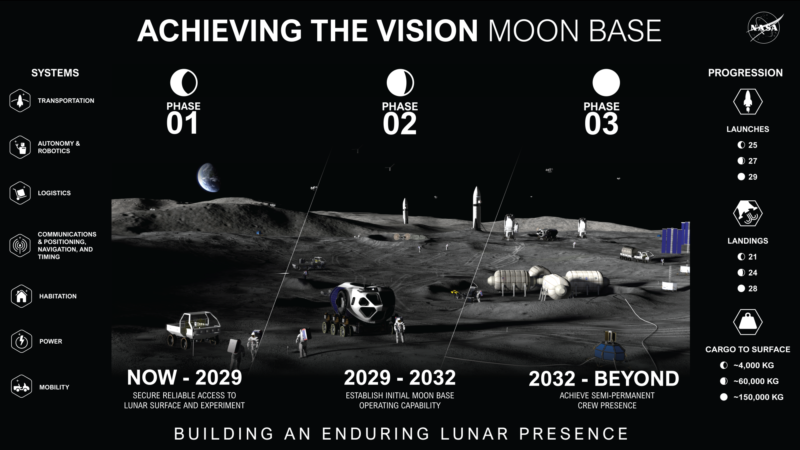
NASA announced the first three moon base missions to begin building sustained operations. Note that these are all contained within Phase 1 of 3 planned long-term phases.
- Moon Base I: Targeted for launch no earlier than fall 2026, this mission will use Blue Origin’s Blue Moon Mark 1 Endurance lander to deliver NASA payloads. Equipment will include the Stereo Cameras for Lunar Plume-Surface Studies instrument to study how thrusters interact with the moon’s surface, and the Laser Retroreflective Array, which helps orbiting spacecraft determine a more precise location using reflected laser light. The mission will land on the Shackleton Connecting Ridge to demonstrate capabilities that reduce risk for future crewed Artemis landing missions in 2028.
- Moon Base II: Planned for launch later this year, this mission will deliver more than 1,100 pounds (500 kg) of cargo on Astrobotic’s Griffin lander, including Astrolab’s FLIP rover, which will test and refine mobility systems to help with the development of future Lunar Terrain Vehicles (LTVs).
- Moon Base III: Also targeted for this year, this mission will fly the first payload selected through NASA’s Payloads and Research Investigations on the Surface of the Moon (PRISM) initiative. Its anchor investigation, Lunar Vertex, will fly on Intuitive Machines’ Nova-C Trinity lunar lander and study lunar swirls, or light spots on the surface of the moon, to improve understanding of surface evolution and material behavior under extreme conditions. The mission will include payloads from European Space Agency (ESA) and the Korea Astronomy and Space Science Institute (KASI), reflecting commercial and international participation in moon base activities.
These missions are the first of more than a dozen missions that will be announced this year, each designed to generate operational data and reduce risk ahead of crewed Artemis surface activities.
MoonFall update
The agency also shared new updates on MoonFall, a mission that will send four drones to fly short hops on the lunar surface as they survey potential landing sites for Artemis astronauts.
NASA’s Jet Propulsion Laboratory in Southern California has been developing the design and testing prototype hardware. It has selected Firefly Aerospace to build the spacecraft that will transport the drones from Earth orbit to the moon. Launch is scheduled for 2028.
The drones will independently land on the lunar surface and then gather high-resolution imagery of hard-to-reach terrain over the course of a single lunar day. After each drone’s final flight, its survive-the-night payload will continue to operate for several months, marking a sustained U.S. presence at the lunar south pole.
García-Galán also revealed in Tuesday’s press conference that these drones could help mark the borders of the moon base:
We’re going to be able to basically put them at the corners of the areas where we think we have either key scientific objectives or we want to build up the moon base.
New contracts for lunar vehicles
NASA announced that it has awarded Astrolab $219 million and Lunar Outpost $220 million to build and deliver the first phase of lunar terrain vehicles. This should enable NASA to deploy crewed and uncrewed mobility systems to the lunar surface by 2028 through the agency’s Commercial Lunar Payload Services initiative.
Astrolab’s Crewed Lunar Vehicle, or CLV-1, adapted from the company’s FLEX architecture, is a crewed rover designed to transport astronauts, carry supplies, and support remote operations, with a compact stowed configuration, a mass of about 2,000 pounds (900 kg), and the ability to reach more than 6 miles per hour (9.6 kph) on level terrain.
Complementing this capability, Lunar Outpost’s Pegasus is a lighter, mission-ready evolution of its Eagle rover designed explicitly to meet NASA’s updated lunar vehicle requirements. Operational for up to a year and capable of manual, autonomous or teleoperated driving at speeds more than 9 miles per hour (14.5 kph), Pegasus incorporates Apollo-heritage technologies and builds on prototype and flight experience to deliver human-centered mobility essential for establishing a sustained moon base.
To deliver these rovers to the moon’s south pole region, NASA awarded Blue Origin $188 million with an option period worth $280.4 million for two task orders. NASA can choose to extend the task order for payload delivery.
Deploying multiple lunar terrain vehicles early in moon base development will accelerate technology demonstrations, inform site planning, and reduce operational risk ahead of crewed Artemis missions.
Artemis 3, currently scheduled for mid-2027, will see a crewed Orion capsule dock with one or both of the lunar landers currently being privately developed: SpaceX’s Starship and Blue Origin’s Blue Moon.
And Artemis 4, currently set for 2028, will finally see humans return to the lunar surface for the first time since 1972. And this time, NASA hopes, we’ll stick around.
Bottom line: NASA has unveiled exciting new plans for its moon base, including timelines and details of hopping drones, landers and vehicles.
Read more: NASA will announce Artemis 3 astronauts on June 9
The post Moon base update! NASA unveils next steps first appeared on EarthSky.










Related Posts


Stay Informed With the Latest & Most Important News
Previous Post
Next Post




Advertisement
-
 01Two Black Holes Observed Circling Each Other for the First Time
 -
 02From Polymerization-Enabled Folding and Assembly to Chemical Evolution: Key Processes for Emergence of Functional Polymers in the Origin of Life
 -
 03Astronomy 101: From the Sun and Moon to Wormholes and Warp Drive, Key Theories, Discoveries, and Facts about the Universe (The Adams 101 Series)
 -
 04True Anomaly hires former York Space executive as chief operating officer
 -
 05Φsat-2 begins science phase for AI Earth images
 -
 06Hurricane forecasters are losing 3 key satellites ahead of peak storm season − a meteorologist explains why it matters
 -
 07Binary star systems are complex astronomical objects − a new AI approach could pin down their properties quickly