
Now Reading: Searching for Earth-sized exoplanets with the POET mission
-
01
Searching for Earth-sized exoplanets with the POET mission


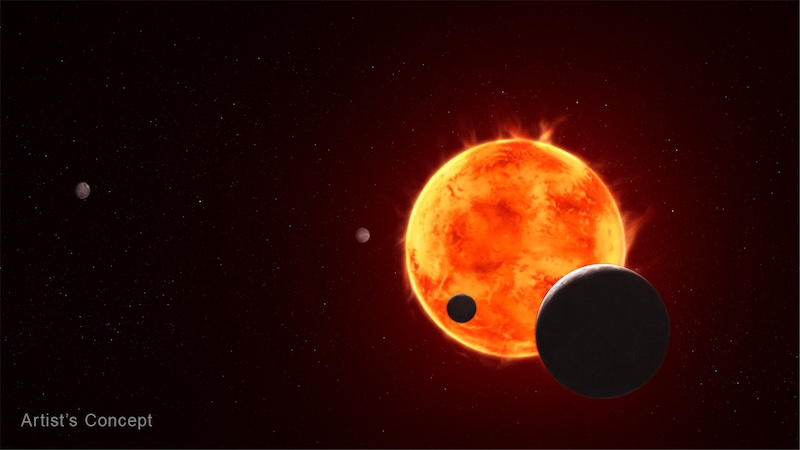
- Astronomers have found a growing number of Earth-sized exoplanets around other stars. But there are many more waiting to be discovered.
- Canada’s POET mission will start searching for more of them in 2029. POET will detect them as they transit in front of their stars, as seen from Earth.
- POET will survey over 3,000 small, cool stars like red dwarfs.
Canada’s POET mission will search for Earth-sized exoplanets
Out of the thousands of exoplanets that astronomers have discovered so far, some are rocky and about the same size as Earth. These are the planets that excite scientists the most in the search for possible life beyond our solar system. And now, researchers in Canada are developing a new mission specifically to search for more of these worlds.
The micro-satellite mission, called POET (Photometric Observations of Exoplanet Transits), will look for more Earth-sized and super-Earth planets. The search, detailed in a new preprint paper on March 25, 2026, will focus on smaller, cooler stars, like red dwarfs.
POET is currently in development and scheduled to be launched in 2029. It is a top priority small-sat space mission in the Canadian Astronomy Long Range Plan 2020–2030. If successful, POET could help astronomers identify some of the best nearby worlds to study for signs of habitability … and perhaps even life itself.
Laurence Tognetti wrote about the new mission, currently in development, for Universe Today on April 29, 2026.
The paper was also previously submitted to SPIE, Proceedings Volume 13627, Techniques and Instrumentation for Detection of Exoplanets XII on September 18, 2025.
Detecting Earth-sized and super-Earth planets
So, how will POET look for these planets? As noted in Universe Today, it will use the transit method. That’s when the planet passes in front of – transits – its star as seen from Earth. And since the stars are smaller and cooler, it is easier to detect small planets than if they orbited larger, brighter stars.
POET is based on previous Canadian micro-satellite missions. These are primarily the MOST (Microvariability and Oscillations of Stars) in 2003 and NEOSSat (Near-Earth Object Surveillance Satellite) in 2013. Micro-satellites are a type of SmallSat. They weigh 22-220 pounds (10-100 kilograms).
Both telescopes observed only in the visible wavelength of light. They were both 6 inches (15 centimeters) in diameter. MOST focused on studying stars, while NEOSSAT looked for asteroids and space debris. MOST also discovered a hot Jupiter exoplanet orbiting HD 209458. Hot Jupiters are similar to Jupiter, but orbit very close to their stars.
Advantages of POET
POET has certain key advantages over its predecessors. These include a larger, 8-inch (20-cm) telescope and being able to observe planets in near-ultraviolet, visible near-infrared and short-wavelength infrared light.
Exoplanet Search and Characterization with the Proposed POET Canadian Space Missionastrobiology.com/2026/03/exop… #astrobiology #exoplanet #astronomy
— Astrobiology (@astrobiology.bsky.social) 2026-03-26T19:33:56.393Z
Canada Proposes POET Mission to Hunt Earth-Sized Planetshttps://www.europesays.com/uk/925913/Exoplanet science and the search for life beyond Earth continue to advance at break-neck speeds, with the number…
POET Input Catalog of Ultracool Dwarfs
How will POET choose which stars to look at? The researchers are using the POET Input Catalog of Ultracool Dwarfs. This is a list of candidate dwarf stars suitable for observations by POET. The research team then narrows down the list even further. They eliminated binary systems and extra bright stars. The brightness of those stars could block out the fainter light of any exoplanets.
Overall, the researchers narrowed the list from over 7,200 stars to just over 3,000. All of them are relatively close, within 326 light-years.
Most of the Earth-sized exoplanets found so far orbit quite close to their stars. They orbit in only a few days, or sometimes even just hours. So they are quite hot and probably lifeless. But some are further out, in the habitable zones of their stars. That’s the region where temperatures on the planets’ surface could allow liquid water to exist.
POET will be able to find planets that orbit anywhere from 7 to 50 days. That’s a lot less than Earth’s 365-day orbital period. It’s a significant improvement.
In addition, the size of the planets that POET can detect will be 1 to 2.5 Earth’s radius.
Searching for habitable planets
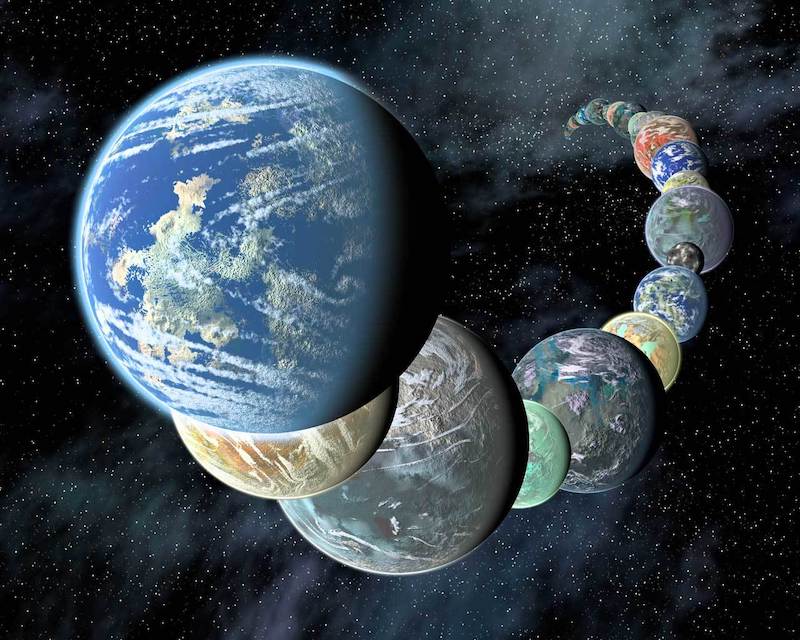
Of particular interest of course, are planets that could be potentially habitable. The paper says:
POET aims to discover some of the nearest potentially habitable Earth-sized exoplanets that could be scrutinized for biosignatures with JWST or future telescopes. Herein we present the assembly of the POET Input Catalog of Ultracool Dwarfs and simulations of the expected yield of rocky planets with POET.
Newly-discovered Earth-sized exoplanets around the nearest ultracool dwarfs would be excellent targets for atmospheric characterization. With orbital periods <7 days, these are likely to be in the habitable zones of their ultracool host stars. They would automatically become top-priority targets for biosignature gas searches with the Webb Space Telescope, or with the Habitable World Observatory further in the future. Hence, POET could deliver some of the most promising Earth analogues for the search for extrasolar life.
Bottom line: In 2029, Canada’s POET mission will start searching for Earth-sized exoplanets as well as super-Earths. It will focus on smaller, cooler stars like red dwarfs.
Read more: Over 10,000 new exoplanet candidates revealed!
Read more: How much water on exoplanets does life need?
The post Searching for Earth-sized exoplanets with the POET mission first appeared on EarthSky.










Related Posts
Stay Informed With the Latest & Most Important News
Previous Post
Next Post



Advertisement
-
 01Two Black Holes Observed Circling Each Other for the First Time
 -
 02From Polymerization-Enabled Folding and Assembly to Chemical Evolution: Key Processes for Emergence of Functional Polymers in the Origin of Life
 -
 03Astronomy 101: From the Sun and Moon to Wormholes and Warp Drive, Key Theories, Discoveries, and Facts about the Universe (The Adams 101 Series)
 -
 04True Anomaly hires former York Space executive as chief operating officer
 -
 05Φsat-2 begins science phase for AI Earth images
 -
 06Hurricane forecasters are losing 3 key satellites ahead of peak storm season − a meteorologist explains why it matters
 -
 07Binary star systems are complex astronomical objects − a new AI approach could pin down their properties quickly